


Enterprise AI-Powered Enterprise Solutions: Hype, Risk and Real Wins
Written with AI assistance under our editorial guidelines
Enterprise AI adoption is driven by 79% of strategists viewing it as critical to success, yet vendors often downplay significant risks and implementation challenges. Real value requires moving beyond hype-driven decisions toward clear use cases, proper data infrastructure, and realistic expectations about AI's actual capabilities and limitations in transforming business operations.
Step into any Fortune 500 boardroom in 2025 and you'll feel it: the electric charge, the restless murmur, the persistent question—"How are we using AI?" The lure of enterprise AI-powered enterprise solutions isn't just a whisper anymore. It's a full-throttle obsession, woven into every conversation about strategy, survival, and status. But for all the glossy presentations and vendor promises, there's a shadow side—a brutal, underexplored reality lurking beneath the surface. If you're ready for the truth—the risks, the rewards, and the pitfalls that no vendor pitch deck will ever show you—keep reading. This is not another cheerleading piece. It’s a razor-sharp, research-backed journey through the enterprise AI maze that will force you to rethink everything you think you know.
The seductive promise of enterprise AI
Why everyone’s obsessed with AI-powered solutions
The boardroom obsession with AI in 2025 is impossible to ignore. Every headline screams about AI’s potential to revolutionize business, and C-suites everywhere feel the pressure. It’s not just hype—it’s survival instinct. According to a 2024 WEKA report, 79% of enterprise strategists now see AI as critical to success, and 88% are actively exploring generative AI models. The media spins endless tales of companies transformed overnight by AI-powered tools, and the narrative has become, frankly, intoxicating. Executives feel the dual pull of hope and fear: hope that AI will unlock previously unimaginable productivity and fear that being late to the party means getting left behind.

Yet, under the surface of every slick demo is a thicket of questions. The marketing language—“transformative,” “intelligent,” “seamless”—is so thick you risk suffocation. It shapes not only how enterprises shop for solutions, but how they define success. Marketers have weaponized buzzwords, creating an arms race of expectations. In the words of Jordan, a tech strategist I interviewed, “Most companies chase AI because they fear being left behind, not because they know what it actually does.” The herd mentality is real. But is it justified?
What vendors aren’t telling you
Peel back the surface glamour and the cracks start to show. Enterprise AI vendors are masters of selective storytelling—showing off dazzling features, downplaying the ugly realities. Platforms get “AI-washed,” with basic automation sold as sentient intelligence. Real integration costs are hidden behind the curtain. The result? Executives buy the dream, then wake up with the bill.
Hidden costs of AI-powered enterprise solutions experts won't tell you:
- Data labeling and cleaning: The grunt work of making messy enterprise data AI-ready isn’t included in most vendor quotes.
- Cloud and infrastructure upgrades: True AI eats infrastructure for breakfast. Be ready for surprise bills.
- Specialist talent: Data scientists and ML engineers don’t come cheap—and the talent war is brutal.
- Change management: Rolling out AI transforms workflows, and resistance from employees creates costly delays.
- Vendor lock-in: Many “platforms” make switching nearly impossible without massive rework.
- Ongoing maintenance: AI models degrade over time, requiring constant tuning and retraining.
- Explainability and compliance: Building transparency and auditability into black-box models adds unexpected complexity.
The rampant “AI-washing” is more than a punchline—it’s a threat. Vendors slap AI labels on legacy tools, muddying the waters for buyers. If you want the real deal, you need to know what’s under the hood.
| Feature | True AI-powered solution | "AI-washed" product |
|---|---|---|
| Adaptive learning | Yes (dynamic model updates) | No (static rules) |
| Explainability tools | Yes | Rare or absent |
| Real-time analytics | Yes | Limited or batch only |
| Data integration | Robust multi-source pipelines | Rudimentary, manual import |
| Automated decision-making | Context-aware, self-improving | Pre-defined, hardcoded |
| Vendor transparency | Open about limitations | Over-promises, vague |
| Ongoing support | Includes tuning, retraining | Minimal, ticket-based |
Table 1: Real AI-powered solutions vs. “AI-washed” products. Source: Original analysis based on Accenture, 2024, WEKA, 2024
The real business stakes in 2025
Here's what’s at risk: hard cash, brand credibility, and leadership reputation. According to Accenture’s recent research, only 16% of companies have fully modernized, AI-led processes. But those who have, see 2.5x revenue growth and 2.4x productivity compared to peers. For everyone else, the cost of misfire—wasted budgets, demoralized teams, failed transformation—is steep. In the high-stakes chess match of modern business, AI is both a queen and a pawn. Get it right, and you leap ahead. Get it wrong, and you’re outmaneuvered.

The bottom line: AI-powered enterprise solutions are not a free lunch. If you buy in for the wrong reasons—or with the wrong expectations—you'll pay dearly.
Decoding the term: What is an AI-powered enterprise solution?
Beyond the buzzwords
“AI-powered” is the most overused (and least understood) phrase in enterprise tech. In 2025, it’s splashed across vendor pages and RFPs, but scratch the surface and you’ll find everything from glorified macros to genuine, self-improving systems. Definitions matter. If you don’t know what you’re buying, you’re the product.
Key terms you must know:
Algorithms that learn from data, improving over time without explicit reprogramming. Example: Predictive maintenance tools that adapt as new failure data comes in.
Predefined, rule-based processes handling repetitive tasks. True automation runs without human intervention, but doesn’t “learn” or adapt like AI.
The ability to understand, audit, and explain how an AI model makes its decisions. Crucial for regulated industries and trust-building.
Systems that can create new data, content, or solutions—think natural language summaries or synthetic data for simulations.
When the underlying data changes so much that AI models become less accurate, requiring retraining.
Knowing these terms isn’t academic nitpicking. Procurement teams and IT leaders who understand the nuances make smarter, safer implementation choices.
Core components and architectures
A real AI-powered enterprise solution isn’t a monolith—it’s a layered cake of components. At the core are machine learning models, often built on neural networks or advanced statistical methods. Around them: data pipelines, orchestration tools, APIs, and user interfaces.
| Solution Type | Essential Components | Optional Components |
|---|---|---|
| Email-based AI coworker | NLP models, workflow automation, APIs | Voice input, external chat |
| Predictive analytics suite | Data lakes, ML models, dashboards | IoT integration, AR overlays |
| Automated customer support | Chatbots, intent recognition, feedback | Sentiment analysis, voice AI |
Table 2: Feature matrix for AI-powered enterprise solutions. Source: Original analysis based on WEKA, 2024, Skim AI, 2024
Integration is where many projects stall. AI is only as smart as the data it ingests, and most enterprise data is a tangled mess—spread across silos, plagued by inconsistencies, and guarded by turf wars. Underestimating data requirements is the quickest way to watch your AI dreams die.
The difference between automation and intelligence
It’s tempting to lump automation and AI together. Don’t. Automation is about speed—taking repetitive tasks off human hands. Intelligence is about adaptation—learning from new data, anticipating the next move, and making decisions with nuance.

Why is this distinction so crucial? Because ROI depends not on replacing humans, but on amplifying what they do best. Traditional automation delivers a quick win; AI-driven intelligence unlocks sustained, compounding value. If you buy an “AI” tool and all it does is automate, you’ve bought into the wrong future.
The invisible hand: How AI is already running your business
Unseen AI use cases hiding in plain sight
For all the talk of AI as a coming revolution, the reality is subtler—and sneakier. Many enterprises already rely on AI without realizing it. From fraud detection scripts in finance to dynamic pricing engines in retail, the invisible hand of AI guides countless daily decisions.
Six unconventional uses for enterprise AI-powered solutions:
- Email thread summarization: AI tools distill sprawling conversations into actionable briefs.
- Smart calendar management: AI optimizes meeting times based on patterns in your team’s schedules.
- Document classification: Auto-sorts contracts or invoices, flagging anomalies.
- Customer sentiment analysis: AI reads emotional tone in feedback, triggering responses.
- Supply chain optimization: Dynamic routing and inventory management adapt to real-time disruption.
- Security anomaly detection: Subtle pattern shifts are flagged before humans notice.
Take the case of a logistics company that implemented AI-powered routing. By analyzing weather, traffic, and historical delivery data, the system slashed delivery times by 20%, reduced fuel costs, and flagged risks before they became crises—a transformation hiding in plain sight.

When you realize how much AI already underpins daily operations, the conversation shifts from “If?” to “Where else?”
The power dynamics of invisible AI
But there’s a darker, less discussed side to this invisibility. When AI operates in the shadows, it quietly redistributes power inside organizations. As Priya, an enterprise transformation lead, puts it:
"The scariest AI is the one you don’t even know is making decisions for you." — Priya, Enterprise Transformation Lead, 2024
When algorithms decide who gets customer leads, which emails get priority, or what risks get escalated, human intuition is sidelined. This lack of transparency breeds mistrust and, if left unchecked, can expose organizations to compliance violations or ethical blowback. The more invisible the AI, the more critical your approach to transparency and accountability.
Myths, misconceptions, and the AI-washing epidemic
Why most 'AI-powered' solutions are just old tech in disguise
The “AI-washing” epidemic is real. Vendors rebrand yesterday’s automation as today’s intelligence—slapping “AI” on workflows that haven’t changed in a decade. Buzzwords like “predictive,” “intelligent,” and “learning” are sprinkled liberally, but often mask hardcoded business logic.
Want proof? According to a 2024 Skim AI analysis, while AI adoption is reported at over 60% in enterprise surveys, only 16% of companies have implemented genuinely AI-led processes (Accenture, 2024). The rest? Mostly old tech with new lipstick.
| Year | Claimed AI adoption (%) | Actual AI-led transformation (%) |
|---|---|---|
| 2023 | 54 | 12 |
| 2024 | 62 | 16 |
| 2025 | 68* | 17* |
Table 3: AI adoption vs. claimed adoption in enterprises (2023–2025).
Source: Original analysis based on Skim AI, 2024, Accenture, 2024
*2025 data projected based on current year surveys.
Debunking the biggest myths
Let’s get surgical:
- Myth #1: AI always delivers ROI. Reality: Most projects fail to reach break-even (Accenture, 2024).
- Myth #2: AI eliminates bias. Fact: Bias moves from human to algorithm unless actively mitigated.
- Myth #3: More data equals better results. Garbage in, garbage out—bad data makes AI worse, not better.
- Myth #4: AI replaces employees. Most value comes when humans and AI collaborate—not compete.
- Myth #5: Open-source AI is “free.” Costs shift to integration, talent, and security.
5 red flags to watch out for when evaluating enterprise AI-powered solutions:
- The vendor can’t clearly explain how the AI works (“It just knows!”).
- Results aren’t auditable or reproducible.
- Promises are vague (“up to 300% productivity!”).
- Solution requires massive manual data prep.
- No clear plan for ongoing monitoring or retraining.
The futurecoworker.ai reality check
In a sea of hype, resources like futurecoworker.ai stand out for their no-bull approach to AI-powered collaboration. Instead of bombarding you with jargon and technical hurdles, they focus on demystifying AI—showing how intelligent enterprise teammates can drive real value without requiring you to become a data scientist overnight. For leaders tired of the noise, platforms that bridge the gap between promise and practice are the antidote.
Real-world impact: Successes, failures, and cautionary tales
When enterprise AI delivers on its promise
Let’s kill the cynicism for a second. When AI works, it’s magic. Take the global retailer that overhauled its supply chain with AI-powered forecasting and robotics. By integrating machine learning with real-time inventory and logistics data, the company reduced stockouts by 30% and slashed transportation costs. The most profound change? The workforce shifted from firefighting mode to strategic management.

"We didn’t just save money—we changed how we work." — Alex, Senior Operations Manager, Global Retailer, 2024
The quantifiable benefits—speed, accuracy, agility—are only half the story. The ripple effects include a cultural shift toward experimentation and continuous learning.
Epic fails (and what you can learn from them)
But for every success, there’s a cautionary tale. A major financial institution bet big on an out-of-the-box AI risk engine. The system, trained on outdated data, flagged thousands of false positives, overwhelming compliance teams and sparking regulatory scrutiny. The rollout was hastily abandoned, costing millions.
6 steps that could have prevented this disaster:
- Validate training data for relevance and bias—don’t trust “default” datasets.
- Pilot in a contained environment before organization-wide deployment.
- Build in human review loops to catch early errors.
- Train staff on new workflows—don’t assume plug-and-play.
- Set up real-time monitoring to flag anomalies.
- Plan for rollback—don’t burn the bridge behind you.
Best practice is brutal honesty: if you’re not ready to invest in training, validation, and monitoring, you’re not ready for AI.
Industry-by-industry breakdown
AI’s impact isn’t uniform. Tech and marketing firms lead the charge, with manufacturing, healthcare, and finance close behind. Satisfaction rates, however, are highly variable—often aligning with how well industries handle change management and data integration.
| Industry | Adoption Rate (%) | Satisfaction (%) |
|---|---|---|
| Technology | 83 | 71 |
| Marketing | 77 | 66 |
| Finance | 68 | 54 |
| Healthcare | 59 | 51 |
| Retail | 62 | 44 |
Table 4: AI-powered enterprise solutions adoption and satisfaction by industry (2025).
Source: Original analysis based on Menlo Ventures, 2024, IDC/Microsoft, 2024
The next frontier? Sectors that crack the cultural and data barriers will pull ahead fast.
The human element: Culture, trust, and workforce transformation
AI and the future of work
AI-powered enterprise solutions aren’t just about algorithms—they’re about people. Job roles shift, workflows morph, and the very nature of “work” evolves. The traditional office, with its rigid hierarchies and manual processes, is being replaced by digital-first, hybrid teams where AI handles the drudgery and humans focus on creativity, judgment, and strategy.

But this shift isn’t automatic. Reskilling, internal mobility, and employee buy-in are essential for making AI stick. The organizations that succeed are those that treat AI not as a replacement, but as an augmentation—an intelligent teammate that makes everyone better.
Building trust and fighting algorithmic bias
Trust is the scarcest resource in AI rollouts. Employees and customers alike want to know: “Can I trust this decision? Can I challenge it if it’s wrong?” The answer lies in explainability, transparency, and continuous oversight.
Key definitions:
The capacity to audit and explain how an AI model reaches its decisions. Essential for regulated industries and for earning user trust.
The phenomenon where incoming data changes from the data the AI model was trained on, leading to degraded performance.
Tools, techniques, and processes that clarify why an AI makes the choices it does—vital for compliance and user acceptance.
Checklist for evaluating AI system fairness:
- Is the training data representative and unbiased?
- Are decision rationales documented and accessible?
- Can users appeal or override AI recommendations?
- Is ongoing monitoring in place for bias or drift?
- Are ethics and compliance teams involved in development?
Managing change and avoiding backlash
Resistance is inevitable. Fear of job loss, loss of control, and “black box” anxiety can derail even the best AI initiatives.
7 priority steps for smooth AI adoption and cultural integration:
- Start with a clear, shared vision for AI’s role.
- Communicate openly about benefits and risks.
- Involve employees early—co-create solutions, don’t just impose them.
- Invest in reskilling and upskilling for impacted teams.
- Celebrate quick wins and share success stories.
- Set up open feedback channels to surface concerns.
- Ensure leadership models transparency and trust.
Communication isn’t a side task—it’s the heart of change management. Leaders who face resistance head-on, with empathy and clarity, turn skeptics into champions.
Implementation: From strategy to execution
What really works (and what doesn’t)
What separates the AI winners from the rest? Brutal self-awareness, relentless pilot testing, and a willingness to iterate. No successful enterprise AI implementation happens in a single leap. The most effective teams roll out pilot programs, learn fast, and scale only what works.
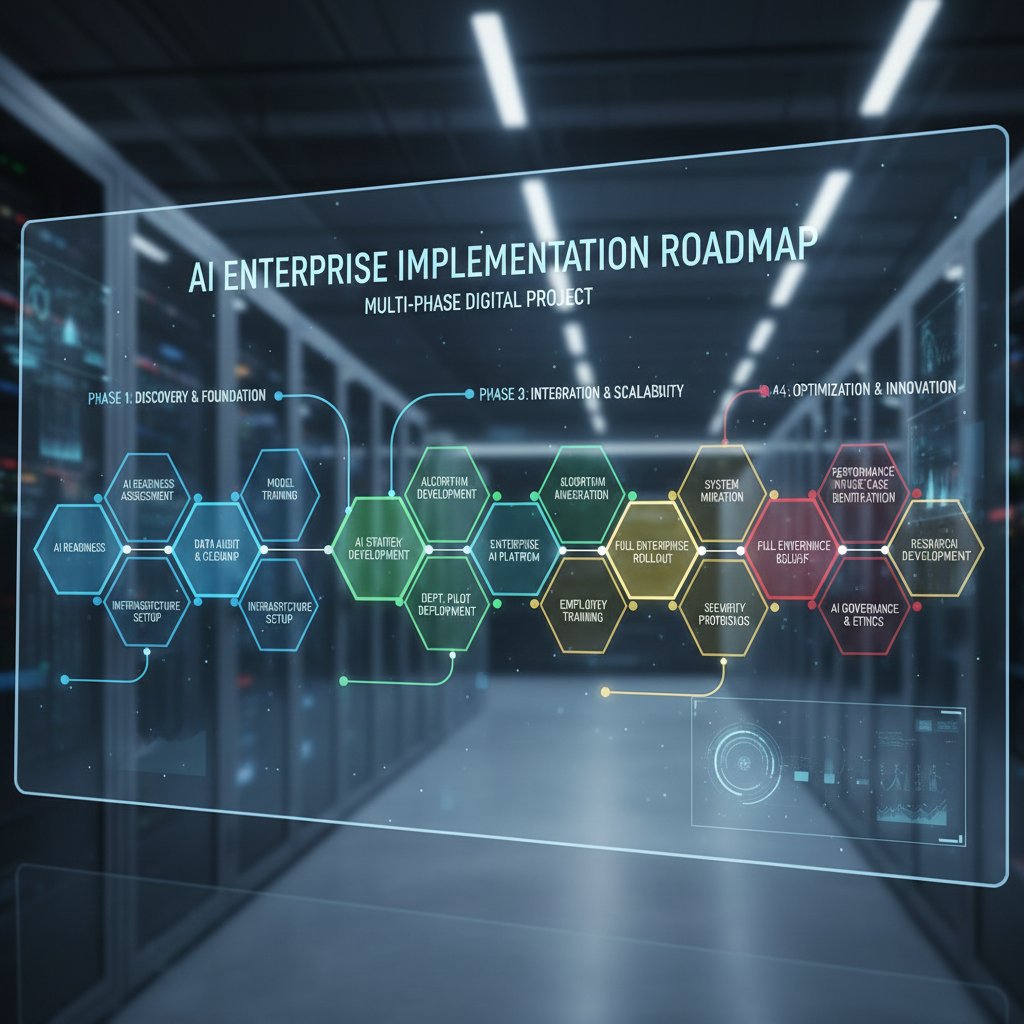
Trying to boil the ocean in one go is a recipe for disaster. Instead, focus on incremental wins and rapid learning loops. Failure isn’t fatal—unless you refuse to learn from it.
Checklist: Is your enterprise ready for AI?
Before you pull the trigger, ask yourself:
- Do we have clean, accessible, and representative data?
- Is there leadership buy-in for both investment and change?
- Have we defined measurable goals and success metrics?
- Are processes in place for ongoing monitoring and tuning?
- Is our infrastructure ready for AI workloads?
- Do we have the talent—internal or external—to support the rollout?
- Is there a clear plan for employee engagement and reskilling?
- Have we identified integration points and dependencies?
- Is security and compliance already top of mind?
- Are we prepared to fail fast—and pivot as needed?
Alignment of stakeholders and infrastructure is non-negotiable. Skip these steps, and you’re rolling the dice with millions on the table.
Integrating with legacy systems (the real pain)
Legacy integration is the silent killer of enterprise AI projects. Old systems don’t play well with cloud-native, API-driven AI models. Data formats clash, workflows break, and project timelines slip.
The fix? Start with deep mapping of existing systems, invest in middleware, and—critically—don’t underestimate the scope. As Jordan, a battle-scarred implementation lead, says, “Integration isn’t sexy, but it’s where most projects live or die.”
Risks, regulations, and the ethics minefield
Security and compliance in the AI era
AI introduces unique security risks: data poisoning, adversarial attacks, and model inversion can all wreak havoc. On top of that, privacy regulations are tightening globally.
| Region | Key AI compliance standards | Enforcement body |
|---|---|---|
| North America | CCPA, AI Bill of Rights | FTC, state AGs |
| Europe | GDPR, EU AI Act | European Data Protection Bd |
| Asia-Pacific | PDPA, sector-specific guidelines | National regulators |
Table 5: Regulatory requirements and compliance standards by region (2025).
Source: Original analysis based on IDC/Microsoft, 2024
Proactive risk management means running regular audits, stress-testing models, and building “red teams” to probe for vulnerabilities.
Ethical dilemmas and unintended consequences
AI doesn’t just automate decisions—it amplifies them. That means mistakes scale, and so do ethical lapses. From covert surveillance to data privacy breaches, the ethical minefield is vast.

The only real defense is internal ethics boards and external audits—structures that force uncomfortable questions about bias, privacy, and unintended impacts.
Mitigating risks and preparing for the unknown
Ongoing risk mitigation isn’t optional. It’s the only way to outpace the unknown unknowns of AI.
6 strategies for future-proofing against AI surprises:
- Regularly retrain models with new, high-quality data.
- Implement continuous monitoring for anomalies and drift.
- Engage cross-functional ethics and compliance teams.
- Build explainability and auditability into every workflow.
- Prepare rollback plans for failed rollouts.
- Use trusted partners like futurecoworker.ai as part of your risk toolkit.
The key is humility: assume you’ll miss something, and plan accordingly.
The future: Trends, predictions, and what comes next
What 2025 (and beyond) holds for enterprise AI
AI-powered enterprise solutions are on an unstoppable trajectory. AI adoption is growing at a blistering 37.3% CAGR, with spending surging from $2.3B in 2023 to $13.8B in 2024 (Menlo Ventures, 2024). The convergence of AI, IoT, and human-centric design is reshaping what’s possible.

But the winners will be those who prioritize adaptability, transparency, and trust—not just raw computational firepower.
Contrarian predictions: When not to use AI
Sometimes, the smartest move is to walk away. AI can backfire or add no value in certain scenarios.
5 scenarios where enterprise AI can backfire or add no value:
- Poor-quality, incomplete, or biased data sets.
- Highly regulated tasks demanding full human oversight.
- Low-complexity tasks where automation suffices.
- Cultures resistant to change or lacking digital maturity.
- Environments with insufficient budget for maintenance and retraining.
Always evaluate whether AI fits your context before falling prey to FOMO.
The evolving role of intelligent teammates
The rise of AI-powered, email-based coworkers—the so-called “intelligent enterprise teammate”—is redefining collaboration. Instead of overwhelming teams with technical baggage, they slot quietly into everyday workflows. The future is hybrid: teams of humans and AI, each doing what they do best.
"The best AI teammates don’t just automate—they amplify what makes us human." — Priya, Enterprise Transformation Lead, 2024
Expect culture to shift as these teammates handle drudgery and free up space for innovation.
Conclusion: Cutting through the noise and finding real value
Forget the hype. The brutal truth about enterprise AI-powered enterprise solutions is that real value only comes with clear-eyed skepticism, relentless iteration, and a willingness to face the hard facts—your data, your culture, your readiness, your risk appetite. Leaders who win don’t chase buzzwords; they ask sharper questions, demand transparency, and build teams where AI and humans work side by side.
7 critical questions to ask before you invest in any AI-powered enterprise solution:
- What problem are we actually solving—and is AI the best tool?
- Do we have the right data and infrastructure?
- Who is accountable for training, tuning, and monitoring?
- How will we measure success—beyond vendor promises?
- What are the full lifecycle costs (including maintenance and retraining)?
- How do we ensure transparency and explainability?
- What’s our plan if it fails?
The companies that thrive in 2025 are those who cut through the noise, take the hard path, and demand substance over sizzle. If you want to be among them, start by questioning everything—especially the solutions that sound too good to be true.
Sources
References cited in this article
- Skim AI(skimai.com)
- Menlo Ventures(menlovc.com)
- Accenture(newsroom.accenture.com)
- WEKA(weka.io)
- IDC/Microsoft(blogs.microsoft.com)
- McKinsey(mckinsey.com)
- BCG(bcg.com)
- AI Infrastructure Alliance(ai-infrastructure.org)
- Forbes(forbes.com)
- HPE(hpe.com)
- Forbes(forbes.com)
- CMSWire(cmswire.com)
- Medium(medium.com)
- Appian(appian.com)
- Moveworks(moveworks.com)
- Appinventiv(appinventiv.com)
- Vena Solutions(venasolutions.com)
- MIT CIS(cis.mit.edu)
- ACM FAccT(dl.acm.org)
- Forbes(forbes.com)
- Okoone(okoone.com)
- Forbes(forbes.com)
- HyScaler(hyscaler.com)
- Gartner(gartner.com)
- Forrester(forrester.com)
- Coworker AI(coworker.ai)
- Deloitte(www2.deloitte.com)
- CIO(cio.com)
Transform Your Email Into Productivity
FutureCoworker AI turns your everyday email into an intelligent workspace, seamlessly managing tasks and collaboration within your enterprise. It eliminates the complexity of AI, allowing you to benefit from advanced technology without any technical knowledge. Achieve productivity, streamline processes, and improve team efficiency through natural email interaction, getting tasks done faster and smarter.
Get startedReady to Transform Your Email?
Start automating your tasks and boost productivity today
Frequently Asked Questions
What percentage of enterprise strategists view AI as critical to success?
According to a 2024 WEKA report cited in the article, 79% of enterprise strategists see AI as critical to success, and 88% are actively exploring generative AI models.
Why are executives pursuing AI solutions according to the article?
The article suggests executives feel a dual pull of hope and fear—hope that AI will unlock unprecedented productivity and fear of being left behind if their company is late to adopt AI. A tech strategist quoted in the article notes that most companies chase AI because they fear being left behind, not because they understand what it actually does.
What is the main criticism of how enterprise AI solutions are marketed?
The article criticizes vendors for using marketing language like 'transformative,' 'intelligent,' and 'seamless' that obscures the reality, and notes that vendors engage in selective storytelling by showcasing dazzling features while downplaying problems.
Continue Reading
Keep exploring Intelligent enterprise teammate

Enterprise AI-Driven Solutions: Separating Hype From Results
Enterprise AI-driven solutions bring both opportunity and risk. This article examines the reality behind the hype, the financial stakes, and how to avoid costly implementation mistakes.

Enterprise AI Integration: Why Adoption Lags and What Works
Enterprise AI integration often fails to deliver. This article examines why adoption rates lag expectations, the myths driving poor decisions, and what actually drives success.

Enterprise AI-Powered Management Platforms: Hype, Risk, Reward
Discover insights about enterprise AI-powered management platforms

Enterprise AI-Enabled Solutions: Outcomes Beyond the Hype
Enterprise AI-enabled solutions promise automation and scale, but 68% of enterprises struggle with adoption.

AI Solutions for Enterprise Processes: What Works in Practice
AI solutions for enterprise processes can transform workflows when implemented correctly. This article examines real-world strategies, common pitfalls, and what separates successful deployments from costly failures.

AI-Powered Enterprise Analytics Tools: Separating Claims From Reality
AI-powered enterprise analytics tools promise automation and competitive advantage. This article examines the marketing claims, actual risks, and capabilities that deliver measurable results.


