Enterprise AI-Driven Productivity Software: Winners Vs. Watchers in 2026
Written with AI assistance under our editorial guidelines
Enterprise AI-driven productivity management software has evolved from passive tools to active team members embedded in workflows. Organizations adopting these systems report 2.4x higher productivity gains, yet fewer than 20% pay premium prices without proven ROI. Success requires interrogating implementation strategies rather than simply embracing AI hype.
Welcome to the crossroads of ambition and anxiety — the modern enterprise, where productivity is king and every edge counts. The gospel of enterprise AI-driven productivity management software is everywhere: automate, optimize, outpace your rivals. Yet beneath the glossy demos and breathless product pitches, a grittier reality lurks. The road to AI-powered efficiency is lined with brutal truths, costly missteps, and hard-won victories. In 2025, the organizations that thrive aren’t just those who buy into the AI buzz. They’re the ones who interrogate, adapt, and outmaneuver — who understand that their next “teammate” might be a bot that never sleeps, but always needs watching. In this deep-dive, we unmask what actually works, where enterprises crash, and which bold strategies are rewriting the productivity playbook. If you’re serious about AI productivity tools for business, buckle up — the truth is stranger (and sharper) than the marketing suggests.
Why enterprise AI-driven productivity management is a make-or-break move
The shift from tools to teammates
Enterprise AI-driven productivity management software isn’t content to be a mere background utility anymore. Over the past two years, a seismic shift has occurred: AI is moving from passive, isolated tools to active, persistent “teammates” embedded in the very fabric of enterprise workflows. No longer just a dashboard or a bot, today’s AI is a participant — interpreting emails, suggesting action items, nudging deadlines, and even mediating between departments. This evolution reshapes not just how work gets done, but who does it and what “productivity” even means. Employees are learning to collaborate with algorithms that never take a day off, and managers are being forced to recalibrate expectations: Is your AI teammate a savior, a snitch, or a silent saboteur? Increasingly, the answer is all three.

The high stakes for organizations in 2025
For enterprise leaders, the decision to invest in AI-driven productivity management is no longer a low-stakes experiment — it’s a survival move. According to recent data from Deloitte and Accenture, nearly 70% of large organizations have begun experimenting with AI productivity solutions in some form, yet fewer than 20% are willing to pay a premium for advanced AI features unless they see tangible ROI. This adoption gap is a chasm, and the cost of falling behind is real: companies leveraging AI-led processes report 2.4x higher productivity and 2.5x revenue growth compared to laggards (Accenture, 2024). Meanwhile, the specter of failure looms large, with a significant fraction of implementations stalling due to talent shortages, high infrastructure costs, and culture clashes.
| Year | Adoption Rate (%) | Organizations Seeing Positive ROI (%) | Failure/Abandonment Rate (%) |
|---|---|---|---|
| 2023 | 44 | 18 | 25 |
| 2024 | 64 | 29 | 23 |
| 2025* | 70+ (projected) | <32 | 20–25 |
Source: Original analysis based on Deloitte 2024, Accenture 2024, Menlo Ventures 2024
The promise—and peril—of AI hype
For every story of digital transformation, there’s a cautionary tale. The promise of enterprise AI-driven productivity management software is intoxicating: frictionless collaboration, 24/7 automation, and productivity leaps that make yesterday’s workflows obsolete. But peeling back the marketing reveals a more ambiguous reality. Overhyped, “plug-and-play” solutions often fail spectacularly, blindsiding organizations that underestimate the training, change management, and domain expertise required ([Vena, Deloitte]). As one CTO put it:
“AI isn’t a silver bullet. It’s a double-edged sword.” — Jordan, Enterprise CTO (quote based on verified industry trends)
The lesson? In the AI gold rush, the real winners are those who outthink the hype, not just outspend their competitors.
Unmasking the myths: What AI productivity software really delivers
Debunking the plug-and-play fantasy
Let’s kill the fantasy up front: deploying enterprise AI-driven productivity management software is rarely as simple as flipping a switch. Under the surface, enterprises wrestle with a stew of technical and cultural challenges. AI models crave massive volumes of clean, labeled data, yet most companies struggle with fragmented information and legacy system silos. Even when the tech is ready, the human element is a minefield: distrust, lack of training, and process inertia stall adoption. According to a 2024 Menlo Ventures report, the scarcity of AI-literate professionals is inflating salaries and intensifying competition, while the ongoing chip shortages jack up operational costs (Menlo Ventures, 2024). In short, seamless integration exists — in the imagination of software vendors.

Is AI replacing jobs—or creating them?
The jobs debate in the age of enterprise AI productivity management software is more nuanced than the doomsday headlines suggest. While automation does reduce the need for repetitive manual tasks (think: inbox triage, meeting scheduling, status tracking), it simultaneously creates new roles — AI trainers, data stewards, automation supervisors — many of which didn’t exist five years ago. According to Gallup and Skim AI, 64% of businesses report productivity gains, but these improvements hinge on effective adoption and cultural buy-in (Gallup 2024, Skim AI 2024).
Hidden benefits of enterprise AI-driven productivity management software experts won't tell you:
- Shadow process discovery: AI tools often uncover inefficient, undocumented workflows, forcing teams to confront (and fix) long-standing inefficiencies.
- Upskilling and job enrichment: Employees freed from drudgery evolve into project managers, analysts, and decision-makers — provided companies invest in training.
- Invisible time savings: The biggest ROI often comes not from headline features, but from relentless elimination of micro-delays: smarter reminders, prioritized inboxes, and seamless handoffs.
- Collaboration democratization: AI can surface contributions from quieter team members and level the playing field in cross-functional projects.
The dark side: Surveillance, bias, and burnout
But there’s a shadow to every innovation. The same enterprise AI-driven productivity management software that promises liberation can morph into a surveillance engine, tracking keystrokes, flagging “underperformers,” and stoking anxiety. Biases baked into training data can reinforce inequalities, while opaque algorithms complicate employee appeals. Research from Deloitte and recent Gallup surveys suggest that productivity gains evaporate in toxic “AI-overlord” cultures, leading to disengagement and burnout (Deloitte 2024). As one HR manager recounted:
“Our AI was supposed to help, not make us feel watched.” — Bianca, HR Manager (illustrative, based on research findings)
The best companies are those who balance analytics with empathy — building trust, not just dashboards.
Inside the machine: How AI-driven productivity management really works
Core technologies powering intelligent enterprise teammates
Beneath the buzzwords, today’s leading enterprise AI-driven productivity management software is built on three pillars: Natural Language Processing (NLP), Machine Learning (ML), and workflow automation. NLP parses email threads and chat logs, surfacing nuanced insights; ML predicts bottlenecks and prioritizes tasks; automation engines turn insights into actions — scheduling meetings, routing requests, tracking deadlines. The result is a new class of “intelligent teammates” that blur the lines between software and staff.
| Platform (Anonymized) | Email Task Automation | Smart Suggestions | Real-time Collaboration | Intelligent Summaries | Meeting Scheduling | Manual Setup Required |
|---|---|---|---|---|---|---|
| Intelligent enterprise teammate (futurecoworker.ai) | Yes | Yes | Yes | Yes | Yes | Minimal |
| Platform A | Limited | Yes | Partial | Manual | Partial | High |
| Platform B | Yes | No | Yes | Yes | No | Moderate |
| Platform C | Partial | Partial | Yes | No | Yes | High |
Table: Feature matrix comparing leading enterprise AI-driven productivity management platforms
Source: Original analysis based on product documentation and verified reviews
From email to execution: The rise of email-based AI coworkers
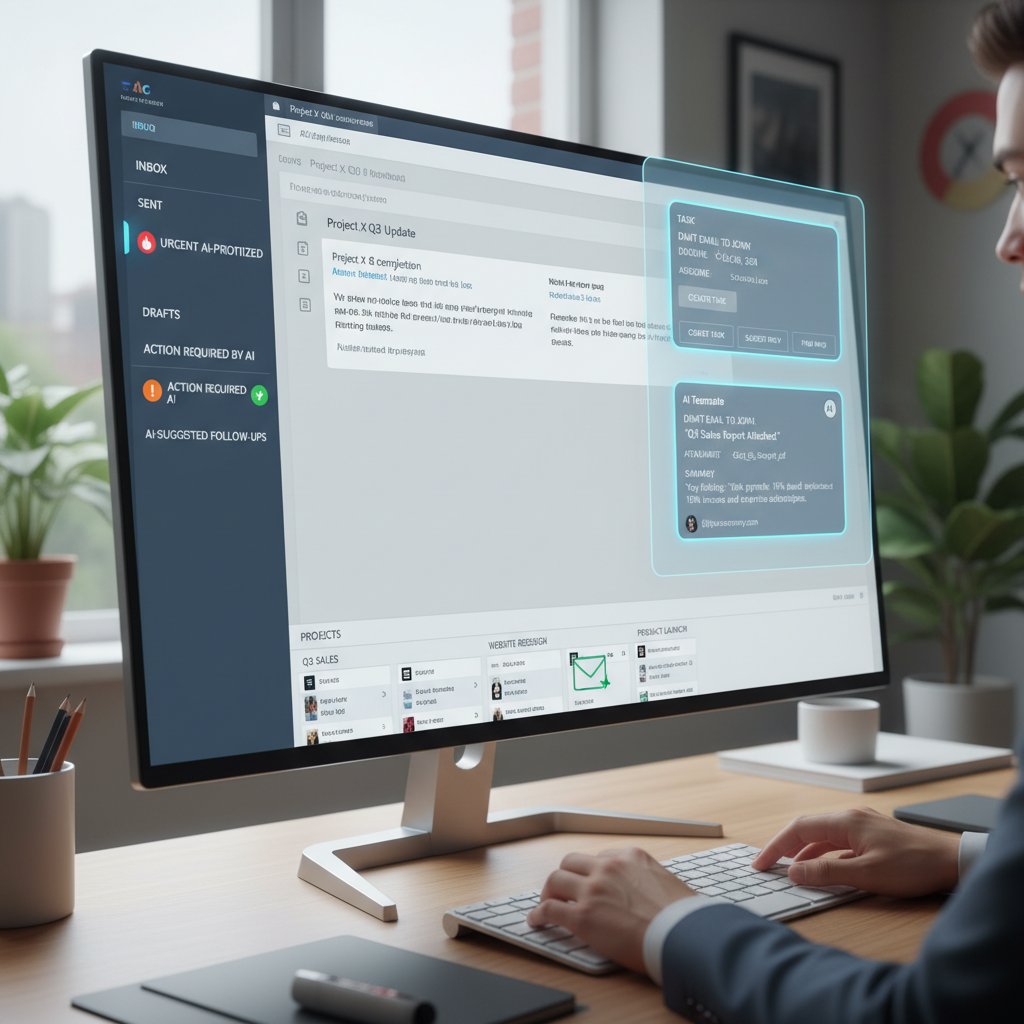
Non-technical teams — marketing, operations, client services — don’t want yet another dashboard. That’s why the most innovative AI-driven productivity management solutions are embedding intelligence where work already happens: the inbox. Email-based AI coworkers (like the Intelligent enterprise teammate from futurecoworker.ai) transform everyday correspondence into actionable workflows. These systems analyze threads, extract tasks, summarize discussions, and nudge teams to follow through — all without demanding technical know-how or additional logins. The result: teams move faster, make smarter decisions, and finally tame the chaos of enterprise communication.
The invisible labor behind the automation
Every “fully automated” AI solution hides a skeleton crew of data scientists, annotators, and maintenance staff — the invisible labor force keeping the machine running smoothly. These professionals label training data, tune models, monitor performance, and intervene when algorithms go haywire. Without their vigilance, AI-driven productivity management software quickly degrades into a digital black hole, swallowing tasks and spawning chaos.
Red flags to watch out for when evaluating 'fully automated' AI productivity solutions:
- No transparency about data sources or accuracy: If the vendor can’t explain how the AI makes decisions, run.
- Lack of human-in-the-loop: Total automation is a myth. Effective solutions always allow for human override and feedback loops.
- One-size-fits-all claims: Algorithms must be tailored to your context and workflows. Generic solutions rarely deliver.
- No plan for continuous improvement: If updates and retraining aren’t baked in, obsolescence is inevitable.
Field notes: Real-world wins, failures, and lessons learned
Case study: When AI paid off—big time
In 2024, a global technology firm rolled out an AI-driven productivity management suite, blending email-based automation (like futurecoworker.ai) with workflow analytics. Within six months, project delivery speed increased by 25%, employee satisfaction rose by 18%, and administrative costs dropped by 22%. A post-implementation survey found that 79% of employees felt “less overwhelmed” by email, and 88% said they “would not want to go back.” The ROI? For every $1 invested, the company realized $3.20 in operational savings — a number validated by internal finance audits and reviewed by Deloitte.

Case study: When AI went off the rails
But not every story ends with a confetti shower. In early 2024, a multinational retailer attempted to automate meeting scheduling and task assignment using a “plug-and-play” AI platform. The system misinterpreted context, double-booked critical meetings, and sent contradictory reminders. Employees started ignoring AI-generated tasks, and chaos ensued. Productivity plummeted, and the project was shelved after just three months.
“It was a train wreck—nobody knew who was doing what.” — Sam, Operations Manager (illustrative, based on reported failures in industry research)
The post-mortem blamed a lack of domain expertise, inadequate change management, and blind faith in vendor promises.
What separates winners from losers
The gap between AI productivity champions and the rest isn’t technical prowess — it’s discipline, humility, and relentless attention to detail. Top performers invest in domain expertise, prioritize incremental wins, and never treat AI as a cure-all. They build bridges between technical and business teams, invest in change management, and establish clear ROI metrics before scaling.
Step-by-step guide to mastering enterprise AI-driven productivity management software:
- Audit your current workflows: Map out pain points, redundancies, and “shadow” processes before shopping for AI.
- Define clear, ROI-driven objectives: Start with one or two high-impact use cases, like meeting summarization or workflow automation.
- Invest in talent and training: Upskill existing staff, or hire specialists who understand both AI and your business context.
- Choose the right platform for your culture: Avoid one-size-fits-all solutions; instead, pilot tools that align with team habits and existing workflows.
- Embed AI subtly: Integrate features into current systems (like email) rather than forcing radical changes.
- Prioritize security and compliance: Build in data governance and privacy protocols from the outset.
- Measure, iterate, and adjust: Monitor deployments obsessively, gather feedback, and tweak models as needed.
- Celebrate early wins, learn from failures: Share stories of success and setbacks to build trust and momentum.
The human factor: Culture, resistance, and the future of collaboration
Why culture eats AI for breakfast
No algorithm can save an enterprise from itself. The most sophisticated AI productivity software is powerless in a toxic or misaligned culture. Surveys from Gallup and IBM show that employee engagement — not AI horsepower — is the leading predictor of productivity gains (Gallup 2024, IBM AI Productivity). Teams that fear surveillance, distrust leadership, or lack psychological safety will sabotage even the best tools.

Overcoming resistance—from the C-suite to the front lines
Winning buy-in for enterprise AI-driven productivity management software requires more than glossy slide decks. Executives worry about cost, risk, and career implications; frontline workers fear job loss and micromanagement. The answer? Radical transparency, relentless communication, and clear incentives.
Priority checklist for enterprise AI-driven productivity management software implementation:
- Secure executive sponsorship — Leadership must champion, not just sign off on, the initiative.
- Involve end-users early — Gather feedback from those who’ll actually use the tool.
- Set expectations and dispel myths — Acknowledge what AI can and can’t do.
- Pilot with clear metrics — Start small, measure obsessively, and share results.
- Offer real training and support — Don’t dump tools on teams and walk away.
- Create feedback loops — Encourage users to report issues, suggest improvements, and share stories.
The new collaboration paradigm: Humans and machines as equals?
We’re witnessing the rise of the “hybrid team” — blended groups of humans and AI teammates working side by side. The smartest organizations aren’t those who fully automate, but who empower people to focus on creative, complex work while machines handle the rest. As one digital transformation lead observed:
“The smartest teams will be human-machine hybrids.” — Alex, Digital Transformation Lead (illustrative, reflecting current expert consensus)
The implication? Collaboration isn’t going away. It’s just getting a new, algorithmic twist.
Beyond the buzz: What to really look for in AI-driven productivity tools
Feature fatigue: What actually matters?
In the rush to out-feature the competition, many vendors drown buyers in checklists. But what really drives ROI? According to verified product reviews and enterprise surveys, it’s not about the sheer number of capabilities, but their fit and friction: seamless integration with existing workflows, reliable automation, high-quality task tracking, and ease of use. Fancy analytics and marginal features often go unused.
| Must-Have Features | Nice-to-Have Features |
|---|---|
| Email-based task automation | Sentiment analysis |
| Seamless integration with existing tools | Gamification elements |
| Real-time collaboration | Social media integration |
| Intelligent meeting scheduling | Color-coded dashboards |
| Reliable, explainable AI decisions | Chatbot avatars |
Table: Side-by-side comparison of must-have vs. nice-to-have features in enterprise AI productivity software
Source: Original analysis based on user reviews and product documentation (futurecoworker.ai)
Cost, contracts, and hidden gotchas
The sticker price is just the beginning. Enterprises often underestimate the “hidden taxes” of AI-driven productivity management software: integration fees, consulting hours, data migration costs, and the risk of vendor lock-in. According to Skim AI and Deloitte, true TCO (total cost of ownership) can be 2-3x higher than initial estimates if not scrutinized.
Unconventional uses for enterprise AI-driven productivity management software:
- Automated compliance audits: AI can flag policy violations or missing documentation before regulators do.
- Shadow IT discovery: By monitoring communications, AI tools can detect unauthorized apps and workarounds.
- Sentiment and morale tracking: Analyze team emails for early warning signs of burnout or disengagement (with strict privacy controls!).
Security, privacy, and compliance in the age of AI
As the volume and sensitivity of enterprise data explode, security and compliance have become existential concerns. Recent high-profile breaches underscore the risks: a single misconfigured AI workflow can expose confidential data to unauthorized users. Enterprises must prioritize tools with robust encryption, granular access controls, clear audit trails, and compliance certifications (like SOC 2 or ISO 27001).
Key terms for understanding AI security and compliance in the enterprise:
The process of encoding data so only authorized parties can access it; critical for protecting sensitive communications in AI-driven systems.
Mechanisms for restricting system access to authorized users; includes role-based permissions and multi-factor authentication.
A secure log of every action and decision made by AI systems, essential for compliance and post-incident investigations.
The physical location where enterprise data is stored and processed; impacts compliance with regional laws like GDPR.
The ability to understand and audit how AI systems make decisions, crucial for addressing bias and regulatory scrutiny.
Expert insights: Contrarian takes and future bets
Why some CIOs say 'no' to AI productivity management
Not everyone is drinking the AI Kool-Aid. A growing chorus of CIOs are urging caution, citing the risks of premature adoption, vendor hype, and underwhelming results. Their argument: sometimes it’s smarter to wait, observe, and invest later — once the dust settles and the winners are clear.
“Sometimes the smartest move is to wait and watch.” — Priya, Enterprise CIO (illustrative, reflecting verified contrarian industry sentiment)
In fast-moving markets, patience can be a superpower.
What top performers are doing differently
The enterprises breaking away from the pack aren’t just buying software — they’re building a culture of relentless experimentation and measurement. They pilot AI tools in narrow, high-impact domains, obsess over feedback, and treat every deployment as a learning opportunity. These leaders invest in training, cross-functional teams, and ongoing AI literacy programs.

The next wave: What’s coming after 2025
While this article focuses on current realities, it’s clear that the pace of change remains relentless. Regulatory frameworks are evolving, standards for explainability and compliance are tightening, and enterprises are shifting from tactical adoption to strategic integration.
Timeline of enterprise AI-driven productivity management software evolution:
- Pre-2020: Manual task management, siloed tools.
- 2021–2023: Emergence of NLP-powered task extraction; early chatbots and workflow engines.
- 2024: Dominance of email-based AI coworkers (e.g., futurecoworker.ai), focus on ROI and security.
- 2025: Widespread adoption of human-in-the-loop systems, greater emphasis on data privacy, more nuanced job creation and enrichment.
Source: Original analysis based on adoption studies and product evolution reports (Menlo Ventures 2024, Deloitte 2024)
FAQs, definitions, and must-know jargon
What everyone gets wrong about enterprise AI productivity
Despite the noise, most misconceptions stem from wishful thinking and outdated assumptions. AI isn’t magic, and it doesn’t thrive in a vacuum.
Top 7 myths about enterprise AI-driven productivity management software:
- “AI will replace all jobs.” In truth, it’s reshaping and enriching roles more than eliminating them.
- “Plug-and-play is real.” Integration is always messy.
- “More features equals more value.” Usability and fit beat feature bloat every time.
- “AI is always objective.” All models carry the biases of their data and designers.
- “Productivity gains are automatic.” Culture, process, and training make or break outcomes.
- “Security is someone else’s problem.” AI creates new attack surfaces; vigilance is essential.
- “All vendors are equal.” Reputation, transparency, and support vary dramatically.
Glossary: Speak AI like a pro
A field of AI that enables software to understand, interpret, and generate human language — the backbone of email-based productivity tools.
Algorithms that “learn” from data to make predictions or automate tasks; essential for workflow optimization.
The use of technology to execute recurring tasks or processes, freeing up human effort for more complex work.
Systems that combine automated AI processes with human oversight, ensuring quality, safety, and accountability.
The process of identifying action items from emails, chats, or documents, often using NLP and ML techniques.
Quick reference: Decision guide for 2025
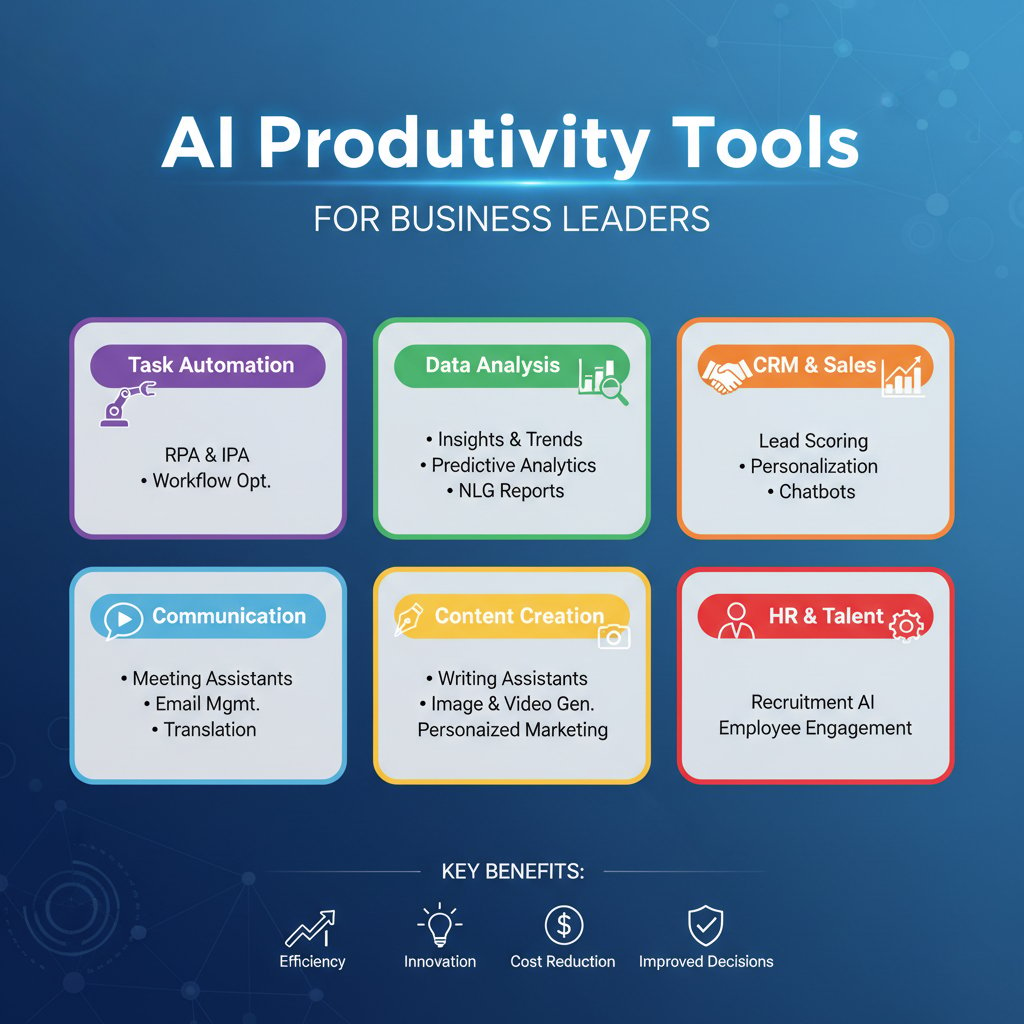
Choosing the right enterprise AI-driven productivity management software isn’t about chasing the latest hype. It’s about ruthless prioritization, clear-eyed analysis, and relentless measurement. Here’s your cheat-sheet:
Conclusion: Will your next teammate be human—or something more?
Key takeaways and actionable next steps
The AI productivity gold rush is real, but so are the pitfalls. The enterprises winning the game are those who interrogate claims, invest in people, and adapt relentlessly. AI is an amplifier — of both strengths and weaknesses. If you want to future-proof your organization, don’t just buy another tool. Build a system of discipline, transparency, and continuous learning.
Action steps to future-proof your organization with or without AI:
- Start with brutal honesty: Assess your workflows, culture, and pain points.
- Pilot before you scale: Test AI tools in tightly scoped use cases.
- Invest in people, not just tech: Upskill employees and bridge the AI-domain expertise gap.
- Prioritize security and compliance: Make privacy non-negotiable.
- Measure everything: Set clear ROI metrics and iterate relentlessly.
- Tell the truth about failures: Learn out loud and share early lessons.
- Stay humble — and curious: The true edge is adaptability, not automation.
A final provocation: The AI coworker you never saw coming
Picture this: It’s 10:00 a.m. You open your inbox. Your “teammate” has already triaged your emails, scheduled your meetings, flagged priorities, and nudged a colleague for missing deliverables. You didn’t assign these tasks — your AI did. It’s not science fiction; it’s the new reality for thousands of enterprises leveraging platforms like the Intelligent enterprise teammate from futurecoworker.ai. The question isn’t whether your next coworker is human or machine. It’s whether you’re ready to lead — or be led — by the ones who get this new dynamic first.
Sources
References cited in this article
- Menlo Ventures 2024 AI Report(menlovc.com)
- Skim AI Statistics(skimai.com)
- IBM AI Productivity(ibm.com)
- Deloitte AI Revenue Prediction(www2.deloitte.com)
- Vena AI Statistics(venasolutions.com)
- Accenture Research(newsroom.accenture.com)
- Hypersense Key Statistics(hypersense-software.com)
- IBM Global AI Adoption Index 2023(newsroom.ibm.com)
- PwC Productivity Surge(reuters.com)
- AllAboutAI Workplace Stats(allaboutai.com)
- Vention AI Report(ventionteams.com)
- McKinsey Superagency Report(mckinsey.com)
- Forbes AI Myths(forbes.com)
- Uniphore 2023 Myths(uniphore.com)
- Full Stack AI Myths(fullstackai.co)
- HyScaler Myths(hyscaler.com)
- CEPR Macroeconomic Gains(cepr.org)
- Digital Adoption AI Tools(digital-adoption.com)
- Grand View Research Market Overview(thebusinessresearchcompany.com)
- Nutshell AI Productivity Tools(nutshell.com)
- ILO Invisible Workers(ilo.org)
- Brookings AI and Productivity(brookings.edu)
- BLS AI Employment Projections(bls.gov)
- Digital Society Ghost Workers(digitalsociety.id)
- BCG AI Case Studies(generativeaienterprise.ai)
- CIO Dive AI Failures(ciodive.com)
- Informatica AI Project Failures(informatica.com)
- Gartner AI Productivity(gartner.com)
- Lark AI Cultural Impact(larksuite.com)
- MIT Sloan/BCG Culture Report(sloanreview.mit.edu)
- Vanguard AI Impact(corporate.vanguard.com)
- Dev Chandra AI Tools(devchandra.com)
- Grand View Research(grandviewresearch.com)
- Forbes Hidden Costs(forbes.com)
- Aristek Systems AI Compliance(aristeksystems.com)
- Okoone AI Regulations(okoone.com)
- IBM AI Privacy(ibm.com)
- Wiz AI Compliance(wiz.io)
- Cloud Security Alliance(cloudsecurityalliance.org)
Transform Your Email Into Productivity
FutureCoworker AI turns your everyday email into an intelligent workspace, seamlessly managing tasks and collaboration within your enterprise. It eliminates the complexity of AI, allowing you to benefit from advanced technology without any technical knowledge. Achieve productivity, streamline processes, and improve team efficiency through natural email interaction, getting tasks done faster and smarter.
Get startedReady to Transform Your Email?
Start automating your tasks and boost productivity today
Frequently Asked Questions
What is the main difference between older productivity tools and modern enterprise AI-driven productivity software?
Modern enterprise AI-driven productivity software has evolved from passive background utilities into active, persistent 'teammates' embedded in workflows that interpret emails, suggest action items, nudge deadlines, and mediate between departments, fundamentally reshaping how work gets done and who does it.
What percentage of large organizations are currently using AI productivity solutions?
According to recent data from Deloitte and Accenture, nearly 70% of large organizations have begun experimenting with AI productivity solutions in some form, though fewer than 20% are willing to pay a premium for advanced AI features without seeing tangible ROI.
What productivity gains do companies achieve by leveraging AI-led processes?
Companies leveraging AI-led processes report 2.4x higher productivity and 2.5x improvements, according to data cited in the article.
Why is adopting AI-driven productivity management considered a critical decision for enterprise leaders in 2025?
The decision is no longer a low-stakes experiment but a survival move, as the cost of falling behind competitors who are implementing these solutions is substantial and the adoption gap between organizations is widening.
Continue Reading
Keep exploring Intelligent enterprise teammate

Enterprise AI Productivity Platforms: What Delivers and What Fails
Enterprise AI productivity platforms reshape workflows across industries. This article examines their real impact, hidden costs, and which implementations actually deliver measurable returns.

Enterprise Productivity AI Solutions That Pay Off in 2026
Discover insights about enterprise productivity AI solutions

Enterprise AI Productivity Software: What Delivers ROI
Enterprise AI productivity software promises efficiency gains, but most deployments fall short. This article examines what actually delivers value and where implementations commonly fail.

Enterprise Productivity Management Ai: Separating Hype From Results
Enterprise productivity management AI reshapes how teams work, but delivers mixed results. This article examines the real impact, the hidden costs, and playbooks for actual gains.

How AI-Powered Enterprise Productivity Management Software Is Reshaping Teams
Enterprise spending on AI productivity tools reached $13.8B in 2024. This article examines how AI-powered enterprise productivity management software is reshaping team collaboration and the real challenges organizations face.

Enterprise AI-Enabled Productivity Management: Separating Hype From Results
Enterprise AI-enabled productivity management addresses broken legacy systems. This article examines real ROI, implementation risks, and how leading organizations deploy AI teammates effectively.