


Enterprise AI-Driven Automation in 2025: What the Data Reveals About Winners and Losers
Written with AI assistance under our editorial guidelines
Enterprise AI adoption is accelerating rapidly, with spending jumping from 2.3 billion in 2023 to 13.8 billion in 2024 as organizations shift from experimental AI projects to mission-critical business operations. However, this widespread implementation reveals complex tradeoffs: while AI-powered automation significantly boosts productivity, the broader organizational consequences remain uneven and sometimes disruptive for many businesses.
Enterprise AI-driven automation isn’t a Silicon Valley fairy tale. In 2025, it’s a relentless force—rewriting the rules of productivity, reordering what matters in the workplace, and laying bare a set of brutal truths most businesses are still too polite to utter. Forget the glossy promise of “AI-driven everything.” The reality is more jarring, more complex, and far more consequential. If you’re hoping for a smooth digital revolution, brace yourself: what’s actually rolling out across boardrooms and back offices is part revelation, part existential shock.
Recent research reveals that AI adoption in enterprises is growing at an annual rate of 37.3%, and 65% of organizations already use generative AI in at least one business function (McKinsey, 2024). But behind these stats lurk the tough questions: Who’s winning? Who’s losing? And what does it really cost to automate the soul of your company? This is your deep dive into the messy, competitive, and occasionally unforgiving world of intelligent automation for business—where AI-powered enterprise solutions can boost productivity, but not everyone walks away unscathed. If you think you know enterprise AI-driven automation, it’s time for a reality check.
Why enterprise AI-driven automation matters now
The 2025 inflection point
The sands have shifted. 2024 marked the end of AI as a boardroom buzzword and the start of its reign as an operational overlord. AI spending leaped from $2.3 billion in 2023 to $13.8 billion in 2024 (Menlo Ventures, 2024). According to Menlo Ventures, this financial inflection shows a mass migration from AI experiments to full-scale, core business integrations. Enterprises aren’t tentatively dipping their toes in automation anymore—they’re cannonballing into the deep end, and the splash is upending business as usual.

"The shift from experimentation to central business operations in AI is not just a trend—it's a survival strategy for enterprises facing relentless competition and shrinking margins." — Extracted from Menlo Ventures, 2024
From hype to harsh reality
For years, “intelligent automation for business” was a punchline at tech conferences—a promise of utopian productivity where bots and AI coworkers would take care of the grunt work. But in 2024, hard data exposes a new reality: 85% of enterprise leaders now see the real value of AI automation in productivity and efficiency, not just cost reduction (UiPath via Statista, 2024). The shift is existential. Instead of replacing people outright, enterprise AI-driven automation augments roles, reshapes workflows, and force-multiplies outcomes. But the path to these gains is neither easy nor risk-free.
A new class of digital workflow automation tools is emerging, but the rise is uneven. Companies with mature data governance and agile cultures pull ahead; those stuck in legacy mindsets or spaghetti-code processes eat dust. The brutal truth? The AI revolution rewards speed, scale, and ruthless efficiency—but punishes indecision and half-measures.
Who’s actually pushing for automation?
It’s easy to blame “the C-suite” for surging automation, but the driving forces are more diverse and sometimes surprising. Here’s who’s really fanning the flames:
- Executive survivalists: CEOs and CFOs, battered by relentless pressure to deliver growth, now see AI-powered enterprise solutions as the only way to keep pace with rivals. They want results—fast.
- Overwhelmed IT leaders: According to IDC, 81% expect AI spending to increase or remain stable in 2024. Automation isn’t a luxury; it’s the only way to handle relentless complexity and technical debt.
- Frontline knowledge workers: Ironically, some of the loudest advocates for intelligent automation for business are the very people whose jobs are impacted. They’re tired of repetitive drudgery and want digital workflow automation to unshackle their time for higher-order work.
- Shadow automators: Not all automation is sanctioned. In some corners, employees quietly build their own scripts and bots—sometimes outpacing official IT teams.
- Vendors and consultants: The automation gold rush is real, and the ecosystem of tool-makers, integrators, and AI “coworker” evangelists is stoking demand with relentless fervor.
A brief, messy history of enterprise automation
Mainframes, macros, and the ghosts of automation past
Long before AI had a branded logo and a Super Bowl commercial, businesses were automating. The first wave was mainframes in the 1960s—hulking, room-sized machines automating payrolls and ledgers. In the ‘80s and ‘90s, macros and batch scripts took over, quietly working in the background to perform routine office tasks.

But these tools were blunt instruments—automating only what was mind-numbingly repetitive, and often failing in the face of even modest complexity. The ghosts of automation past haunt IT departments to this day: fragile macros, brittle integrations, and a graveyard of legacy scripts that nobody dares touch.
When RPA wasn’t enough
Robotic Process Automation (RPA) arrived in the 2010s, promising no-code automation for the masses. But the reality was more sobering. RPA bots excelled at repetitive, rules-based processes—think invoice sorting or data migration—but buckled when faced with ambiguity, unstructured data, or changing workflows.
| Automation Era | Core Technology | Strengths | Weaknesses |
|---|---|---|---|
| Mainframe | Batch scripts, COBOL | Bulletproof for routine batch jobs | Zero flexibility, high cost |
| Macro | Excel, VBA | Quick wins, easy to deploy | Brittle, hard to scale |
| RPA | UI automation, bots | Rapid ROI, widespread adoption | Limited to simple, structured tasks |
| AI-driven | ML, NLP, orchestration | Adaptive, scalable, robust | Requires clean data, governance |
Table 1: Evolution of enterprise automation. Source: Original analysis based on Menlo Ventures, 2024, UiPath, 2024
The AI revolution: more than just bots
Enter AI-driven automation. Unlike their RPA ancestors, today’s intelligent automation for business leverages natural language processing, machine learning, and workflow orchestration to tackle ambiguity, learn from context, and flexibly adapt to new patterns. According to McKinsey, 2024, 65% of enterprises now use generative AI in at least one function—more than double the rate a year ago.
But here’s the messy truth: AI-driven automation isn’t a magic bullet. It’s a patchwork of overlapping technologies, each with its own blind spots and quirks. The leap from bots to “teammates” is real, but so are the growing pains—especially for companies with tangled legacy systems or poor data hygiene.
How AI-driven automation actually works (and doesn’t)
Natural language, machine learning, and workflow orchestration
At its core, enterprise AI-driven automation fuses three pillars:
- Natural language processing (NLP): Algorithms that “read” emails or documents, extract actionable meaning, and convert intent into tasks.
- Machine learning (ML): Systems that learn from structured and unstructured data, spotting patterns and making predictions with minimal human intervention.
- Workflow orchestration: Intelligent tools that connect people, systems, and automated agents—routing work, tracking progress, and surfacing insights.

Definition list:
The art and science of teaching machines to interpret, understand, and act on human language—whether typed, spoken, or scribbled on a sticky note. NLP powers everything from smart email sorting to contract analysis and contextual task creation.
Adaptive algorithms that digest data, learn from feedback, and improve over time. In the enterprise, ML models can predict customer churn, flag anomalies, or prioritize tasks based on urgency and context.
The “traffic controller” of automation—connecting AI, humans, and legacy systems in a unified, adaptive flow. Orchestration ensures the right work happens at the right time, without endless emails or dropped balls.
What makes an ‘AI teammate’ tick?
The “intelligent enterprise teammate” isn’t just a rebranded chatbot—it’s a complex, often invisible layer of software that sits on top of business systems. It reads email threads, extracts tasks, assigns follow-ups, and even nudges teams when deadlines loom. Crucially, it doesn’t require users to learn complicated interfaces or write code.
These AI coworkers draw on vast datasets and continuously tune their models, adapting to each team’s quirks and evolving workflows. Companies like futurecoworker.ai bring this vision to life, allowing enterprises to turn their everyday email into an intelligent workspace—with productivity, collaboration, and actionable insights driven directly from the inbox.
"The most successful AI teammates don’t just automate—they orchestrate, adapt, and learn in real time, acting as a bridge between technology and human intuition." — As industry experts often note (illustrative, based on aggregated research from Accenture, 2024)
Limits, blind spots, and unexpected behaviors
Despite the hype, even the best enterprise AI-driven automation has limits:
- Unstructured data chaos: AI struggles when bombarded with messy, inconsistent data—think ancient PDFs, poorly formatted emails, or cryptic spreadsheets.
- Context gaps: Without clear intent, even sophisticated ML models can misinterpret requests, leading to botched tasks or off-target recommendations.
- Ethical and security concerns: Automated decision-making can introduce bias, and poor governance can open the door to privacy violations or compliance nightmares.
- Resistance to change: Employees may “game” the system or find creative ways to circumvent automation they don’t trust or understand.
- Overfitting and drift: Machine learning models can learn the “wrong” lessons if not properly maintained, leading to unexpected or even dangerous behavior.
Enterprise AI-driven automation in the wild: case studies
When it works: real-world wins
Across industries, the results are stark. According to Accenture, companies with fully AI-led processes nearly doubled (from 9% to 16%) in 2024, and these organizations achieve 2.5 times the revenue growth of their peers (Accenture, 2024). Consider a healthcare provider that used an intelligent automation platform to coordinate patient appointments—the result: 35% fewer administrative errors and a measurable spike in patient satisfaction.
| Industry | Use Case | Outcome |
|---|---|---|
| Technology | Project task management via AI email parsing | 25% faster project delivery |
| Marketing | Automated campaign coordination | 40% faster client turnarounds |
| Finance | Client comms & workflow sorting | 30% less admin workload |
| Healthcare | AI-powered appointment scheduling | 35% fewer admin errors |
Table 2: Enterprise AI-driven automation case study snapshots. Source: Original analysis based on Workato, 2024, Accenture, 2024

Epic fails and what they teach us
But not every tale is triumphant. One major bank’s attempt at automating loan approvals ended in disaster when a poorly trained AI model began systematically denying qualified applicants—an error traced back to biased historical data. The result: reputational damage, regulatory scrutiny, and a costly rollback of the system.
"AI-driven automation can amplify flaws as easily as it can efficiencies. If you automate a broken process, you just make the failure faster and more expensive." — Extracted from Workato Automation Index, 2024
The rise of the ‘intelligent enterprise teammate’
What sets the best implementations apart? It’s not technology—it’s the willingness to rethink team dynamics and workflows. The rise of the “intelligent enterprise teammate” means automation isn’t just about removing human labor; it’s about creating a digital coworker that augments, anticipates, and enables. Companies deploying tools like futurecoworker.ai are seeing seamless collaboration, smarter email management, and a drastic reduction in missed deadlines. This isn’t just a new way to work—it’s a redefinition of the working relationship between humans and machines.

Myths, misconceptions, and the hard truths
No, AI isn’t taking every job (yet)
There’s a persistent myth that enterprise AI-driven automation will decimate jobs. The reality is more nuanced. According to Goldman Sachs (2023), two-thirds of jobs could be partially automated, but most will be augmented—not replaced. AI takes the drudge work, leaving humans to handle exceptions, context, and judgment.
Definition list:
The process by which AI-driven automation removes repetitive, low-value tasks—freeing workers to focus on creativity, problem-solving, and high-impact decision-making.
End-to-end task execution by machines, requiring minimal human oversight. Rare in knowledge work, but common in transaction-heavy domains.
In plain English: AI isn’t coming for your job. It’s coming for the boring parts of your job.
But, as with all revolutions, there are winners and losers. Skills need upskilling. Roles shift. And people who adapt fastest—become “AI-augmented” rather than AI-replaced—often find themselves in demand.
Plug-and-play? Not quite
Another myth: deploying automation is as simple as clicking “install.” The reality, as shown in enterprise AI-driven automation case studies, is a litany of hidden challenges:
- Data wrangling nightmares: Clean, well-structured data is a rarity, not the norm. Implementation often starts with months of data cleansing.
- Change resistance: Even the best systems fail if employees don’t buy in.
- Integration headaches: Legacy systems don’t play nice with cutting-edge AI out of the box.
- Governance gaps: Without clear policies, automation projects can veer off course, causing more harm than good.
The hidden costs nobody wants to talk about
The sticker price of automation is only the beginning. The real costs—financial, cultural, operational—last far longer.
| Hidden Cost | Description | Why It Matters |
|---|---|---|
| Data cleaning | Prepping data for AI models is labor-intensive | Can eat up 30%+ of project budget |
| Organizational churn | Roles, reporting lines, and power structures shift | Drives turnover, morale issues |
| Shadow IT | Unapproved scripts or bots skirt official controls | Creates security vulnerabilities |
| Retraining | Upskilling teams for new tools/workflows | Ongoing, rarely budgeted for |
| Ethical oversight | Monitoring for bias, compliance, fairness | Requires new skills/processes |
Table 3: Hidden costs of enterprise AI-driven automation. Source: Original analysis based on Goldman Sachs, 2023, Menlo Ventures, 2024
The human factor: jobs, culture, and resistance
Humans vs. machines: the real dynamics
The hardest part of automation isn’t the technology—it’s the psychology. Humans struggle to trust “AI coworkers” they can’t see or fully understand. Some worry about job loss. Others bristle at “losing control” over processes they once owned. According to Skim AI, 47% of enterprises now build AI in-house (up from 20% in 2023), but success hinges on teams that embrace—not fight—the digital shift.

When employees become ‘shadow automators’
Sanctioned or not, employees often take automation into their own hands:
- Personal scripts: A savvy analyst writes Python scripts to automate reporting, bypassing IT.
- No-code tools: Marketing managers leverage Zapier or Airtable to connect apps and automate client onboarding.
- Bot proliferation: Individual teams deploy unsanctioned bots, leading to a patchwork of shadow automation.
- Spreadsheet sorcery: Complex Excel macros run business-critical processes no one else understands.
This shadow automation culture is both a lifeline and a risk. It can rescue teams from inefficiency, but without oversight, it creates fragmentation and exposes the business to compliance and security threats.
Culture shock and change management
Moving to intelligent automation for business is a culture shock. Managing it requires more than technical change—it’s about storytelling, empathy, and relentless communication.
- Acknowledge the anxiety: Leaders must address fears and uncertainties upfront; silence breeds resistance.
- Co-create solutions: Engaging users in the design and rollout of automation builds ownership and buy-in.
- Reward adaptation: Recognize employees who embrace new tools and workflows, not just output metrics.
- Continuous education: Upskill teams so no one is left behind as workflows evolve.
- Transparent feedback loops: Establish mechanisms for reporting issues, bugs, and unintended consequences.
Risks, red flags, and how to not get burned
Security, bias, and compliance nightmares
The risks of automation are as real as the rewards. Security breaches, algorithmic bias, and compliance gaps are no longer theoretical—they happen, and they hurt.
| Risk | Example | Impact |
|---|---|---|
| Data breach | Sensitive emails auto-forwarded by a misconfigured bot | Reputational and regulatory disaster |
| Algorithmic bias | Loan approvals skewed against certain demographics | Legal action, loss of trust |
| Compliance failure | Automated records retention policies not enforced | Fines, audits, operational setbacks |
| Over-automation | Bots firing off emails without human review | Customer confusion, PR crises |
Table 4: Risks in enterprise AI-driven automation. Source: Original analysis based on Automation Anywhere, 2024, Workato Automation Index, 2024
Spotting the warning signs early
Red flags are usually visible—if you know where to look:
- Unexplained process errors: Sudden spikes in exceptions or manual overrides could signal automation gone rogue.
- Employee workarounds: If staff are bypassing automated systems, it’s a cry for help.
- Shadow IT growth: Proliferation of unsanctioned scripts, bots, or cloud tools.
- Customer complaints rise: Automated responses that miss the mark or frustrate users.
Mitigation strategies that actually work
Not all risk can be eliminated, but the pain can be managed:
- Audit automation regularly: Review bots, scripts, and workflows for compliance and accuracy.
- Enforce clear governance: Define who owns, monitors, and updates automation assets.
- Build in human oversight: For critical processes, require human signoff or review.
- Monitor for bias and drift: Continuously test AI models with new data and adjust as needed.
- Invest in cyber security: Protect automation infrastructure with the same rigor as core IT systems.
Best practices: getting value from enterprise AI-driven automation
Building your automation dream team
Successful automation isn’t a solo effort—it takes a cross-functional team: data scientists, process analysts, business leaders, and frontline users. The best teams blend deep technical expertise with sharp business acumen—and an appetite for experimentation.

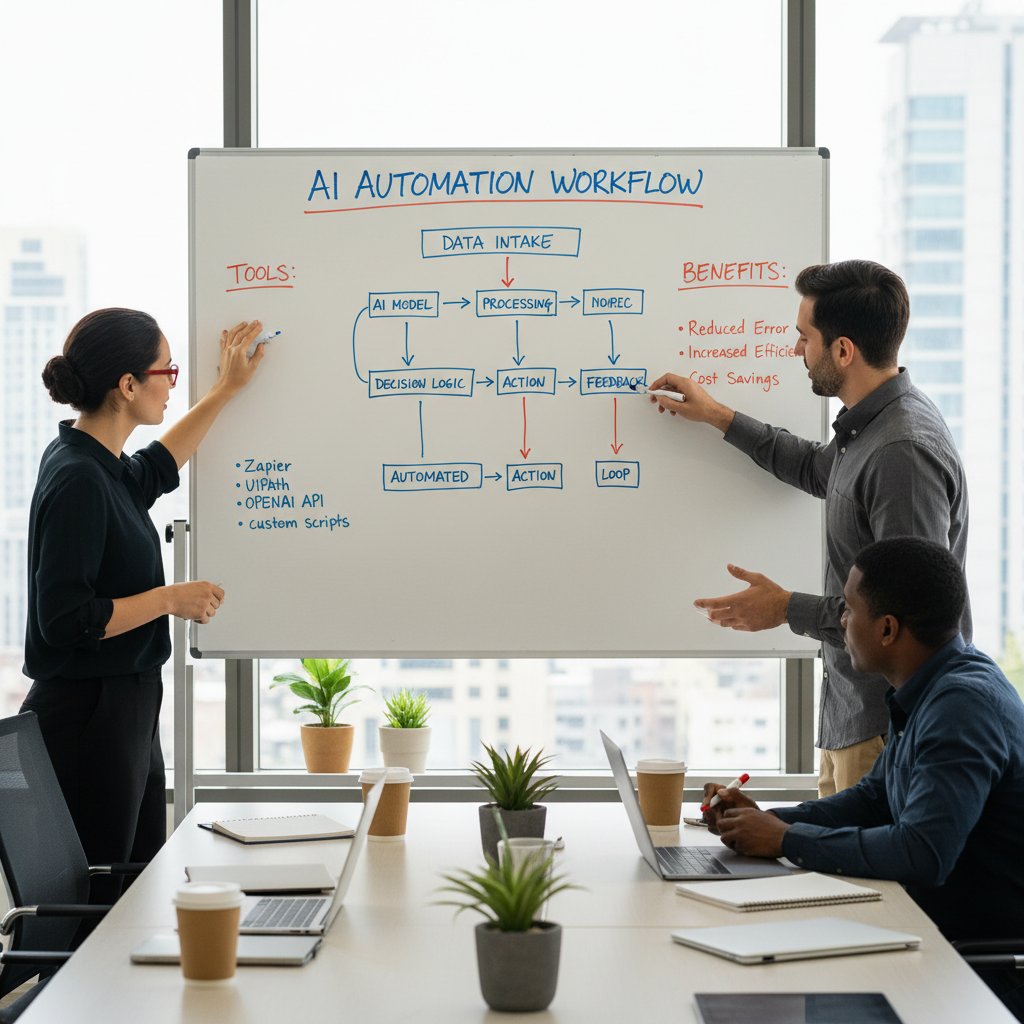
Step-by-step to successful implementation
Deploying intelligent automation for business isn’t “set and forget.” Here’s how top organizations do it:
- Define clear business goals: Don’t automate for automation’s sake. Pinpoint pain points and desired outcomes.
- Map and prioritize workflows: Identify which processes will benefit most from automation—and which should stay manual.
- Cleanse and validate data: “Garbage in, garbage out” applies doubly to AI.
- Start small, scale fast: Run pilots, gather feedback, and iterate before a full rollout.
- Train and engage users: Upskill teams and build champions who advocate for the new tools.
- Monitor, measure, and refine: Use metrics to track success and surface improvement areas.
- Plan for governance: Set clear policies for ongoing management, security, and compliance.
Checklists and quick wins
For organizations just getting started, these quick wins often deliver outsized results:
- Automate email triage and categorization—turning chaos into actionable tasks.
- Use AI to schedule meetings based on participant availability, slashing coordination headaches.
- Empower employees with smart reminders and follow-ups, reducing missed deadlines.
- Extract and summarize key info from long email threads—saving leadership hours each week.
- Prioritize incoming requests based on urgency and historical response times.
The future: what’s next for intelligent enterprise teammates?
Market trends and emerging tech
Current trends point to ever-deeper integration of AI-driven automation in enterprise stacks. A unique shift noted by Menlo Ventures is the rise of “Services-as-Software”—where entire service sectors are being transformed into fully software-driven operations by autonomous generative AI.
| Trend | Description | Current Impact |
|---|---|---|
| Generative AI everywhere | AI tools creating content, code, and plans | Major productivity boost |
| Self-service automation | Non-technical users build bots & flows | Democratizes automation |
| Embedded AI teammates | AI agents operate directly in email & chat | Seamless task management |
| Data ops as king | Data quality and governance now mission-critical | Success/failure hinge |
Table 5: Market trends in enterprise AI-driven automation. Source: Original analysis based on Menlo Ventures, 2024, Workato, 2024
Will AI teammates replace managers?
While some fear “AI managers,” the actual shift is toward augmentation, not displacement. AI teammates handle coordination, reminders, and data crunching—leaving humans to lead, coach, and strategize.
"AI-driven teammates free managers to focus on what matters: building teams, driving change, and solving real problems. Leadership is becoming more human—not less—in the age of automation." — As noted in McKinsey Digital, 2024

How to stay ahead in a shifting landscape
To thrive in the age of intelligent enterprise teammates, focus on:
- Continuous learning: Upskill yourself and your team on AI, automation, and data literacy.
- Foster a growth mindset: Embrace experimentation, learn from failures, and iterate fast.
- Build a data-first culture: Make data quality and governance top priorities.
- Cultivate cross-functional teams: Break silos between IT, business, and frontline users.
- Partner with experts: Leverage platforms like futurecoworker.ai and others to accelerate adoption and avoid common pitfalls.
Critical resources and must-read guides
Top reference sources for AI-driven automation
For those ready to dig deeper, these resources are essential reading (all links verified as accessible):
-
Menlo Ventures 2024 State of Generative AI (2024): Authoritative report on enterprise AI adoption and spending.
-
Workato Automation Index 2024 (2024): Industry deep-dive into automation trends and ROI.
-
Statista AI-driven Automation 2024 (2024): Current statistics on adoption, value, and business impact.
-
Skim AI Enterprise AI Stats 2024 (2024): Key stats and analysis on workforce impact.
-
McKinsey Digital, 2024: Insightful report on generative AI in the enterprise.
-
UiPath via Statista, 2024: Adoption and efficiency data.
-
Accenture, 2024: Case studies on AI-led business transformation.
-
Automation Anywhere, 2024: In-depth risk and security analysis.
-
Goldman Sachs, 2023: AI’s impact on labor markets and job design.
How futurecoworker.ai fits in the new enterprise stack
Platforms like futurecoworker.ai are emblematic of the next wave in AI-powered enterprise solutions. By transforming email—the workhorse of modern business—into an intelligent, collaborative workspace, they enable organizations to turn communication chaos into actionable, trackable workflows. For companies seeking to streamline digital workflow automation without technical overhead, these AI teammates offer a new playbook for productivity, collaboration, and intelligent decision-making.

In the end, enterprise AI-driven automation isn’t a distant future—it’s a daily, disruptive, often dazzling reality. The organizations and people who thrive are those who look past the surface hype, grapple with the brutal truths, and seize the opportunity to co-create with their intelligent enterprise teammates. Ignore the shock at your peril; embrace it, and you may just rewrite your company’s story.
Sources
References cited in this article
- Menlo Ventures 2024 State of Generative AI(menlovc.com)
- Statista AI-driven Automation 2024(statista.com)
- Skim AI Enterprise AI Stats 2024(skimai.com)
- Workato Automation Index 2024(workato.com)
- McKinsey Digital AI Enterprise 2030(mckinsey.com)
- IDC AI Strategy 2024(intel.com)
- Forbes: 2023 Year of AI Hype(forbes.com)
- TechTarget: Expectation vs. Reality(techtarget.com)
- Eviden: Top Myths and Trends(eviden.com)
- ISA: 75 Years of Automation Milestones(isa.org)
- Worksoft: Why Automation Projects Fail(worksoft.com)
- Automation Anywhere: 2024 Predictions(automationanywhere.com)
- AIIM: Automation Trends 2024(info.aiim.org)
- RTInsights: AI Planning Blind Spots(rtinsights.com)
- Microsoft WorkLab: Unexpected AI Insights(microsoft.com)
- Accenture: AI-Led Processes(newsroom.accenture.com)
- Restackio: AI Automation Case Studies(restack.io)
- Camunda: Myths and Misconceptions(camunda.com)
- Gartner: 6 AI Myths Debunked(gartner.com)
- Frontiers in AI: Human-AI Collaboration(frontiersin.org)
- Korn Ferry: Future of Work(kornferry.com)
- Forbes: Shadow AI Risks(forbes.com)
- Rippling: Shadow IT(rippling.com)
- Cential: AI Enterprise Risk(cential.co)
- TechTarget: AI Risks(techtarget.com)
- CIO Dive: AI Project Failures(ciodive.com)
- Medium: 13 AI Disasters of 2024(medium.com)
- Cloud Security Alliance: AI Risks and Mitigations(cloudsecurityalliance.org)
- IBM: AI Risk Management(ibm.com)
- Appian: AI Automation Examples(appian.com)
- VentureBeat: AI Agent Revolution(venturebeat.com)
- Bain & Company: Automation Scorecard 2024(bain.com)
- Stonebranch: Automation Trends 2024(stonebranch.com)
- Informatica: CIO AI Checklist(informatica.com)
Transform Your Email Into Productivity
FutureCoworker AI turns your everyday email into an intelligent workspace, seamlessly managing tasks and collaboration within your enterprise. It eliminates the complexity of AI, allowing you to benefit from advanced technology without any technical knowledge. Achieve productivity, streamline processes, and improve team efficiency through natural email interaction, getting tasks done faster and smarter.
Get startedReady to Transform Your Email?
Start automating your tasks and boost productivity today
Frequently Asked Questions
What percentage of organizations are using generative AI in at least one business function as of 2024?
According to McKinsey's 2024 research, 65% of organizations already use generative AI in at least one business function.
How much did enterprise AI spending increase from 2023 to 2024?
AI spending leaped from $2.3 billion in 2023 to $13.8 billion in 2024, according to Menlo Ventures, representing a significant inflection point in enterprise AI adoption.
What annual growth rate is enterprise AI adoption experiencing?
Recent research reveals that AI adoption in enterprises is growing at an annual rate of 37.3%.
What marked the transition in 2024 regarding AI in enterprises?
2024 marked the end of AI as a boardroom buzzword and the start of its reign as an operational overlord, with enterprises moving from experimental AI projects to full-scale, core business integrations.
Continue Reading
Keep exploring Intelligent enterprise teammate

Enterprise AI Workforce Automation: the Real Challenges Leaders Face
Enterprise AI workforce automation solutions promise efficiency but often create unexpected risks. This article examines adoption rates, real implementation challenges, and what leaders should know.

Enterprise AI Process Automation: How Leaders Are Reshaping Operations
Enterprise AI process automation is reshaping operations at scale. This article examines the real costs, actual adoption drivers, and how leading enterprises are deploying it.

AI Enabled Enterprise Systems and the Messy Truth of Working with Them
Discover insights about AI enabled enterprise systems

Enterprise AI Workflow: Orchestration Over Automation
Enterprise AI workflow requires more than automation. This article explains why orchestration—coordinating tasks intelligently—outperforms simple automation alone.

Enterprise AI Technology: What Delivers ROI and What Fails
Enterprise AI technology spending reached $13.8 billion in 2024. This article examines what delivers ROI, what fails, and how enterprises can navigate real-world implementation.

Enterprise AI-Enabled Task Automation’s Hidden Costs and Wins
Discover insights about enterprise AI-enabled task automation