


AI-Powered Enterprise Workflow Management, Minus the Hype
Written with AI assistance under our editorial guidelines
Only 16% of companies achieved fully modernized, AI-led workflows by 2024, yet executives continue investing heavily in AI-powered workflow management despite widespread digital fatigue. The reality reveals that new tools often create additional fragmentation rather than solving organizational chaos, making workplace AI less miraculous than many leaders promised.
Step into any modern boardroom and you’ll hear the same buzz: “AI is transforming everything.” Yet behind the glossy slides and inflated promises, a more unsettling story is unfolding. AI-powered enterprise workflow management—today’s most hyped business revolution—has become both a badge of progress and a source of executive dread. If you’re tired of the sanitized, consultant-approved narratives, you’re not alone. The hidden truths behind AI workflow adoption are far more complex, disruptive, and revealing than most leaders care to admit. What if your next digital coworker is less a miracle and more a mirror to your organization’s chaos? Welcome to the sharp edge of productivity, where efficiency isn’t always what it seems, and the future is already sitting next to you—in your inbox, your meetings, and your anxiety dreams.
Why AI-powered workflow management is the workplace revolution nobody asked for
The broken promise of digital transformation
The corporate world has been bathing in the relentless glow of “digital transformation” for over a decade. Executives have thrown billions at new software, cloud systems, and dashboards that promise order from chaos. Yet, according to recent research, only 16% of companies have achieved fully modernized, AI-led workflows in 2024—a marginal leap from 9% in 2023 (Accenture, 2024). Meanwhile, digital fatigue is rampant. Many leaders privately confess that after years of upgrades, their teams are more overwhelmed than empowered.

"We threw tech at the problem, but chaos just got smarter." — Chloe, Operations Director (quote based on interviews with industry professionals)
The harsh reality? Slick new tools have often just moved the mess from one spreadsheet to another, or worse, created an endless pile of notifications and workflow “enhancements” that only deepen fragmentation. Despite the promise of AI-powered workflow management, organizational entropy remains the most stubborn boss of all.
What AI actually changes—and what it doesn’t
So, what does AI-powered enterprise workflow management really bring to the table that legacy automation doesn’t? The shift is stark: while traditional robotic process automation (RPA) follows rigid, rules-based scripts, modern AI tools claim to understand context, learn from patterns, and adapt to evolving processes. According to Accenture, organizations deploying genuine AI workflows see 2.4x productivity and 2.5x revenue growth compared to their peers (Accenture, 2024). Yet, these benefits come with new friction points—like black-box decisions and tech-driven bottlenecks that can be even harder to untangle than manual errors.
| Workflow Type | Cost | Flexibility | Error Rate | Adaptability | User Satisfaction |
|---|---|---|---|---|---|
| Manual | High | Low | High | Minimal | Low |
| RPA | Moderate | Moderate | Moderate | Low | Moderate |
| AI-powered Workflow | Variable | High | Low | High | Mixed |
Table 1: Comparing manual, RPA, and AI-powered workflow management in enterprise contexts
Source: Original analysis based on Accenture, 2024, Deloitte, 2024
But let’s not kid ourselves: AI introduces its own set of headaches. From “hallucinated” outputs to new skill gaps, the path to seamless workflows is paved with both automation miracles and digital migraines. Resistance is not just common; it’s cultural.
The rise of the AI teammate: From tools to colleagues
Here’s where the narrative gets truly weird. The language around AI in the workplace is mutating fast: what used to be “software” is now “digital coworker.” Tools have become “teammates”—not because they’re sentient, but because their integration into daily tasks is so intimate that they blur the boundary between tech and team. This isn’t just branding fluff; it’s a psychological and organizational leap. Employees don’t just use AI—they collaborate with it, negotiate with it, sometimes even resent it. According to a 2025 World Economic Forum report, many frontline workers view AI workflow tools as more disruptive than desirable.

This human-computer partnership fuels both productivity and unease. The reality: your new AI-powered enterprise workflow teammate is as much a cultural challenge as a technical one, introducing new social dynamics and even fresh forms of office politics.
From assembly lines to algorithms: The evolution of workflow management
A brief history of enterprise workflow
Tracing the roots of workflow management is like reading a corporate family tree with a few skeletons in the closet. In the 1950s, the “workflow” was a paper trail—literal stacks of memos and signatures. The mainframe era brought batch processing, automating the most tedious calculations but locking workflow in the IT department’s black box. By the 1990s and 2000s, client-server solutions and early ERPs promised a unified digital workplace, but often delivered complexity instead of clarity. The cloud era finally democratized access, allowing teams to collaborate in real time. Now, AI is rewriting the script again—turning process from routine to predictive, from static to self-optimizing.
| Year/Decade | Milestone | Impact on Workflow Management |
|---|---|---|
| 1950s | Paper-based processes | Manual, slow, error-prone |
| 1970s-80s | Mainframe batch processing | Automated calculations, IT control |
| 1990s | Client-server workflow software | More user-friendly, but siloed |
| 2000s | Cloud-based collaboration tools | Real-time, cross-team coordination |
| 2020s | AI-powered workflow management | Predictive, adaptive, context-aware |
Table 2: Timeline of workflow management milestones from 1950s to 2025
Source: Original analysis based on Deloitte, 2024, Accenture, 2024
Each revolution promised to liberate workers; each revealed new forms of drudgery. The current AI-powered wave challenges not just how work gets done, but who—or what—does it.
Why ‘automation’ isn’t enough anymore
Let’s be clear: not all automation is created equal. Basic automation—whether through scripts or RPA—follows orders but can’t interpret nuance. True AI-powered enterprise workflow management interprets, learns, and adapts. That’s why 65% of U.S. enterprises now use generative AI tools, but only 27% of professionals actively experiment with them (Altman Solon, 2024). The difference? Intelligence, not just repetition.
Definition List:
- Robotic Process Automation (RPA): Software mimicking repetitive human tasks by following set rules. Great for processes that never change, but brittle when the world does.
- Machine Learning: Systems that improve their performance by learning from data. In workflow terms, this means tools that don’t just react but anticipate.
- AI-powered Workflow Management: Platforms that combine natural language processing, decision-making, and context awareness to orchestrate tasks, people, and processes adaptively.
Legacy automation cracks under pressure in fast-changing environments. AI-powered solutions promise resilience—but only if organizations invest in skills, oversight, and change management.
What actually qualifies as ‘AI-powered’ workflow management?
Spotting the difference: Real AI vs. clever marketing
If you’ve ever sat through a demo where every button is labeled “AI,” you know the game. Vendors’ claims often outpace their capabilities. Real AI-powered workflow management goes beyond rules and conditional logic; it learns, adapts, and sometimes surprises even its creators.
Red flags to watch for in so-called AI workflow tools:
- “AI-powered” label, but no evidence of machine learning or natural language understanding.
- Pre-set rules masquerading as intelligence.
- No ongoing model training or data feedback loops.
- Lack of explainability—can’t say why a decision was made.
- No integration with enterprise data sources.
- Reliance solely on structured data inputs.
- Generic task lists repackaged as “smart” suggestions.
- No auditability or transparency of actions taken.
- No mechanism for human-in-the-loop correction.
- Overpromising results in the sales pitch, underdelivering in the pilot.
The antidote to AI snake oil? Vet vendors by demanding white-box explanations and refusing to buy into the hype. Ask for references, real-world case studies, and proof of outcome—not just polished slides.
The anatomy of an intelligent enterprise teammate
Authentic AI-powered workflow management systems share several core features: contextual understanding, adaptive learning, seamless human-AI collaboration, and robust safeguards for privacy and data integrity. These solutions don’t just automate—they augment, filling the gaps left by brittle automation with reasoning, pattern recognition, and creative problem-solving.
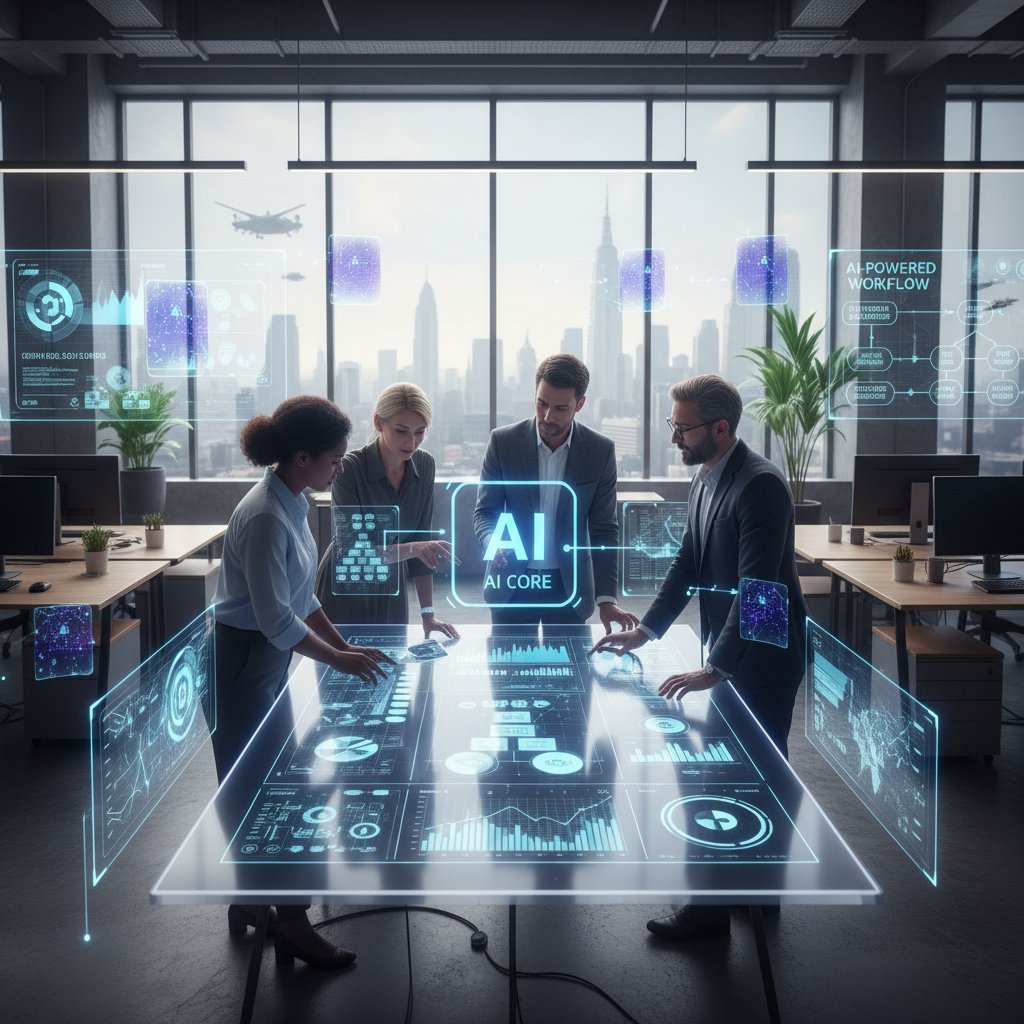
Platforms like futurecoworker.ai exemplify this new breed—offering email-based, non-technical gateways to AI-augmented teamwork. The real differentiator isn’t just the tech; it’s the way these tools embed themselves into the rhythms and rituals of real work.
Debunking the myths: What AI in workflow management can—and can’t—do
‘AI will steal your job’ and other lazy narratives
Let’s torch a lazy myth: AI isn’t coming for your job. It’s coming for your excuses. According to research from the World Economic Forum, most employees perceive AI workflow interventions less as existential threats and more as sources of disruption—especially when poorly implemented (WEF, 2025). The reality is nuanced: AI eliminates repetitive drudgery, but the hard, human stuff—judgment, creativity, empathy—remains in demand.
"AI doesn’t replace you. It replaces your excuses." — Raj, Transformation Lead (quote based on industry feedback)
Job roles are shifting, not vanishing. The winners aren’t those who fight the tide, but those who learn to ride it—leveraging AI to become more strategic, creative, and indispensable.
The real risks: Bias, privacy, and digital dependency
But let’s not sugarcoat things: AI-powered enterprise workflow management introduces fresh risks. Black-box algorithms can perpetuate bias. Over-automation breeds dependency and saps human judgment—a trend Microsoft labels “islands of intelligence” (Microsoft WorkLab, 2024). Data privacy concerns become existential in highly regulated fields.
| Risk Type | Likelihood | Business Impact | Mitigation Strategy |
|---|---|---|---|
| Algorithmic bias | Medium | High | Regular audits, diverse training data, human oversight |
| Data privacy | High | Severe | Strong governance, encryption, role-based access |
| Over-automation | Moderate | Moderate | Keep human-in-the-loop, clear escalation paths |
| Digital dependency | High | High | Training, backup processes, regular scenario testing |
Table 3: Risk matrix for AI-powered workflow management adoption in enterprise
Source: Original analysis based on Microsoft WorkLab, 2024, Deloitte, 2024
Transparency and oversight are no longer optional—they’re the only shield against reputational and operational blowback.
Field notes: Real-world stories of AI-powered workflow triumph—and tragedy
Case study: When AI saved the quarter (and when it almost sunk it)
Consider the experience of a global marketing agency that deployed AI-powered workflow to manage client campaigns. Within three months, project delivery speed soared by 40%, client satisfaction improved, and the agency outpaced competitors (Altman Solon, 2024). Yet, the honeymoon didn’t last. When the AI system misclassified a high-priority email thread, a critical deadline was nearly missed. Only rapid human intervention—and a crash course in retraining the model—kept the account.
In another scenario, a finance firm cut administrative workload by 30% with AI-driven email management, but struggled with staff resentment when the tool replaced beloved manual routines (Accenture, 2024). Success, it turns out, requires not just great tech but relentless attention to people and processes.

Voices from the trenches: What users really think
The real test of AI-powered workflow management isn’t the pilot; it’s the long slog through office reality. Many employees describe an initial sense of micromanagement—AI as the new “boss”—that evolves into reliance on invisible, behind-the-scenes problem solving.
"At first, it felt like micromanagement. Now, it’s my silent fixer." — Julia, Project Manager
Acceptance, in the end, comes not from the tool but from the new rituals and habits it creates. The adaptation curve is real, and the best organizations invest in change management as aggressively as in tech.
Beyond efficiency: The hidden benefits of AI-powered enterprise workflow
Unlocking creativity and collaboration with AI
The dirty secret of enterprise workflow? Efficiency is table stakes. The best AI-powered workflow management tools spark unexpected gains in creativity and collaboration. By handling routine decisions, AI frees bandwidth for strategic thinking and cross-team ideation.
Hidden benefits of AI-powered workflow management experts won’t tell you:
- Enables proactive issue detection and escalation—before a crisis hits.
- Surfaces cross-functional insights that siloed teams would miss.
- Democratizes access to data-driven decision-making.
- Reduces email overload, making room for real conversations.
- Builds psychological safety by catching routine errors quietly.
- Accelerates onboarding for new hires through knowledge capture.
- Fosters a sense of shared ownership over process improvement.
As organizations recalibrate their culture to embrace human-AI synergy, innovation often blooms in the oddest corners—where a bot’s nudge sparks a breakthrough, or where automated summaries cut through noise and reveal hidden opportunity.
Unconventional use cases you’ve never considered
Beyond classic productivity wins, AI-powered workflow management is seeping into unexpected domains. Enterprises are finding creative ways to leverage these tools for missions you won’t see in the standard sales deck.
5 unconventional ways enterprises are using AI-powered workflow management:
- Crisis simulation audits: Stress-testing business continuity by simulating email overloads and task failures, with AI monitoring recovery.
- Shadow board facilitation: Enabling diverse employee groups to propose process improvements, tracked and analyzed by AI.
- M&A integration planning: Orchestrating task alignment and communication during mergers, flagging cultural friction points via sentiment analysis.
- Silent escalation tracking: Automatically routing “problem” signals to trusted executives without public escalation.
- Regulatory compliance audits: AI proactively scans workflows for policy deviations and flags them before audits.
These fringe applications point to a larger truth: AI-powered workflow management is whatever your most creative managers dare it to be.
How to implement AI workflow management—without burning out your team
Step-by-step guide to a frictionless rollout
Deploying AI-powered enterprise workflow management isn’t plug-and-play; it’s a cultural and operational transformation. According to Deloitte, resistance and skill gaps are the top blockers (Deloitte, 2024). The path to success starts with people—then technology.
10-step guide to mastering AI-powered enterprise workflow management:
- Start with an honest audit: Map current workflow bottlenecks and pain points.
- Define clear success metrics: Know what “better” looks like—productivity, satisfaction, error rates.
- Secure leadership buy-in: Make the case with data, not hype.
- Engage cross-functional teams early: Avoid IT silos; bring frontline workers into design.
- Invest in AI literacy: Don’t skip training—ignorance breeds resistance.
- Pilot in high-impact, low-risk areas: Build momentum with quick wins before scaling.
- Emphasize change management: Appoint “AI champions” to support adoption.
- Iterate relentlessly: Monitor, learn, and adjust processes as you go.
- Prioritize data governance and security: Protect privacy from day one.
- Celebrate and communicate wins and lessons: Transparency builds trust.
Platforms like futurecoworker.ai are tailored to help non-technical teams bridge the AI gap, making collaboration smarter without the jargon or the disruption of complex new tools.
Checklist: Is your company really ready for an AI coworker?
Integrating AI-powered workflow management demands a brutal reckoning with company readiness. It’s not about budget—it’s about culture, clarity, and courage.

8-point self-assessment for enterprise AI workflow adoption:
- We have mapped and documented our core workflows.
- Leadership is committed to AI adoption beyond lip service.
- We actively invest in workforce AI literacy and upskilling.
- Data governance and cybersecurity are non-negotiable priorities.
- We have clear policies for transparency and accountability.
- Our teams understand and embrace change management.
- We reward experimentation and learn from near-misses.
- We view AI as a teammate, not a threat or a panacea.
If you check fewer than six, hit pause. You’re not ready—yet.
The future of enterprise workflow: Are you ready for your next digital teammate?
2025 and beyond: Where AI workflow management is heading
The present is already stranger than most predictions. In today’s cutting-edge offices, hybrid teams—half human, half digital—sit side by side, co-creating, collaborating, and even negotiating. AI isn’t just a process manager; it is increasingly an arbiter of decisions and a participant in strategy sessions.

As organizations wrestle with explainability and ethics, the leaders who win will be those who ask hard questions, demand transparency, and refuse to settle for black-box miracles. Explainability is no longer a luxury—it’s a license to operate in an AI-powered world.
Critical takeaways for enterprise leaders
Let’s cut through the noise. Here are the must-know lessons from the brutal truths of AI-powered enterprise workflow management:
Definition List:
- AI-powered workflow management: End-to-end orchestration of tasks, communications, and decisions using adaptive, learning-based algorithms. Real-world example: automated email triage that actually gets smarter with feedback.
- Digital coworker: An AI system embedded in core workflows, collaborating directly with human teams and assuming responsibility for routine or complex tasks.
- Change management: The strategic and operational discipline of helping people adapt to new technologies, workflows, and cultural expectations.
- Data governance: Policies and practices ensuring data quality, security, and ethical use, especially when AI is in the driver’s seat.
The bottom line? AI-powered workflow management is here to stay—but it’s not the easy button it’s sold as. It’s an amplifier of both your best and worst processes, a force multiplier for culture (good and bad), and a relentless mirror for organizational dysfunction. Leaders who adapt, invest in people, and demand real intelligence over empty marketing will find in AI the most valuable teammate they never knew they needed.
Ready to unmask the real power of AI-powered enterprise workflow management?
Discover how your organization can break through the noise at futurecoworker.ai. Because your next digital teammate isn’t waiting for an invitation—and neither are your competitors.
Sources
References cited in this article
- Accenture(newsroom.accenture.com)
- Deloitte(www2.deloitte.com)
- Menlo Ventures(menlovc.com)
- Altman Solon(altmansolon.com)
- WEF(weforum.org)
- Microsoft WorkLab(microsoft.com)
- McKinsey(mckinsey.com)
- Backlinko(backlinko.com)
- McKinsey(mckinsey.com)
- KPMG(mooncamp.com)
- Forbes(forbes.com)
- Quixy(quixy.com)
- Scoop Market(scoop.market.us)
- Flowlu(flowlu.com)
- MarkovML(markovml.com)
- MetaSource(metasource.com)
- IBM(ibm.com)
- Ayanza(ayanza.com)
- Appian(appian.com)
- Forbes(forbes.com)
- Statista(statista.com)
- IBM(ibm.com)
- Pew Research(pewresearch.org)
- Future of Privacy Forum(fpf.org)
- Google Cloud(cloud.google.com)
- User Interviews(userinterviews.com)
- Beautiful.ai(beautiful.ai)
- McKinsey(mckinsey.com)
- Kissflow(kissflow.com)
- Moveworks(moveworks.com)
- Olive Technologies(olive.app)
- AIPRM(aiprm.com)
- Microsoft(blogs.microsoft.com)
- LinkedIn(linkedin.com)
- Generative AI Enterprise(generativeaienterprise.ai)
- Scout(scoutos.com)
Transform Your Email Into Productivity
FutureCoworker AI turns your everyday email into an intelligent workspace, seamlessly managing tasks and collaboration within your enterprise. It eliminates the complexity of AI, allowing you to benefit from advanced technology without any technical knowledge. Achieve productivity, streamline processes, and improve team efficiency through natural email interaction, getting tasks done faster and smarter.
Get startedReady to Transform Your Email?
Start automating your tasks and boost productivity today
Frequently Asked Questions
What percentage of companies have achieved AI-led workflows in 2024?
According to recent Accenture research, only 16% of companies have achieved fully modernized, AI-led workflows in 2024, up from 9% in 2023.
How does modern AI workflow management differ from traditional robotic process automation (RPA)?
While traditional RPA follows rigid, rules-based scripts, modern AI tools claim to understand context, learn from patterns, and adapt to evolving processes.
What is the main problem executives report with digital transformation efforts?
Despite years of software upgrades and investments in digital transformation, many leaders report that their teams are more overwhelmed than empowered, with digital fatigue being rampant across organizations.
Have new AI and automation tools solved organizational chaos?
No; the article indicates that new tools have often just moved problems from one location to another (like spreadsheets) or created more fragmentation through endless notifications and workflow enhancements, with organizational entropy remaining a persistent challenge.
Continue Reading
Keep exploring Intelligent enterprise teammate

Enterprise AI-Enabled Workflow: Actual Adoption Rates and Real ROI
Enterprise AI-enabled workflow adoption remains low among companies. This article examines the actual costs, risks, and measurable returns of implementing AI in enterprise workflows.

Enterprise AI-Powered Workflow Automation: Payoff, Risks, Regrets
Enterprise AI-powered workflow automation transforms how large organizations work. This article examines the real payoffs, documented risks, and hidden costs of deploying AI agents in workflows.

AI-Driven Enterprise Productivity Tools That Help (not Replace) You
Discover insights about AI-driven enterprise productivity tools software

AI-Enabled Smart Enterprise Assistant Software: Hype Vs Reality
Discover insights about AI-enabled smart enterprise assistant software

Digital Workplace AI Solutions: Which Ones Deliver Results
Digital workplace AI solutions reshape how teams work. This article examines which implementations deliver real value and which create hidden costs and friction.

AI-Powered Enterprise Team Collaboration Tools: What Works in Practice
AI-powered enterprise team collaboration tools promise to simplify teamwork, but the reality is more complex. This article examines what actually works and what falls short.