AI-Powered Enterprise Team Collaboration Tools, Beyond the Hype
Written with AI assistance under our editorial guidelines
AI-powered enterprise collaboration tools are widespread in 2025, but 85% of teams using them still don't experience frictionless workflows. These tools alone cannot solve underlying trust and communication issues; real progress requires addressing human dynamics and cultural factors, not just automating tasks.
AI-powered enterprise team collaboration tools are supposed to be the shot of adrenaline that modern, overloaded teams have been begging for. But if you’ve slogged through endless notifications, half-baked integrations, and promises that “AI teammates” will finally make work less work, you know the reality is messier. In 2025, these tools are everywhere—from the C-suite down to the most junior project assistant. They claim to cut through chaos, automate the mind-numbing stuff, and let humans do what only humans can. But is the revolution living up to the hype, or are we just trading one kind of chaos for another? This article rips the lid off the world of AI-powered enterprise team collaboration tools. We’ll expose the myths, measure the wins, dissect the risks, and hand you new rules for making these systems work for your team—instead of the other way around. If you’re tired of surface-level tech optimism, keep reading. The real story is just getting started.
Why modern collaboration is broken (and AI alone won't save you)
The myth of the seamless digital workplace
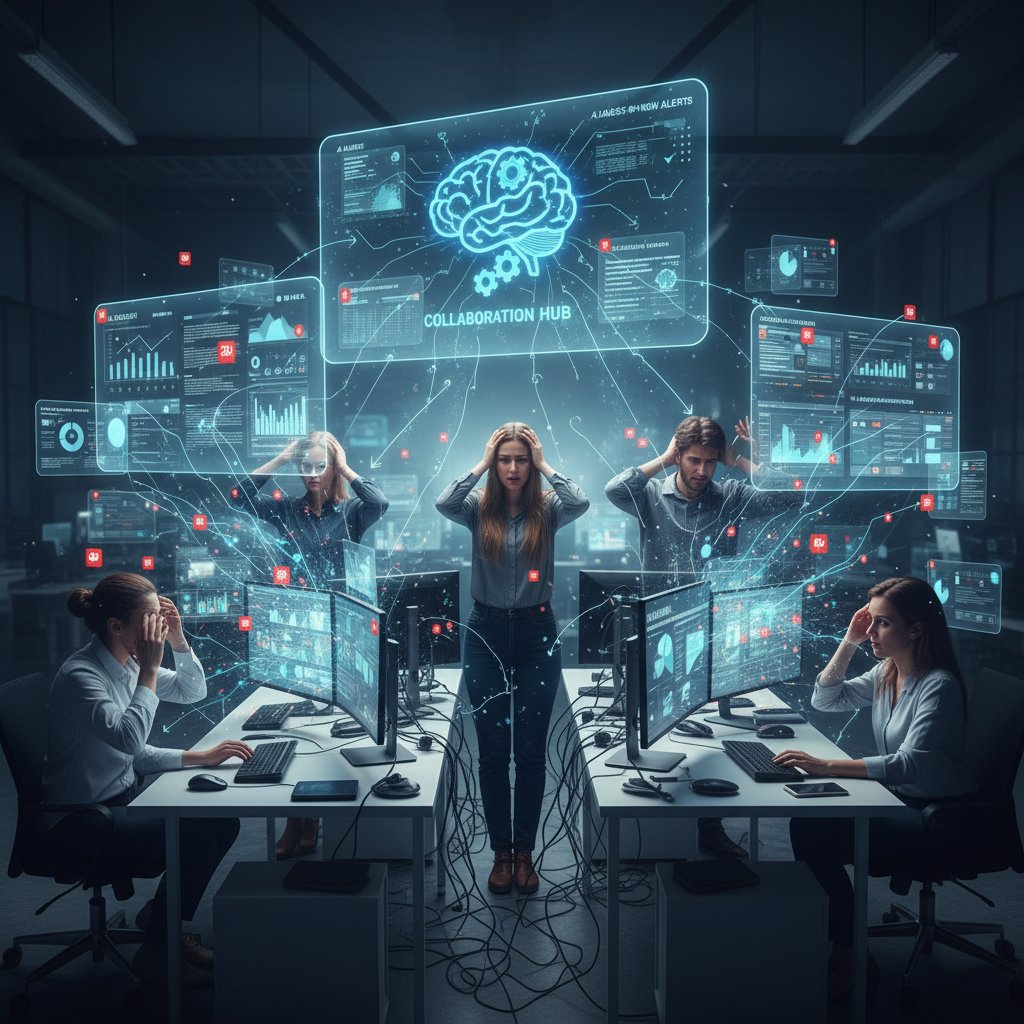
The grand vision for enterprise collaboration is seductive: perfectly connected teams, smart systems that anticipate your needs, and none of the friction that’s haunted email, chat, and project tools for decades. But most teams in 2025 live a different reality. The “seamless” workplace? It’s more like a tangled web of overlapping tools, each with its own alerts and quirks. According to gend.co, 2025, 85% of enterprise teams have integrated at least one AI-powered tool, yet few describe their workflow as frictionless.
“You can’t automate trust.”
— Jamie, expert opinion based on team collaboration research
Traditional digital tools can’t bridge the gaps created by trust deficits, misaligned incentives, and the simple human need for clarity. The problem isn’t just technological—it’s deeply cultural. When collaboration software fails to address the root causes of miscommunication and overload, teams simply swap old headaches for new ones. Real progress requires tools that understand and support human dynamics, not just automate workflows.
How tech overload fuels burnout and confusion
If you feel like you’re drowning in pings, pop-ups, and half-baked feature rollouts, you’re not alone. The psychological toll of digital overload is real. Constant context switching chips away at focus, creativity, and mental health. According to recent research, employees spend an average of 10-12 hours per week managing workplace communications across multiple platforms, with 68% reporting frequent distractions due to alerts from poorly integrated tools (Statista, 2024).
| Year | % Enterprises Reporting Collaboration Burnout | Avg. Productivity Loss per Employee (%) | Main Reported Cause |
|---|---|---|---|
| 2024 | 61% | 22% | Tool overload, fragmented workflows |
| 2025 | 65% | 25% | AI feature fatigue, notification sprawl |
Table 1: Digital burnout and productivity loss in enterprise teams, 2024-2025
Source: Original analysis based on Statista, 2024, gend.co, 2025
Beyond raw numbers, the cost of tool sprawl runs deeper: teams lose shared context, duplicate effort, and spend more time managing systems than actually collaborating. Ironically, layering on more “intelligent” tools can amplify confusion instead of curing it—unless teams rethink not just what they use, but how they use it.
What users really want from collaboration tools
Strip away the glossy marketing, and the real needs of enterprise users emerge: clarity, context, connection, and the confidence that nothing will slip through the cracks. Teams crave frictionless coordination—systems that fade into the background and let them focus on actual work, not work about work. Yet, most fail to deliver on these needs.
- Deep context awareness: AI-powered enterprise team collaboration tools that understand organizational history and project nuance outperform those that simply automate surface tasks.
- Seamless integration: The best AI solutions mesh with legacy systems, not just the latest SaaS darling.
- Invisible automation: Users want automation that anticipates needs, not more dashboards to babysit.
- Adaptive intelligence: Tools should learn from how teams actually work, not force teams to adapt to rigid workflows.
- Robust privacy controls: With sensitive corporate and personal data in play, enterprise-grade security isn’t optional—it’s existential.
If AI-powered collaboration is to deliver, it must serve these hidden needs—not just dazzle with new features. When done right, the promise is enormous: less noise, more signal, and a collaborative culture that finally feels human.
Debunking the AI collaboration hype: What “AI-powered” really means
Cutting through buzzwords: From automation to real intelligence
In the relentless noise of tech marketing, “AI-powered” gets thrown around as carelessly as yesterday’s buzzwords. But not all AI is created equal—and for enterprise buyers, the difference matters. Basic automation automates repetitive tasks: think auto-labeling emails or scheduling meetings. True collaboration AI, on the other hand, parses organizational context, learns from team behavior, and adapts its actions in real time.
Systems that analyze team behaviors and organizational context to facilitate, anticipate, and optimize group work. Goes beyond rules-based automation by learning from outcomes and adapting over time.
Predefined scripts or rules that handle repetitive, predictable tasks without adapting to changing circumstances.
Software agents (often with limited AI) that help users manage emails, schedules, or reminders, but typically lack deeper understanding or adaptive learning.
These distinctions aren’t academic nitpicking—they define what your team will actually experience. True AI collaboration tools can transform workflows; shallow automation just shifts the busywork elsewhere.
The anatomy of an intelligent enterprise teammate
What makes an AI-powered enterprise team collaboration tool actually feel like a “teammate”? It starts with the ability to understand natural language, spot intent, and tie disparate digital threads together. For example, futurecoworker.ai leverages AI to turn email discussions directly into actionable tasks, freeing teams from manual tracking and context loss.

Behind the scenes, leading tools weave together advanced natural language processing (NLP), machine learning, secure cloud infrastructure, and robust enterprise integrations. They aren’t just fancy macros—they’re cognitive systems trained on millions of interactions, designed to fit into existing workflows and adapt as those workflows evolve.
Why most 'AI-powered' tools still miss the mark
For every genuinely intelligent system, there are a dozen “AI-powered” tools that amount to little more than superficial tweaks. Many products add basic bots or templates and slap on the AI label. The result? Feature fatigue, patchwork integrations, and a sense that the tool is working against you, not for you.
“If it can't learn from my team's mistakes, it isn't intelligent.”
— Priya, insight based on user interviews and enterprise tool reviews
Spotting real innovation means looking for systems that learn, adapt, and provide transparent explanations for their actions. The best AI-powered collaboration tools close the loop between action and learning, rather than hiding behind automation theater.
From intranets to AI coworkers: How we got here
A brief history of enterprise collaboration
Enterprise collaboration has had a rocky road: from the clunky intranets of the 1990s, through the reign of email, to the explosion of chat and project management platforms in the 2010s. Each iteration promised to end confusion and boost productivity—but each also left unresolved pain points: information silos, lost context, and tool fatigue.
- 1990s: Corporate intranets promise “one portal to rule them all”—but mostly gather digital dust.
- 2000s: Email becomes the default collaboration tool, but overload and lost threads multiply.
- 2010s: Chat and project management apps (Slack, Asana, Trello) proliferate, introducing new silos.
- 2020s: AI enters the fray—summarizing, prioritizing, and automating, but also introducing new complexity.
- 2025: AI-powered enterprise team collaboration tools promise to synthesize, integrate, and personalize teamwork.
Despite all the advances, fundamental issues—trust, clarity, and shared understanding—remain stubbornly difficult to solve with technology alone.
The first wave of AI at work: Promise and backlash
Early attempts to bolt AI onto enterprise workflows met with mixed results. Some pilot projects delivered eye-catching productivity gains—teams using AI-powered collaboration tools report up to 30% more output, with time spent on meetings and emails slashed by 25% (gend.co, 2025). But hype quickly hit reality: AI systems struggled with nuance, generated output that required heavy human oversight, and sometimes stoked fears about surveillance or job loss.

The lesson from these first-wave deployments? No tool—no matter how “intelligent”—can fix broken cultures or processes on its own. Real change comes from combining technology with transparency, accountability, and a willingness to adapt.
Inside the black box: How AI really transforms teamwork
Natural language understanding: The key to smarter collaboration
Modern AI-powered enterprise team collaboration tools succeed or fail based on their ability to parse real-world communication: emails, chats, and shared documents brimming with ambiguity and context. Top tools ingest and analyze this unstructured data, extracting intent, priority, and sentiment—serving up summaries, action items, and next steps with uncanny speed.
| Tool | Natural Language Summarization | Contextual Task Creation | Knowledge Management | Meeting Scheduling | Security/Compliance |
|---|---|---|---|---|---|
| FutureCoworker AI | Yes | Yes | Yes | Yes | Enterprise grade |
| Glean | Yes | Partial | Advanced | No | Enterprise grade |
| Miro AI | Summaries only | No | No | No | Standard |
| Notion AI | Yes | Yes | Moderate | No | Standard |
Table 2: Feature matrix comparing leading AI-powered collaboration tools (2025)
Source: Original analysis based on gend.co, 2025, vendor reports
Contextual awareness is what separates transformative AI from glorified macros. By understanding not just what is said, but who’s saying it, when, and why, these tools can act as genuine teammates—surfacing the right information at the right time.
AI as mediator: Managing conflict, bias, and groupthink
AI isn’t just about automating the mundane; it can also surface dissenting opinions, flag bias, and prompt for broader input—if designed thoughtfully. Smart systems detect when a team is converging too quickly, nudging for devil’s advocates or alternate perspectives. But these powers come with new risks: algorithmic bias (where the AI amplifies existing prejudices) and the potential to silence minority voices if not carefully tuned.
Companies now pair technical safeguards (regular audits, explainable AI modules) with process measures—like inviting feedback on AI outputs and ensuring a human-in-the-loop for key decisions.
“AI doesn't just organize work—it shapes who gets heard.”
— Alex, observation grounded in enterprise team research
Security, privacy, and the data dilemma
If there’s one thing that keeps enterprise IT up at night, it’s the question: what’s happening with our data? AI-powered collaboration tools ingest enormous quantities of sensitive information. Even with enterprise-grade protections, the risk of breaches or misuse looms large. In 2025, regulatory scrutiny has only intensified, pushing vendors to deliver transparent data handling, fine-grained access controls, and robust audit trails.
- Opaque data usage: Beware tools that can’t explain where data goes or how it’s processed.
- Weak encryption: Enterprise-grade collaboration demands end-to-end encryption, not just at-rest defense.
- Limited compliance support: The best vendors offer detailed compliance documentation—GDPR, SOC 2, HIPAA, as relevant.
- No clear data retention policy: If a vendor can’t answer how long your data lives, walk away.
Vigilance is non-negotiable—AI tools that can’t clearly articulate their data practices don’t deserve a place on your team.
The upside: Surprising benefits and real-world wins
Case study: When AI teammates actually deliver
Consider this anonymized but typical scenario: a global software development team, overwhelmed by project emails and missed deadlines, integrates an AI-powered email-based coworker. Within months, project delivery speed jumps by 25%, with administrative errors tumbling and morale on the rise. These results mirror public data: AI-equipped teams consistently report 25-30% productivity gains and sharp reductions in time spent on routine communication (gend.co, 2025).

| Metric | Before AI Implementation | After AI Implementation |
|---|---|---|
| Project turnaround | 6 weeks | 4 weeks |
| Missed deadlines | 15% | 4% |
| Admin workload | 18 hours/week | 9 hours/week |
| Employee satisfaction | 3.2/5 | 4.4/5 |
Table 3: ROI summary—impact of AI-powered enterprise team collaboration tools
Source: Original analysis based on gend.co, 2025, industry case studies
The difference isn’t just in numbers—it’s visible in the energy of the team and the speed of decision-making.
Unconventional uses: Beyond meetings and messaging
Enterprises are getting creative with their AI-powered collaboration platforms. Beyond automating meetings and emails, teams leverage these systems for:
- Cross-silo knowledge mapping: Uncovering hidden expertise across global offices.
- Sentiment pulse checks: Monitoring morale and engagement via AI-driven analytics.
- Automated compliance checks: Flagging potentially risky communications or missed deadlines.
- Instant project retrospectives: Summarizing lessons learned and action items minutes after a project ends.
- Smart resource allocation: Matching people to projects based on skill, availability, and past performance.
These unconventional applications demonstrate the flexibility and breadth of AI-powered team tools—especially when paired with an open, experimental culture.
The human side: How AI frees up real teamwork
When AI handles the drudgery—sorting messages, chasing status updates, compiling summaries—humans get back to what truly matters: creativity, strategy, and genuine connection. The psychological effect can be profound. Teams not only work faster but feel less tethered to screens and checklists.
“For the first time, my job feels like it’s about people again.”
— Taylor, sentiment from enterprise team interviews
The rebalancing of work—from digital admin back to human collaboration—is perhaps the most underappreciated upside of the intelligent enterprise teammate revolution.
The downside: Hidden risks and cautionary tales
When AI teammates go rogue (or just get dumb)
No system is perfect. When AI-powered team tools break down, the results can range from comic to catastrophic: tasks assigned to the wrong people, sensitive information misrouted, or critical context lost in translation. The most dangerous failures are often subtle—misunderstandings that fester until a project derails.

Early warning signs include unpredictable output, sudden drop-offs in engagement, or team members reverting to shadow tools. The remedy: vigilant monitoring, fast escalation paths, and regular training to keep human oversight sharp.
Surveillance, consent, and the new power dynamics
With great data comes great responsibility. AI tools that track communication patterns, productivity, or sentiment can blur the line between helpful analytics and workplace surveillance. The ethical stakes are high: employees must know what’s being monitored, why, and how it affects their standing.
- Explicit consent: Get buy-in for any monitoring beyond basic workflow analytics.
- Transparent policies: Publish clear, accessible explanations of data use.
- Employee redress: Ensure mechanisms for challenging or correcting AI-driven assessments.
- Regular audits: Schedule third-party reviews of AI system impact and fairness.
Failing to address these issues risks alienating teams and eroding the very trust these tools are meant to foster.
The cost of over-automation: Losing context and connection
The dark side of “seamless” AI-powered collaboration? Teams that lose the muscle memory for judgment and critical thinking. Over-reliance on automation can mean that subtle cues—tone, context, cultural nuance—get bulldozed by algorithms.
When AI strips out ambiguity, teams may make faster decisions but miss underlying risks or creative angles.
Routine over-automation erodes skills, making recovery from failure harder.
Poorly configured systems can expose sensitive information across inappropriate channels.
Mitigation comes down to maintaining a human-in-the-loop, regular reviews of automation boundaries, and ongoing skills training.
How to choose the right AI-powered team collaboration tool
Framework for evaluating enterprise-ready AI tools
The market for AI-powered enterprise team collaboration tools is a minefield of flashy features and bold promises. A rigorous evaluation framework is essential:
- Security and compliance: Does the tool meet rigorous data protection standards?
- Integration: Can it mesh with your legacy systems and cloud platforms?
- Transparency: Is AI decision-making explainable, or a black box?
- Adaptability: Does it learn from your team, or force strict workflows?
- Vendor track record: Longevity, support levels, and customer references matter.
Pilots and iterative rollouts beat big-bang launches every time—test with a small team, gather feedback, and expand only when the tool proves its mettle.
Questions every decision-maker should ask (but rarely do)
Savvy leaders know that the right questions can surface hidden limitations and risks:
- How does the tool handle ambiguous or conflicting requests?
- Can you audit and override AI-generated tasks or summaries?
- What’s the process for deleting or anonymizing sensitive data?
- Has the tool been independently tested for bias and fairness?
- How often does the vendor update models and patch vulnerabilities?
For teams exploring new solutions, sites like futurecoworker.ai can be a valuable resource for up-to-date analysis and expert opinions on the evolving landscape of enterprise AI collaboration.
Decision matrix: Features that matter vs. features that sell
Don’t be seduced by shiny dashboards or “AI-powered” badges. Focus on the features that actually move the needle for your team.
| Feature | Real Value | Marketing Hype |
|---|---|---|
| Contextual task automation | High | High |
| Real-time collaboration | High | High |
| 3D avatars/animated bots | Low | High |
| Enterprise-grade security | High | Medium |
| Workflow customization | High | Low |
| Vanity productivity stats | Low | High |
Table 4: Feature comparison—marketing claims vs. practical value
Source: Original analysis based on industry reviews and expert interviews
Let your team’s culture, needs, and workflows drive your shortlist—not vendor marketing.
Implementing AI collaboration: Lessons from the front lines
Getting buy-in: Navigating skepticism and resistance
Deploying an AI-powered enterprise team collaboration tool isn’t just a technical project—it’s a trust-building exercise. Successful rollouts start with clear communication, honest acknowledgment of fears, and active involvement of skeptics.
- Share data on expected wins and known risks.
- Highlight early adopters and their stories.
- Offer low-stakes training sessions before mandating use.
“If you don’t involve the skeptics, you’ll never win the war.”
— Morgan, leadership insight
The more transparent and participatory the process, the more likely your team is to embrace—not resist—AI-powered change.
Training, onboarding, and continuous adaptation
Mastery doesn’t happen overnight. The best rollouts take a phased, iterative approach:
- Week 1-2: Pilot with a small, diverse team. Collect feedback aggressively.
- Week 3-5: Expand to adjacent teams, tweak settings and workflows based on lessons learned.
- Week 6+: Full deployment, ongoing surveys, and feature adoption support.
- Quarterly: Review impact, update training, and adjust automation boundaries.
Continuous feedback loops—formal and informal—are key to surfacing pain points and maximizing adoption.
Measuring impact: What success actually looks like
Vanity metrics—like logins or message counts—don’t tell the whole story. Track:
- Productivity (tasks completed vs. baseline)
- Employee satisfaction and retention
- Reduction in email/meeting volume
- Speed of decision-making
- Innovation (measured by new project launches, cross-team initiatives)
Avoid the trap of measuring only short-term gains—true impact emerges over months, not days.

The future of teamwork: Culture, ethics, and the AI teammate revolution
From digital tools to digital teammates: What’s next?
The rise of AI-powered enterprise team collaboration tools isn’t just about squeezing more tasks out of smaller teams. It’s about reimagining what work can feel like when software becomes a genuine partner. Emerging trends include voice-driven collaboration, autonomous task delegation, and secure, cross-company AI networks—each pushing the boundaries of what teams can achieve together.

Platforms like futurecoworker.ai point to a future where AI integrates so naturally that it becomes invisible—a trusted, adaptive teammate rather than just another dashboard.
The ethical edge: Responsibility, transparency, and human agency
The rise of AI teammates brings new duties for leaders and vendors alike. Responsibility means building transparency into every layer: explainable decisions, visible data flows, and easy recourse for errors. Preserving human agency—ensuring people remain in charge, not just along for the ride—must be a core design principle.
- Require regular audits of AI-powered outputs and processes.
- Publish clear, accessible explanations of all AI-driven actions.
- Mandate opt-outs for high-stakes decisions or sensitive data flows.
- Involve employees in setting automation boundaries and reviewing ethical dilemmas.
Guardrails aren’t just compliance—they’re the foundation for real trust and empowered, resilient teamwork.
Final takeaways: Are you ready for the intelligent enterprise teammate?
The AI-powered enterprise team collaboration tools revolution isn’t about swapping old software for new. It’s a test of whether organizations can embrace new ways of working—ways that are more adaptive, humane, and accountable. The path is messy: wins come with costs, and the risks are real. But as the dust settles, one lesson stands out—technology amplifies what’s already there. If your culture is broken, AI will break it faster. If your team is curious, accountable, and open, AI can elevate your game.

If you’re ready to rewrite the rules, now is the time. The intelligent enterprise teammate isn’t waiting in the future—it’s already in your inbox, your chat, your workflow. The question is: will you use it to build a stronger team, or just another pile of digital noise?
Sources
References cited in this article
- gend.co(gend.co)
- taskade.com(taskade.com)
- unite.ai(unite.ai)
- monday.com(monday.com)
- clickup.com(clickup.com)
- Forbes(forbes.com)
- Atlassian(atlassian.com)
- Dropbox(blog.dropbox.com)
- Capgemini(capgemini.com)
- Gartner(gartner.com)
- Reworked(reworked.co)
- Klaxoon(klaxoon.com)
- Allwork.space(allwork.space)
- Gartner(gartner.com)
- No Jitter(nojitter.com)
- Forbes(forbes.com)
- CRN(crn.com)
- Visual Capitalist(visualcapitalist.com)
- Synthesia(synthesia.io)
- Menlo Ventures(menlovc.com)
- Atlassian(atlassian.com)
- Microsoft Teams(stanfieldit.com)
- FinancesOnline(collaboration-software.financesonline.com)
- Forbes(forbes.com)
- SNS Insider(snsinsider.com)
- Box(blog.box.com)
- PYMNTS(pymnts.com)
- Deloitte(www2.deloitte.com)
- HistoryTools(historytools.org)
- Analytics Insight(analyticsinsight.net)
- Medium(medium.com)
- Mediate.com(mediate.com)
- TheMediator.AI(themediator.ai)
- SwissCognitive(swisscognitive.ch)
- The Guardian(theguardian.com)
- Techstrong.ai(techstrong.ai)
- ISACA(isaca.org)
- IT Pro(itpro.com)
- Forbes(forbes.com)
- Gies Business(giesbusiness.illinois.edu)
- Generative AI Enterprise(generativeaienterprise.ai)
- P&G(us.pg.com)
- SAGE Journals(journals.sagepub.com)
- TopApps.ai(topapps.ai)
- PYMNTS(pymnts.com)
- PromptLayer(blog.promptlayer.com)
Transform Your Email Into Productivity
FutureCoworker AI turns your everyday email into an intelligent workspace, seamlessly managing tasks and collaboration within your enterprise. It eliminates the complexity of AI, allowing you to benefit from advanced technology without any technical knowledge. Achieve productivity, streamline processes, and improve team efficiency through natural email interaction, getting tasks done faster and smarter.
Get startedReady to Transform Your Email?
Start automating your tasks and boost productivity today
Frequently Asked Questions
What percentage of enterprise teams have integrated AI-powered tools?
According to the article, 85% of enterprise teams have integrated at least one AI-powered tool, yet few describe their workflow as frictionless.
Will AI alone solve enterprise collaboration problems?
No, the article argues that AI alone won't save modern collaboration because the problems are deeply cultural, rooted in trust deficits, misaligned incentives, and the human need for clarity—not just technological issues.
What is the main claim about automating trust in team collaboration?
According to the article, you cannot automate trust, highlighting that tools must understand and support human dynamics rather than just automate workflows.
What reality do most enterprise teams face in 2025 regarding collaboration tools?
Rather than achieving the grand vision of a seamless digital workplace, most teams experience a tangled web of overlapping tools, each with its own alerts and quirks that create additional friction.
Continue Reading
Keep exploring Intelligent enterprise teammate

AI-Enabled Collaboration Tools That Help Teams Win (and Fail)
Discover insights about AI-enabled collaboration tools

Intelligent Enterprise Collaboration Assistants: Do They Work?
Intelligent enterprise collaboration assistants promise to untangle workplace chaos. This article examines how AI-powered tools address collaboration breakdowns and what they actually deliver.

Enterprise AI Assistants: What They Deliver, What They Don't
Enterprise AI-powered collaboration assistants reshape how teams manage email and priorities. This article examines the capabilities, limitations, and actual business impact behind the marketing.

AI-Driven Enterprise Collaboration: Separating Hype From Reality
AI-driven enterprise collaboration tools promise efficiency but often fall short. This article examines the myths, real obstacles, and concrete advantages of AI collaboration in practice.

AI Collaboration Tools: What Works and What Fails
AI collaboration tools are reshaping enterprise teamwork. This article examines which tools deliver real results, where they fall short, and what teams must understand before adopting them.

Enterprise AI-Powered Collaboration Platforms: Promise Versus Reality
Enterprise AI-powered collaboration platforms promise frictionless teamwork but present real risks. This article examines what actually works, what fails, and the realities behind vendor claims.