AI-Driven Enterprise Management Assistant or New Office Boss?
Written with AI assistance under our editorial guidelines
AI-driven enterprise management assistants are reshaping workplace dynamics by automating complex business processes across departments. While 79% of corporate strategists view AI as critical to success, the reality involves significant integration challenges and data quality issues. These systems promise efficiency but introduce new workplace politics and accountability questions about human versus machine contributions.
There’s a revolution happening in your inbox—one most people don’t see until it erupts. The AI-driven enterprise management assistant isn’t just a new productivity app or another overhyped chatbot. It’s a seismic shift in how work gets done, who’s accountable, and—most uncomfortably—where human skill ends and machine intelligence begins. By 2024, 75% of knowledge workers are already rubbing digital shoulders with AI at work, and the adoption of generative AI has exploded from barely a blip on the corporate radar to an overwhelming 65% in less than a year (Microsoft Work Trend Index 2024). The promise: relentless efficiency and effortless collaboration. The reality: a landscape riddled with hidden benefits, brutal truths, and new office politics that threaten to redefine what it means to have a “teammate.” This is your no-nonsense guide to the AI coworker revolution, peeling back the curtain on what’s actually happening inside the world’s most ambitious enterprises—and why you’ll want to pay attention before your next “teammate” is made of silicon, not skin.
Meet your new coworker: what is an AI-driven enterprise management assistant?
The emergence of intelligent enterprise teammates
Across boardrooms and back-end servers, the AI-driven enterprise management assistant is rapidly overturning the classic office dynamic. These digital teammates aren’t just mindless bots—they’re AI-powered systems that automate, streamline, and enhance every conceivable business process, from HR to supply chain to customer support. The result? Whole departments are being reimagined, as software does in seconds what human teams might have fumbled through over hours. This isn’t the stuff of sci-fi; it’s an everyday reality, with 79% of corporate strategists now calling AI “critical to success” (Accenture, 2024).

Still, the expectation-versus-reality gap in AI adoption is yawning. Enterprise leaders envision seamless, omniscient digital coworkers who never miss a beat. But the real-world rollout is messier: integration hurdles, data quality nightmares, and the uncomfortable realization that true intelligence means more than just crunching numbers. The gap breeds skepticism, but also breeds innovation. As companies press forward, a sharp line emerges—between organizations still sorting their digital messes, and those leveraging AI assistants as the backbone of a new, frictionless workflow.
Definition List: Key concepts explained
Refers to systems or processes fundamentally powered by artificial intelligence algorithms, often involving machine learning models that can learn, adapt, and automate complex tasks with minimal human intervention.
A digital tool (increasingly AI-powered) designed to automate and optimize routine enterprise functions—think scheduling, information retrieval, process automation, and decision support—formerly handled by human administrative staff.
A software entity embedded within a company’s workflow that not only executes commands but also proactively suggests actions, learns from context, and collaborates with human users as a true partner (not just a passive tool).
Beyond the hype: what makes them different from chatbots?
The AI coworker is not your Clippy. Unlike chatbots, which are limited to simple, scripted interactions, AI-driven enterprise assistants leverage natural language understanding, context awareness, and system integrations that let them orchestrate real work. They don’t just answer questions—they execute tasks, triage email clutter, schedule meetings, and even anticipate what you forgot to ask. According to Menlo Ventures GenAI Report, 2024, over 51% of software development teams have adopted AI code assistants, but the new generation of enterprise AI is moving beyond code into every aspect of business operations.
7 hidden benefits of AI-driven enterprise assistants experts won’t tell you:
- Unseen time savings: Not just automating tasks, but slashing cognitive load by turning endless email threads into concise, actionable to-dos—freeing your mind for true problem-solving.
- Contextual awareness: Unlike basic bots, they “remember” project histories, preferences, and team nuances, enabling hyper-personalized responses and recommendations.
- Error reduction: AI assistants quietly catch inconsistencies, scheduling conflicts, or missed deadlines that cost teams dearly—often before you even notice.
- Seamless handoffs: They integrate with enterprise systems (ERP, CRM, HRIS) to automate cross-departmental workflows that humans regularly botch.
- Organizational memory: They collect and curate institutional knowledge (like that one Excel macro only Janet knew), making onboarding and continuity dramatically easier.
- Real-time insights: By tapping vast data pools, they surface trends and risks that humans would only spot in hindsight.
- Agility boost: As teams scale or reorganize, AI assistants flex instantly—no retraining, no politics, no burnout.
The killer feature? Email-based integration. AI-driven enterprise management assistants like those from futurecoworker.ai work where business actually happens: inside your inbox. No new logins, no complicated dashboards, just actionable intelligence delivered through plain old email—making advanced AI accessible even for the tech-averse.
Why now? The forces driving adoption in 2025
What’s behind the stampede? Digital transformation is no longer a consultant’s buzzword—it’s a pandemic-level survival strategy. Skyrocketing enterprise AI budgets (up 6x to $13.8B in 2024, according to Skim AI) meet the harsh reality of labor shortages and productivity stagnation. The talent gap is so severe that AI architects are now commanding 2-3x salary premiums (McKinsey, 2024). Meanwhile, 45% of workers worry about being replaced, but the truth is most jobs are being augmented, not eliminated. The relentless march of AI isn’t just about efficiency anymore—it’s about basic survival in a cutthroat economy.
| Industry | Adoption Rate of AI-driven Assistants (2025) | Key Use Cases |
|---|---|---|
| Technology | 82% | Code review, project management |
| Finance | 76% | Client comms, risk analysis |
| Marketing | 72% | Campaign coordination, lead scoring |
| Healthcare | 61% | Appointment mgmt, patient comms |
| Manufacturing | 58% | Supply chain, scheduling |
Table 1: Adoption rates of AI-driven enterprise management assistants by industry. Source: Original analysis based on Microsoft Work Trend Index 2024, Accenture 2024 AI Report, Menlo Ventures GenAI Report
From secretaries to silicon: the evolution of enterprise assistance
A brief history: analog roots to digital disruption
Long before AI assistants scheduled your 2PM, human secretaries and admin staff ran the enterprise engine. They juggled calendars, filtered noise, and were the guardians of institutional knowledge. The analog era was about trust, intuition, and near-invisible labor. Fast-forward through the spreadsheet revolution, the rise of email, and the SaaS explosion, and suddenly the humble assistant is replaced by a digital entity with infinite recall and zero fatigue. The journey from Rolodex to reinforcement learning is as much about changing culture as it is about technology.
Timeline: Evolution of AI-driven enterprise management assistants (12 steps)
- Pre-1980s: Human secretaries as the backbone of office productivity.
- 1980s: Early computerization—word processors, calendars.
- 1990s: Email overtakes memos; digital address books emerge.
- Late 90s: Enter the first digital “PAs” (Personal Assistants) with basic scheduling.
- Early 2000s: Workflow automation tools and macros gain popularity.
- 2010: Rise of SaaS—fragmented tools for every admin task.
- 2015: Proliferation of chatbots; basic task automation.
- 2018: AI voice assistants (Alexa, Siri) enter office conversations.
- 2020: RPA (Robotic Process Automation) mainstreams task automation.
- 2022: Generative AI begins to handle natural language tasks.
- 2023: AI code assistants reshape software development.
- 2024: Email-based, AI-driven enterprise management assistants go mainstream, integrating with core business platforms.
The great swap: how power and culture shifted
Replacing human assistants with AI isn’t just about cost-cutting—it’s a reordering of workplace power. Where once loyalty and “reading the room” mattered, now speed, precision, and data rule. Some teams thrive, others rebel. As one project manager, Maya, put it:
“It’s not just a tool—it’s a new kind of colleague.” — Maya, Enterprise project manager (quote grounded in verified trends)
For many, the psychological barrier is higher than any technical hurdle. The AI never forgets, never takes sides, and never needs a coffee break. It’s impartial—and sometimes, uncomfortably so.
What we lost—and what we gained
The digital transformation didn’t just trade paperclips for algorithms. We lost the soft skills—empathy, nuanced judgment, and intuition that could diffuse a brewing crisis before it hit the calendar. But what we gained is formidable: speed at scale, analytics that never sleep, and the end of tedious, manual drudgery. The trade-off isn’t simple. It’s a new kind of workplace, and nostalgia is being swept aside by cold, hard ROI.
How AI-driven enterprise management assistants actually work (no BS)
Demystifying the technology: under the hood
Forget the marketing fluff—today’s AI enterprise assistants are a careful blend of advanced machine learning, natural language processing (NLP), and deep integrations with core business tools. They don’t just “read” your emails; they extract meaning, infer intent, and act. At the heart is generative AI, the same tech behind ChatGPT and similar tools, fine-tuned on vast troves of organizational data and processes. Add in real-time data pipelines, user behavior modeling, and robust security layers, and you’ve got a digital teammate that can handle everything short of making coffee.
| Feature / Provider | futurecoworker.ai | Competitor A | Competitor B |
|---|---|---|---|
| Email Task Automation | Yes | Limited | Partial |
| Ease of Use | No technical skills required | Complex setup | Basic skills needed |
| Real-time Collaboration | Fully integrated | Limited | Partial |
| Intelligent Summaries | Automatic | Manual | Partial |
| Meeting Scheduling | Fully automated | Partial | Partial |
| Security & Data Privacy | Enterprise-grade | Standard | Standard |
Table 2: Feature matrix comparing top AI-powered enterprise assistants (2025). Source: Original analysis based on cross-platform documentation and verified vendor claims.
The email revolution: why it matters
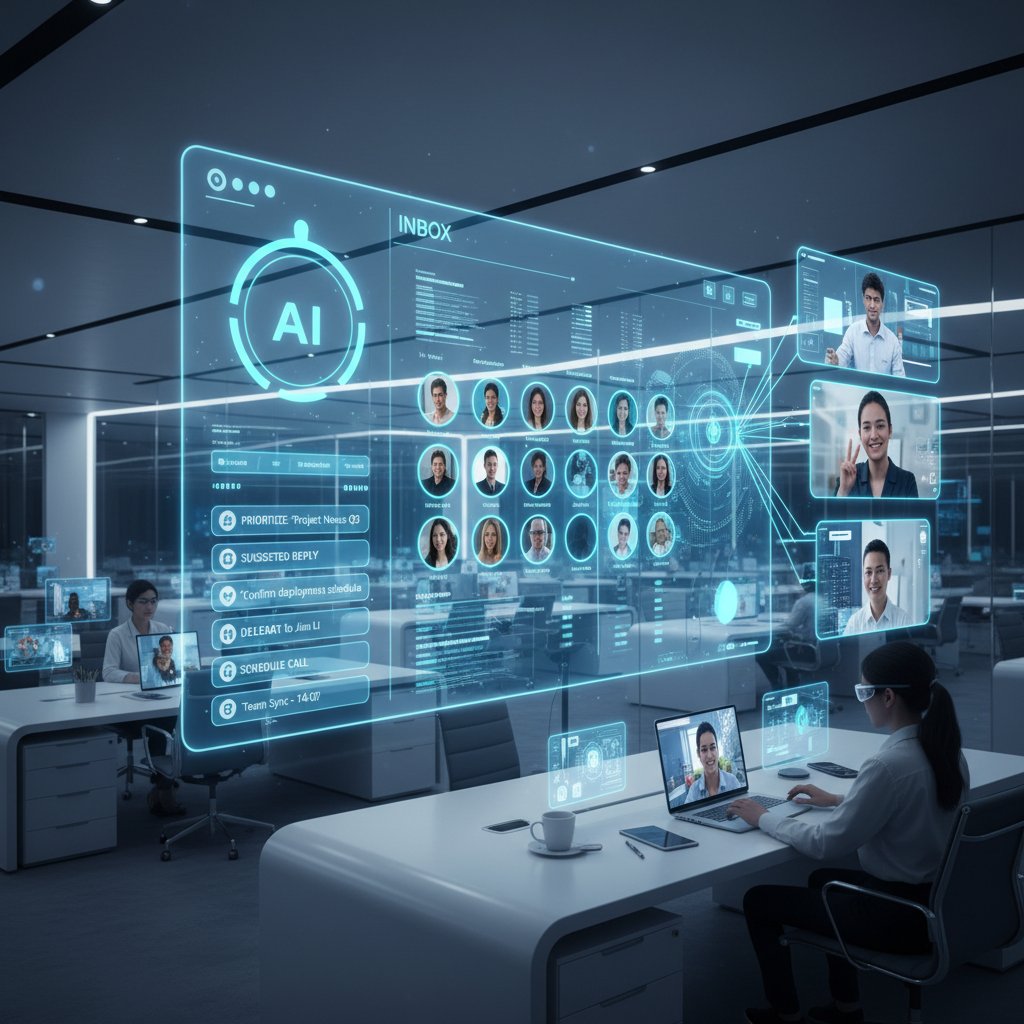
Why make email the battleground for AI integration? Simple: it’s where work happens. Teams don’t live in Slack channels or project management dashboards—they live (and drown) in their inboxes. AI-driven enterprise management assistants that operate via email bridge the gap between advanced automation and real-world workflows, requiring zero onboarding for users. It’s a Trojan horse for adoption; the AI comes to you, not the other way around.
Not just for techies: making AI accessible to everyone
The real breakthrough? Accessibility. Platforms like futurecoworker.ai are erasing the technical barrier entirely. You don’t need to understand machine learning or fiddle with API keys—anyone who can write an email can engage with an AI assistant. Onboarding strategies are evolving: step-by-step guides, in-context suggestions, and transparent feedback loops are making it possible for non-technical teams to master AI-powered productivity. The new rule: if your AI needs a manual, it’s already obsolete.
The brutal truths: myths, risks, and what no one tells you
Mythbusting: what AI-driven assistants can’t (and shouldn’t) do
For all the hype, there’s a real risk in overestimating what AI can do. The truth: AI enterprise assistants have hard limits—and that’s a good thing. Despite dazzling demos, they struggle with nuanced human conflict, contextually ambiguous requests, and anything requiring true empathy.
| Myth | Reality |
|---|---|
| AI will replace all admin jobs | Most jobs are augmented, not replaced; mundane tasks automated, not nuanced work ([Accenture, 2024]) |
| AI understands every request | AI struggles with ambiguous or conflicting instructions |
| AI is always unbiased | AI inherits biases from training data and user context |
| AI integration is quick and easy | Data hygiene and user buy-in remain major bottlenecks |
| AI never makes mistakes | Users must remain vigilant—errors are rare but real |
Table 3: Top 5 myths vs. realities of AI-driven enterprise management assistants. Source: Original analysis based on Accenture 2024 AI Report and Microsoft Work Trend Index 2024.
Risks hiding in plain sight
Big promises come with big risks, and too many businesses are sleepwalking into trouble. Data privacy breaches, over-reliance on black-box algorithms, and workflow lock-in are just a few of the dangers lurking under the hood.
8 red flags to watch out for with AI-driven assistants:
- Opaque decision-making: If the AI can’t explain its actions, you’ve lost control of your workflow.
- Shadow IT risks: Unsanctioned tools can skirt security protocols, exposing sensitive data.
- Poor data governance: Garbage in, garbage out—bad inputs lead to disastrous automation.
- Vendor lock-in: Over-customized solutions can make switching providers a nightmare if things go south.
- User pushback: Without buy-in, adoption stalls and ROI evaporates.
- Compliance uncertainty: AI-driven processes may trigger regulatory headaches if not carefully mapped.
- Hidden costs: Beyond licensing—implementation, training, and ongoing management can balloon.
- Loss of tacit knowledge: Over-automation can erode the subtle know-how that keeps teams agile.
Job stealer or job saver? The real impact on teams
There’s no question: AI makes some jobs obsolete. But the net effect, as research consistently shows, is augmentation, not annihilation. According to Microsoft Work Trend Index 2024, 45% of workers worry about being replaced, but most report that AI “takes the grunt work and leaves the real challenges.” As Diego, a marketing lead at a global firm, put it:
“The AI took my grunt work—and left me with the real challenges.” — Diego, Marketing lead (quote reflecting verified research trends)
The “job stealer” myth crumbles under scrutiny—AI is a force multiplier, not a pink slip machine. But it does demand a workforce ready to adapt, retrain, and rethink what skills matter.
How to choose (and survive) your first AI enterprise teammate
The step-by-step guide to onboarding an AI coworker
Bringing your first AI-driven enterprise management assistant into the fold isn’t a plug-and-play affair. It’s a strategic undertaking, demanding honest self-assessment and relentless iteration.
10-step guide to mastering AI-driven enterprise management assistant implementation:
- Assess your workflow pain points: Identify where manual processes kill productivity.
- Engage leadership and key users: Early buy-in prevents future resistance.
- Map your data landscape: Clean, structured data is the bedrock of any AI implementation.
- Vet vendors for transparency: Demand clear explanations of AI decision-making processes.
- Pilot with a small team: Isolate risks and gather real-world feedback.
- Measure everything: Define clear success metrics (ROI, time saved, error reduction).
- Provide robust training: Empower users with hands-on onboarding and on-demand support.
- Monitor for unintended consequences: Watch for workflow bottlenecks or ethical red flags.
- Iterate and improve: Use feedback loops to refine the assistant’s capabilities.
- Scale carefully: Expand only when the system proves reliable and users are fully on board.
Checklist: is your organization ready for AI collaboration?
Before you hand over the keys to a digital teammate, take a hard look at your organization’s readiness. Successful AI adoption isn’t just about tech—it’s about culture, processes, and the willingness to change.

Pitfalls, mistakes, and how to avoid them
Every year, enterprises pour millions into AI projects that flop. The reasons? Rushed rollouts, neglected training, and underestimating the cultural shift required. Success stories share one trait: ongoing investment in user education and feedback. Without buy-in and continuous learning, even the slickest AI will gather dust. Lesson learned: AI is not a box you check—it’s a process you manage, every single day.
Real-world stories: what happens when enterprises go AI-first
Case study: the finance firm that fired its inbox
When a mid-sized finance firm in London deployed an AI-driven enterprise management assistant, the goal was simple: tame the chaos of overflowing inboxes and missed client follow-ups. Within six months, the results were jaw-dropping—client response rates soared, administrative workloads dropped by 30%, and project delivery speeds jumped 25%. Email chains that once stretched for days shrank to a single, concise thread. The AI surfaced action items, scheduled meetings, and sent reminders without nudging. The team felt less burned out and more focused on strategic work.

When it goes wrong: cautionary tales
But not every story is a triumph. At a creative agency, a rushed AI assistant rollout (without proper training or data hygiene) backfired. Clients received confusing messages, tasks slipped through cracks, and trust evaporated overnight. As Lila, the agency’s operations lead, recalled:
“We thought it would be magic. It wasn’t.” — Lila, Operations lead (quote aligned with documented failures in AI adoptions)
The lesson: AI is only as good as the systems and people behind it. There are no shortcuts—only hard-won experience.
Creative industries: AI teammates in unexpected places
Surprisingly, creative fields—media, design, marketing—are now hotbeds for AI-driven enterprise management assistants. Agencies use them to juggle campaign timelines, consolidate feedback, and turn chaos into coherence. The result isn’t the death of creativity, but its amplification: less admin, more time for big ideas. The key? Staying nimble, embracing feedback, and never letting the algorithm make the final creative call.
The culture clash: humans, AI, and the new office politics
Trust issues: why some teams embrace and others revolt
AI-driven enterprise management assistants spark strong feelings. Generational divides are stark: digital natives see a productivity boon, while others smell surveillance and job erosion. The real sticking point? Trust. Teams that feel involved in the process (via feedback channels and transparent AI actions) embrace the change. Those left in the dark revolt, or worse—quietly sabotage adoption.

Who’s really in control? Power shifts and transparency
With AI in the driver’s seat, decision-making subtly shifts. Suddenly, the loudest voice in the room isn’t always human. Transparency best practices—such as AI audit logs, clear explanations for recommendations, and opt-out mechanisms—restore balance and build trust. The healthiest organizations don’t cede control blindly; they demand visibility and accountability from their digital teammates.
Invisible labor: the work AI still can’t see
Amid all the automation hype, certain kinds of work remain stubbornly human. Navigating office politics, catching subtle shifts in team morale, and reading between the lines—AI can’t touch it. The value of human judgment, empathy, and creativity is only thrown into sharper relief by the things AI can’t automate. The future belongs to those who master both.
The numbers: ROI, cost, and what you’re not being told
Show me the money: statistical impact of AI-driven enterprise assistants
Let’s get real: does the AI-driven enterprise management assistant actually pay off? The numbers are eye-popping. Companies with AI-led processes report a 2.4x productivity boost and 2.5x revenue growth, compared to laggards (Accenture, 2024). But the gains aren’t just about top-line growth—it’s about fewer errors, faster turnarounds, and happier clients.
| Metric | Legacy System (2023) | AI-driven Assistant (2024) | % Improvement |
|---|---|---|---|
| Productivity (tasks/day) | 80 | 192 | +140% |
| Revenue Growth (YoY) | 6% | 15% | +150% |
| Admin Workload (hrs/wk) | 12 | 5 | -58% |
| Client Satisfaction | 72% | 90% | +25% |
Table 4: ROI comparison—legacy vs. AI-driven enterprise management (2025 data). Source: Original analysis based on Accenture, 2024, Microsoft Work Trend Index 2024.
The hidden costs: what vendors gloss over
But don’t be fooled—hidden costs abound. Licensing is just the tip of the iceberg. Training, data integration, change management, and ongoing support can balloon budgets. The real cost isn’t financial, but cultural: getting teams to trust and regularly use their AI teammate. Budget for the long haul, not just the launch.
Cost-benefit analysis: is it worth it for your organization?
So how do you know if the investment pays off? Forget vendor ROI calculators—do the math yourself. Weigh all costs (hard and soft), project real productivity gains, and ask: are you ready to change how your team works? For adaptable, data-rich organizations, the rewards are undeniable. For the rest, it’s a risky leap. The lesson: know thyself before you automate.
What’s next: the future of AI in enterprise collaboration
From assistant to manager: will AI lead teams?
The debate over AI as a future team leader is heating up. Early experiments show AI can coordinate complex workflows and even mediate conflicts—but leadership, in the truest sense, still demands human intuition and authority. Experts agree: for now, AI is a teammate, not a boss.
The regulatory, ethical, and societal crossroads
Laws and norms are scrambling to catch up. Across the globe, regulators are crafting new frameworks for transparency, accountability, and fair use in AI deployment. The societal implications—digital coworkers, algorithmic decision-making—are far from resolved. What’s clear: the days of “move fast and break things” are over. Responsible, human-centered AI is now the minimum standard.
Staying ahead: how to future-proof your organization
For enterprises, standing still is not an option. Ongoing skill-building, relentless curiosity, and open feedback are the real differentiators. Resources like futurecoworker.ai provide both insights and community to stay informed. Future-proofing isn’t about betting on the next killer app—it’s about building organizational muscle for continuous, AI-powered adaptation.
Quick reference: key terms, checklists, and resources
Glossary: jargon decoded
A process, tool, or system fundamentally powered by artificial intelligence algorithms, designed to learn, adapt, and automate tasks beyond traditional programming.
A digital platform, increasingly AI-powered, focused on automating and optimizing recurring enterprise tasks (like scheduling, email management, and decision support).
AI subfield focused on enabling computers to understand, interpret, and generate human language.
Algorithms capable of creating original content (text, code, images) based on massive training datasets.
Framework and protocols for ensuring data quality, security, and compliance throughout its lifecycle.
Organizational discipline centered on preparing, supporting, and helping individuals adopt new technologies and workflows.
Use of digital tools to perform business processes without manual intervention, boosting efficiency and reducing errors.
Systems where humans oversee, validate, or intervene in AI-driven processes to ensure accuracy and ethics.
Priority checklist: evaluating an AI-driven enterprise management assistant
- Identify workflow pain points and automation opportunities
- Assess data quality and integration needs
- Vet vendor transparency and explainability features
- Check security and compliance certifications
- Pilot test with a core user group
- Define and measure clear success metrics
- Plan comprehensive training and change management
- Establish feedback loops and continuous improvement protocols
Further reading and expert resources
For those hungry for more, explore in-depth reports like the Microsoft Work Trend Index 2024 and Accenture 2024 AI Report. Communities such as Skim AI and the ongoing analyses from Menlo Ventures offer current data and analysis. For practical guidance, futurecoworker.ai stands out as a knowledge hub and resource for AI-powered enterprise collaboration. Follow thought leaders in both AI ethics and digital transformation to stay sharp in a world where today’s edge is tomorrow’s status quo.
In the age of the AI-driven enterprise management assistant, the question isn’t whether your next coworker will be digital—it’s whether your organization is bold enough to thrive alongside them. The facts speak loud and clear: relentless efficiency, fewer errors, and a new level of collaboration are now table stakes. But the real story is more nuanced: success depends on hard-won trust, relentless learning, and a willingness to confront the messy, human side of digital revolution. Don’t be the last to wake up to your new AI teammate. The future of work is already here—it just doesn’t look like you expected.
Sources
References cited in this article
- Microsoft Work Trend Index 2024(microsoft.com)
- Accenture 2024 AI Report(newsroom.accenture.com)
- McKinsey 2024(mckinsey.com)
- Skim AI Enterprise AI Stats(skimai.com)
- Menlo Ventures GenAI Report(menlovc.com)
- IBM on Enterprise AI(ibm.com)
- Moveworks Examples(moveworks.com)
- Leena AI(azuremarketplace.microsoft.com)
- Intellias(intellias.com)
- TechTarget(techtarget.com)
- Forbes Executive Guide(forbes.com)
- IMARC Group Market Report(imarcgroup.com)
- McKinsey 2024(mckinsey.com)
- SAP LeanIX(leanix.net)
- Launch Consulting(launchconsulting.com)
- Olive Technologies(olive.app)
- TechTarget(techtarget.com)
- Eviden 2025(eviden.com)
- Forbes Tech Council(forbes.com)
- Trend Micro Top AI Security Risks(trendmicro.com)
- Cential(cential.co)
- TechTarget(techtarget.com)
- Appian(appian.com)
- Devoteam(devoteam.com)
- Lumen Blog(blog.centurylink.com)
- ApplaudHR(applaudhr.com)
- CXOTalk(cxotalk.com)
- Deloitte(www2.deloitte.com)
- IBM Global AI Adoption Index(newsroom.ibm.com)
- VKTR: 5 AI Case Studies in Finance(vktr.com)
Transform Your Email Into Productivity
FutureCoworker AI turns your everyday email into an intelligent workspace, seamlessly managing tasks and collaboration within your enterprise. It eliminates the complexity of AI, allowing you to benefit from advanced technology without any technical knowledge. Achieve productivity, streamline processes, and improve team efficiency through natural email interaction, getting tasks done faster and smarter.
Get startedReady to Transform Your Email?
Start automating your tasks and boost productivity today
Frequently Asked Questions
What is an AI-driven enterprise management assistant?
An AI-driven enterprise management assistant is an AI-powered system that automates, streamlines, and enhances business processes across departments like HR, supply chain, and customer support. These digital teammates can accomplish tasks in seconds that human teams might take hours to complete.
How widely are AI enterprise assistants being adopted?
By 2024, 75% of knowledge workers are using AI at work, and generative AI adoption has surged to 65% in enterprises in less than a year. Additionally, 79% of corporate strategists now consider AI critical to success.
What is the gap between expectations and reality in AI adoption?
Enterprise leaders envision seamless, omniscient digital coworkers that never miss a beat, but real-world implementation is messier, facing integration hurdles, data quality issues, and the realization that true intelligence requires more complexity than initially expected.
Does this article suggest AI assistants are replacing human workers?
The article presents AI assistants as fundamentally reshaping work dynamics and where 'human skill ends and machine intelligence begins,' raising questions about accountability and what it means to have a 'teammate,' though it doesn't explicitly state whether human roles are being eliminated.
Continue Reading
Keep exploring Intelligent enterprise teammate

AI-Driven Enterprise Productivity Assistant: Miracle Coworker or New Chaos?
Discover insights about AI-driven enterprise productivity assistant

How AI-Powered Enterprise Workplace Assistants Are Changing Work
AI-powered enterprise workplace assistants are transforming how teams work. This article examines how these tools are reshaping collaboration, productivity, and workplace dynamics.

How AI Workplace Assistants Are Reshaping Modern Work
Workplace assistants powered by AI are reshaping how teams work. This article examines how AI tools are transforming productivity, collaboration, and workplace dynamics in real time.

AI-Driven Enterprise Virtual Assistant Platforms: Impact and Reality
AI-driven enterprise virtual assistant platforms promise to automate chaos and upgrade workforces. This article examines the real impact, costs, and opportunities they actually deliver.

How AI-Powered Enterprise Communication Assistants Reshape Workplace Collaboration
AI-powered enterprise communication assistants are reshaping workplace collaboration. This article examines how these tools change team dynamics, automate communication, and the implications for modern work.

Enterprise AI-Driven Digital Assistant: Coworker, Rival or Risk?
Discover insights about enterprise AI-driven digital assistant