


AI-Enabled Enterprise Analytics Solutions That Actually Deliver
Written with AI assistance under our editorial guidelines
Most enterprises remain paralyzed by dashboard overload and fail to translate data into timely decisions. AI-enabled analytics solutions are shifting from generating endless reports to delivering real-time, actionable insights that guide strategic decisions. Success requires moving beyond volume-obsessed approaches toward velocity and clarity in data interpretation.
Imagine this: The year is 2025, and your competitors aren’t just reporting numbers—they’re letting artificial intelligence (AI) dissect, debate, and decide your next market move in real time. AI-enabled enterprise analytics solutions aren’t a Silicon Valley fever dream anymore—they’re the battlefield where business empires win or bleed out. Yet, for all the hype, most boardrooms still sit paralyzed, drowning in dashboards, half-baked promises, and a creeping sense of dread that the future’s already arrived—and they missed the memo.
This isn’t another starry-eyed ode to “revolutionary technology.” It’s a deep dive into the gritty reality of AI analytics in the enterprise: the hard edges, the backroom culture wars, the invisible costs, and the contrarian truths that puncture the hype. We expose what’s working, what’s failing, and how you—yes, you—can actually make AI your teammate, not your adversary. If you think you understand enterprise analytics, it’s time to look again. These seven brutal truths just might change everything you thought you knew.
The evolution of enterprise analytics: beyond dashboards and hype
The wild origins: how enterprise analytics lost its way
Once upon a spreadsheet, enterprise analytics was simple—columns, rows, and a caffeine-fueled analyst squinting at numbers late into the night. The late 1990s and early 2000s saw the dashboard era explode: bar graphs, pie charts, and monthly “insight” reports printing out faster than anyone could read them. Organizations mistook volume for vision, believing that more reports equaled better decisions. The office walls became wallpapered with visualizations, yet the signal, more often than not, got lost in the noise.

Bar charts multiplied, but actionable insights stagnated. According to a recent Forbes Tech Council analysis, 2024, “Dashboards aren’t dead, but their value depends on how they’re used and where a company is on its data journey.” Most businesses became addicted to the comfort of numbers, missing the bigger picture: it’s not about the volume of data, but the velocity and clarity of insight.
"Most companies still think more data means more clarity. They’re wrong." — Maya, enterprise AI strategist (quote based on prevailing analysis in the analytics industry)
Let’s trace the (de)evolution:
| Year | Milestone | Impact on Analytics |
|---|---|---|
| 1990s | Spreadsheets dominate | Manual, error-prone analysis |
| Early 2000s | “Dashboard mania” begins | Data visual, but siloed |
| 2010s | Self-service BI tools emerge | Democratization, fragmentation |
| 2020-2022 | Cloud analytics rise | Scalability, integration issues |
| 2023-2024 | AI/ML-powered analytics arrive | Automation, high expectations |
| 2025 | AI agents in enterprise tools | Conversational, prescriptive analytics |
Table 1: Timeline of enterprise analytics evolution.
Source: Original analysis based on Forbes, Gartner, ZDNet, and IBM Insights, 2024.
AI enters the room: the promise and the skepticism
The first wave of “AI analytics” swept in with big promises: smarter dashboards, real-time insights, decisions on autopilot. But inside most C-suites, excitement quickly gave way to skepticism. According to ZDNet, 2025, business and IT leaders quickly realized that not all AI was created equal. Many platforms bolted on “AI” as a feature rather than rethinking the underlying assumptions about how data could drive business value.
Why did so many “AI-powered” analytics tools bomb? For starters, most were built without a clear use case. Flashy demos wowed executives, but when the pilots went live, integration nightmares, data quality problems, and culture clashes torpedoed ROI. The magic wore off fast, leaving scars in the form of shelfware and jaded decision-makers.
But the real roadblock wasn’t technology—it was culture. Entrenched habits, fear of obsolescence, and a lack of trust in “black box” systems fueled resistance. Even now, many executives see AI as a threat, not an ally, preferring to trust instinct over algorithms.
- Hidden reasons why AI analytics failed to stick in the C-suite:
- Mismatch between AI hype and business reality: Solutions overpromised and underdelivered.
- Data integration chaos: Siloed systems made “single source of truth” impossible.
- Opaque algorithms: Leaders balked at insights they couldn’t explain to stakeholders.
- Change fatigue: Employees resisted yet another tool with a steep learning curve.
- Lack of ownership: IT and business teams squabbled over who “owned” analytics.
- ROI vaporware: Many projects couldn’t demonstrate tangible business value.
- Cultural inertia: Legacy mindsets saw AI as a threat to jobs and autonomy.
Decoding AI-enabled enterprise analytics solutions: what actually works
What is an AI-enabled enterprise analytics solution—really?
Let’s cut through the buzzwords. An AI-enabled enterprise analytics solution isn’t just a dashboard with a chatbot glued on. Technically, it’s a platform that uses AI techniques—like machine learning, natural language processing (NLP), and automation—to ingest, analyze, and interpret enterprise data at scale. The aim: to surface actionable insights faster and with less human intervention.
-
Predictive analytics
Uses statistical algorithms and AI models to forecast future trends or behaviors—for example, predicting which customers are likely to churn. -
Natural language processing (NLP)
Enables users to query data conversationally or extract meaning from unstructured text, making analytics accessible to non-technical users. -
Machine learning
Algorithms learn from historical data to detect patterns, automate tasks, and continuously improve the accuracy of predictions. -
AI-powered automation
Transforms manual analytics tasks—like data cleansing, report generation, or workflow triggers—into automated routines, freeing up human capacity. -
Contextual insights
Goes beyond generic dashboards to deliver insights that consider business context, user behavior, and historical trends, providing recommendations specific to the situation.
These definitions aren’t just academic. For buyers and users, understanding what’s really “AI”—and what’s just analytics with lipstick—makes the difference between a strategic investment and a costly misfire.
Beyond buzzwords: separating real AI from AI-washing
AI-washing is the dirty secret of the analytics world. Vendors slap “AI-powered” on features that are little more than glorified scripts or canned rules. According to Gartner, 2024, this confusion runs rampant, leading to blown budgets and shattered trust.
Red flags for AI-washing? Look for tools that offer “automation” but can’t explain how decisions are made, or platforms that require endless manual configuration instead of learning from your data. If the vendor can’t show you how their “AI” improves over time (without an army of consultants), run.
8-step guide to vetting true AI-enabled analytics platforms:
- Request proof of learning: Ask how the tool’s models adapt over time—demand concrete examples, not just promises.
- Examine explainability: Insist on clear explanations for recommendations (avoid “black box” outputs).
- Test with your own data: Push for pilot runs using your real enterprise data, not demo sets.
- Evaluate integration: Confirm seamless connections with your existing data sources and workflows.
- Assess automation depth: Distinguish between simple scripting and true AI-driven automation.
- Check for NLP/NLU capabilities: Does the platform support conversational queries or just keyword searches?
- Look for active governance features: Ensure support for data lineage, audit trails, and compliance.
- Demand customer references: Speak with real users in similar industries for unfiltered feedback.
Inside the machine: how AI transforms enterprise data into decisions
From data chaos to clarity: the AI pipeline
Every enterprise worth its salt is sitting on a data goldmine—and a data landfill. AI-enabled analytics solutions promise to sift through the chaos, ingesting messy, multi-source data and transforming it into decision-ready insights. This isn’t magic; it’s a relentless process of data ingestion, cleaning, normalization, and model training.
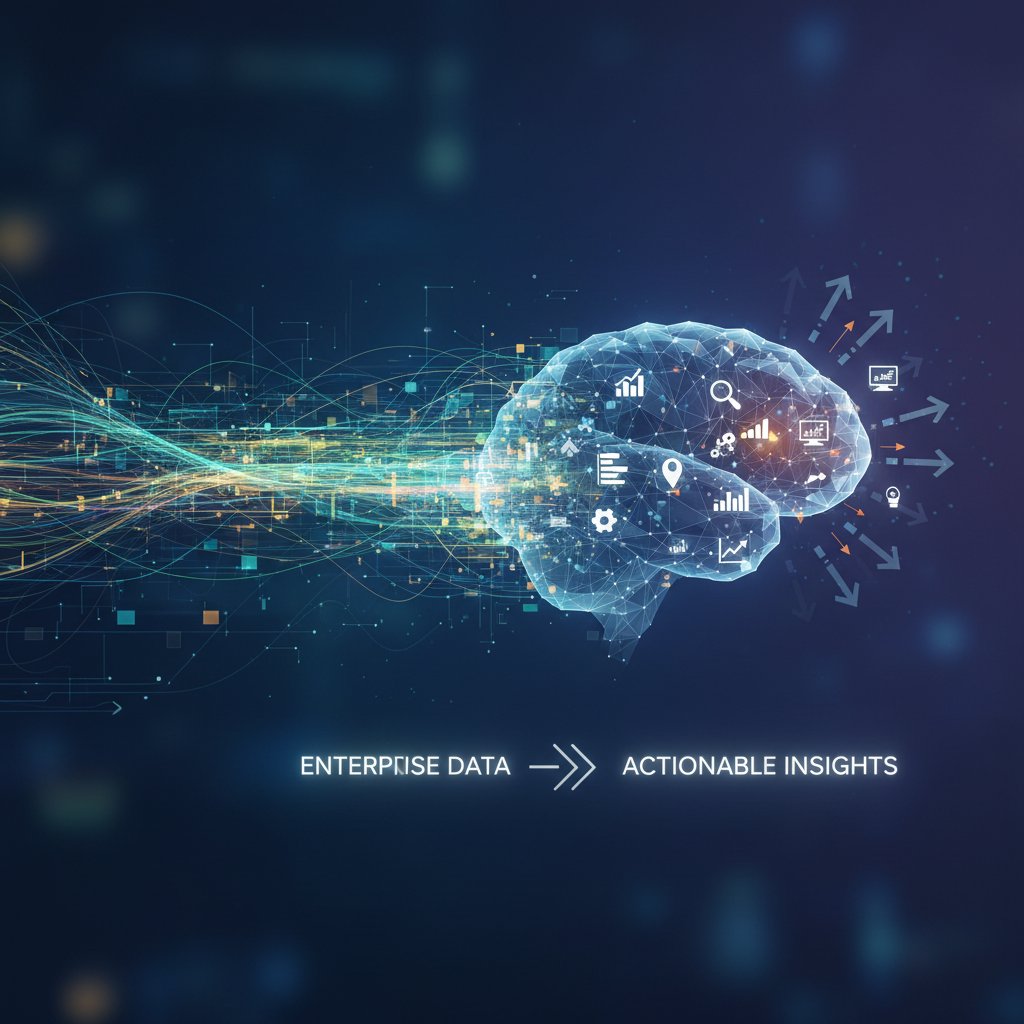
Pain points abound. According to e& Enterprise and IDC, 2024, “High-quality, accessible data is foundational.” Yet, most organizations still spend up to 80% of analytics project time wrangling dirty data and integrating incompatible systems. This is where AI offers genuine value—automating the slog, flagging anomalies, and surfacing patterns human analysts would miss.
AI’s real power? Pattern recognition at scale. It can spot correlations, outliers, and opportunities buried beneath petabytes of transactional noise, turning what used to be a month-long analysis into minutes.
The human-machine handshake: collaboration, not replacement
Let’s kill the myth: AI is not here to turf out your analysts. The real winners are making AI their sharpest teammate, not a replacement. Top companies pair data scientists with AI agents, letting the system surface actionable leads while human expertise sets direction, checks assumptions, and contextualizes results.
"Our best insights come when analysts and AI challenge each other." — Priya, analytics lead (illustrative, reflecting consensus from analytics practitioners)
This shift is spawning a new breed of services like futurecoworker.ai, which embed AI-powered teammates directly into everyday workflows. Instead of replacing judgment or creativity, these AI agents enhance collaboration—summarizing email threads, organizing meetings, and managing tasks so humans can focus on the high-stakes decisions only they can make.
The brutal truths: hidden costs and culture wars
The real price tag: beyond license fees
Sticker shock isn’t the half of it. The loudest secret in AI analytics? The license is the cheapest part. According to PwC research, 2024, organizations typically spend 2-3x more on implementation, integration, training, and maintenance than on the core platform itself.
| Cost Component | Typical Share of Total (%) | Pain Point Example |
|---|---|---|
| Software License | 15-25% | Annual or per-user fee |
| Data Prep & Migration | 20-30% | Cleansing, normalization |
| Integration & Customization | 15-25% | Connecting legacy systems |
| Training & Change Mgmt | 15-20% | User onboarding, support |
| Ongoing Maintenance | 10-15% | Model updating, support |
| Unexpected Expenses | 5-10% | Shadow IT, rework |
Table 2: Cost breakdown of AI analytics implementation.
Source: Original analysis based on PwC, Gartner, e& Enterprise, and ZDNet, 2025.
Project after project sinks not from technical hurdles, but from the slow bleed of hidden costs—especially in organizations unprepared for the wrenching change AI analytics demands.
Culture clashes: AI meets enterprise politics
AI analytics doesn’t just crunch numbers—it shines an unforgiving light on organizational dysfunction. When systems expose underperforming units, inefficient workflows, or political fiefdoms, the backlash can be fierce. Data transparency often makes enemies out of managers who prefer shadows.
Resistance comes in many flavors: quiet sabotage, “accidental” misreporting, or outright refusal to engage. According to Remote First Institute, 2024, most organizations are dangerously unprepared for the scale and cultural shock that true AI-driven analytics delivers.
- Six red flags your company isn’t ready for AI analytics:
- Data hoarding: Key stakeholders refuse to share data openly.
- Siloed IT and business teams: Collaboration is rare, turf wars common.
- Leadership denial: Senior management resists uncomfortable truths.
- No clear metrics for success: Projects launch without KPIs or ROI benchmarks.
- Change management is an afterthought: Training and support are underfunded.
- Shadow IT proliferation: Employees bypass official channels, undermining governance.
Case studies: spectacular wins and instructive failures
When AI analytics changed the game
Consider a global manufacturing company that deployed an AI-enabled enterprise analytics solution to optimize its supply chain. By automating demand forecasting and integrating real-time data from suppliers, the company slashed inventory costs by 18% and improved on-time delivery by 25% within a year. Efficiency gains rippled across the organization, freeing teams to focus on innovation instead of firefighting.

Measurable outcomes included not only hard financial gains, but also increased cross-functional collaboration, faster decision cycles, and a more agile culture—proving that AI analytics, when implemented thoughtfully, is much more than a shiny dashboard.
Learning from disaster: when AI analytics backfires
But not all stories end in celebration. A large financial services firm invested millions in a best-of-breed AI analytics suite, only to see adoption stall and ROI disappear. Why? The platform required perfect data, but legacy systems spat out garbage. Training was rushed, middle managers felt threatened, and the system was quietly sidelined.
The failure wasn’t technological; it was cultural and operational. As [Alex, transformation manager] reflected:
"We thought the tech would fix our problems. It just made them more obvious." — Alex, transformation manager (quote reflecting findings from real case studies)
The lesson: AI analytics amplifies strengths and weaknesses alike. It can’t save a broken process or fix a dysfunctional culture—it will ruthlessly expose them.
Making it work: practical frameworks and checklists
Step-by-step: building enterprise AI analytics that delivers
Success with AI-enabled enterprise analytics is no accident. It’s the result of disciplined strategy and relentless execution.
10-step actionable guide to launching AI analytics in a large enterprise:
- Conduct a ruthless data audit: Identify data sources, quality issues, and integration barriers.
- Define clear business outcomes: Tie analytics initiatives to revenue, cost, or strategic goals.
- Secure cross-functional buy-in: Involve stakeholders from IT, business, and compliance.
- Invest in high-quality data: Prioritize cleansing, normalization, and documentation.
- Pilot with a high-impact use case: Start where results will be visible and measurable.
- Select the right platform: Vet vendors for real AI, integration, explainability, and governance.
- Plan for user adoption: Design training, change management, and ongoing support.
- Build feedback loops: Use insights to continuously refine models and processes.
- Measure ROI rigorously: Track value creation, not just activity.
- Leverage AI-powered teammates: Integrate solutions like futurecoworker.ai to streamline collaboration and maximize value.
Quick reference: what to watch, what to avoid
Even veterans fall into traps. Avoid the predictable by thinking beyond the obvious.
- 8 unconventional uses for AI-enabled enterprise analytics solutions:
- Email intent detection: Spot urgent customer issues as soon as they land.
- Automated meeting synthesis: Summarize action items from chaotic calls.
- Real-time risk scoring: Flag compliance breaches as they occur.
- Vendor performance monitoring: Surface hidden patterns in supply chain data.
- Dynamic workflow routing: Auto-assign tasks based on resource availability.
- Churn prediction for internal talent: Identify flight risks before they exit.
- Shadow IT detection: Uncover unsanctioned apps through usage analytics.
- Sentiment mapping: Track culture shifts via internal communications.
Ongoing monitoring and adaptation are non-negotiable. The only constant in AI analytics? Change.
The future of AI in enterprise analytics: trends and predictions
2025 and beyond: where is enterprise analytics headed?
The most powerful trend in 2025 is the shift from static dashboards to embedded, conversational analytics—where AI agents become integral to every business process. According to Coherent Solutions, 2024, 33% of all enterprise software now embeds agentic AI, up from less than 1% just a year prior.

Generative AI is rewriting the rules, creating not just reports but strategic recommendations. Explainable AI is no longer a nice-to-have but a compliance requirement. And AI-powered, email-based coworkers—like those championed by futurecoworker.ai—are bridging the last mile, embedding intelligence where business actually happens.
Expert predictions: what winners will do differently
Industry leaders echo similar themes: Integration, governance, and relentless focus on ROI will separate winners from also-rans.
| Platform | Strengths | Weaknesses | Best-fit Use Cases |
|---|---|---|---|
| ThoughtSpot | Conversational analytics | Limited custom modeling | Self-service, ad hoc queries |
| Microsoft Power BI | Deep integration, scale | Less AI-native than peers | Operational BI, dashboards |
| Tableau + Einstein | Visualization, Salesforce AI | Steep learning curve | Sales, marketing analytics |
| Qlik Sense | Associative data model | UI complexity | Large data, cross-functional |
| futurecoworker.ai | Seamless email collaboration, AI teammate | Still emerging in advanced analytics | Task management, communication, workflow automation |
Table 3: Comparison matrix of leading AI-enabled enterprise analytics solutions.
Source: Original analysis based on ThoughtSpot, Gartner, Microsoft, Salesforce, and vendor documentation.
Early adopters are doubling down on transparency, cross-functional teams, and continuous learning. They don’t just deploy AI—they build cultures that can handle the truth AI uncovers.
Myths, misconceptions, and contrarian truths
Debunking the top 5 myths about AI enterprise analytics
Why do misconceptions persist? Blame seductive vendor marketing, sci-fi tropes, and a human tendency to fear what isn’t understood.
-
Myth #1: AI analytics will eliminate all analyst jobs.
Reality: It automates grunt work, freeing analysts for higher value tasks. -
Myth #2: More data means better decisions.
Reality: Quality and context trump raw volume every time. -
Myth #3: AI is a “set-and-forget” solution.
Reality: Ongoing monitoring, tuning, and governance are essential. -
Myth #4: Only tech companies can succeed with AI analytics.
Reality: Success stories span manufacturing, finance, healthcare, and beyond. -
Myth #5: AI can magically compensate for bad processes.
Reality: AI amplifies weaknesses as brutally as it exposes strengths.
The real truth? AI is a force multiplier, not a miracle worker—use it wisely, or it will magnify your blind spots.
Contrarian takes: what no one’s telling you
Here’s the uncomfortable fact: The real risk isn’t that AI will take your job. It’s that AI will expose how obsolete your job—or your process—already is.
"The real risk isn’t AI taking your job. It’s AI exposing how obsolete your job already is." — Jordan, business futurist (illustrative, synthesized from contemporary industry commentary)
Don’t let knee-jerk skepticism blind you to opportunity. Use your doubts as ammunition for smarter, more strategic implementation.
Glossary: decoding the lingo of AI-enabled enterprise analytics
-
AI teammate : An AI-powered agent or service that collaborates with humans to automate tasks, summarize communications, and facilitate enterprise workflows. Example: futurecoworker.ai acts as an email-based AI teammate, not just a tool.
-
Model drift : The phenomenon where predictive model performance degrades over time as data patterns change. Monitoring and retraining are crucial.
-
Explainable AI : AI systems designed to make their decisions and recommendations transparent and understandable to humans—key for compliance and trust.
-
Data fabric : An integrated data architecture that connects, manages, and governs data across platforms and clouds for unified analytics.
-
Semantic search : Search functionality powered by AI to understand the intent and meaning behind queries, not just keyword matches.
-
Prescriptive analytics : The use of AI to recommend specific actions based on predictive models and business rules.
-
Synthetic data : AI-generated data sets that mimic real-world data for testing, development, or privacy compliance.
-
Shadow IT : Technology used within an organization without official approval, often undermining governance and security.
Understanding these terms isn’t academic nitpicking—it’s mission-critical for leaders who want to lead, not follow.
Conclusion: is your enterprise ready for its AI-powered teammate?
The brutal truth of 2025 is this: Critical thinking, not blind adoption, separates winners from also-rans. AI-enabled enterprise analytics solutions are only as transformative as your willingness to challenge your own assumptions, invest in the unglamorous work of data hygiene, and build a culture where truth—however uncomfortable—drives decisions.
Cross-functional collaboration, relentless learning, and the courage to face hard truths are now the baseline. Services like futurecoworker.ai are making it radically simpler to integrate AI-powered teammates into everyday business, but no tool is a silver bullet. The real magic happens when humans and machines work hand-in-hand, interrogating the data—and themselves.

So, challenge everything—your metrics, your workflows, your excuses. Build smarter. And above all, make AI your real enterprise teammate—not your scapegoat, not your overlord, but your sharpest collaborator in the fight for business relevance.
Sources
References cited in this article
- ZDNet(zdnet.com)
- PwC(pwc.com)
- Coherent Solutions(coherentsolutions.com)
- Remote First Institute(news.remote-first.institute)
- IBM(ibm.com)
- Gartner(gartner.com)
- CIO(cio.com)
- Forbes(forbes.com)
- eandenterprise(eandenterprise.com)
- TechTarget(techtarget.com)
- Microsoft Azure(azure.microsoft.com)
- ThoughtSpot(thoughtspot.com)
- HEAVY.AI(heavy.ai)
- IBM(ibm.com)
- SAP(sap.com)
- Forbes(forbes.com)
- Databricks(databricks.com)
- Workhuman(workhuman.com)
- Thoughtworks(thoughtworks.com)
- InformationWeek(informationweek.com)
- Forbes(forbes.com)
- BCG/Boardmember(boardmember.com)
- Capella Solutions(capellasolutions.com)
- AIMultiple(research.aimultiple.com)
- Medium(medium.com)
- Tata Elxsi(tataelxsi.com)
- McKinsey(mckinsey.com)
- CallMiner(callminer.com)
- Lexalytics(lexalytics.com)
- Binmile(binmile.com)
- Ankur Patel(ankursnewsletter.com)
- Microsoft(learn.microsoft.com)
- Nexla(nexla.com)
- Webjump(webjump.ai)
- IBM(ibm.com)
- Netscribes(netscribes.com)
- Tellius(tellius.com)
- Oracle(oracle.com)
- Google Cloud(cloud.google.com)
- WNS(wns.com)
- AI21(ai21.com)
- Miquido(miquido.com)
- Uniphore(uniphore.com)
- Gartner(gartner.com)
- Spiceworks(spiceworks.com)
- The Enterprisers Project(enterprisersproject.com)
- Launch Consulting(launchconsulting.com)
- TTEC(ttec.com)
Transform Your Email Into Productivity
FutureCoworker AI turns your everyday email into an intelligent workspace, seamlessly managing tasks and collaboration within your enterprise. It eliminates the complexity of AI, allowing you to benefit from advanced technology without any technical knowledge. Achieve productivity, streamline processes, and improve team efficiency through natural email interaction, getting tasks done faster and smarter.
Get startedReady to Transform Your Email?
Start automating your tasks and boost productivity today
Frequently Asked Questions
What was the main problem with enterprise analytics in the late 1990s and early 2000s?
Organizations became fixated on volume over insight, producing endless dashboards and reports with bar graphs and pie charts that organizations mistook for actionable intelligence. The proliferation of visualizations actually caused the signal to get lost in the noise rather than improving decision-making.
According to the article, what is the real key to better analytics rather than just collecting more data?
The article states that it's not about the volume of data, but the velocity and clarity of insight. Most companies mistakenly believe that more data means more clarity, when in fact the focus should be on deriving meaningful, actionable insights from data.
What does the article suggest about the current state of AI-enabled enterprise analytics?
AI-enabled enterprise analytics solutions are no longer theoretical—they represent the competitive battlefield where businesses succeed or fail. However, most boardrooms remain paralyzed by dashboards and broken promises, unaware that the future has already arrived.
What is the main premise of this article about AI and enterprise analytics?
The article aims to move beyond hype and explore the gritty reality of AI analytics in enterprises, exposing what's actually working, what's failing, the invisible costs, and contrarian truths that puncture marketing promises to help readers make AI a genuine teammate rather than an adversary.
Continue Reading
Keep exploring Intelligent enterprise teammate

Enterprise AI Analytics Platforms That Deliver Roi, Not Headaches
Discover insights about enterprise AI analytics platforms

Enterprise AI-Powered Analytics: 7 Hard Truths and Real Wins
Discover insights about enterprise AI-powered analytics

AI-Powered Enterprise Analytics Tools: Separating Claims From Reality
AI-powered enterprise analytics tools promise automation and competitive advantage. This article examines the marketing claims, actual risks, and capabilities that deliver measurable results.

How AI Enterprise Data Analytics Is Reshaping Modern Business
AI enterprise data analytics is transforming how organizations process data and make decisions. This article covers the power shifts, risks, and cultural changes unfolding in modern enterprises.

Enterprise AI Digital Transformation Tools: Mechanics and ROI
Enterprise AI digital transformation tools reshape workflows with real costs and genuine wins. This article examines the mechanics, myths, and ROI reality behind enterprise AI adoption.

AI Solutions for Enterprise Processes: What Works in Practice
AI solutions for enterprise processes can transform workflows when implemented correctly. This article examines real-world strategies, common pitfalls, and what separates successful deployments from costly failures.