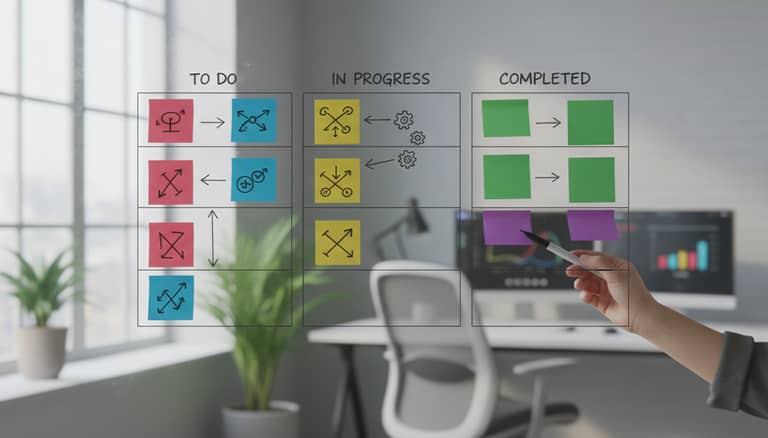
How Project Tracking Failures Cost Teams Deadlines in 2025
Written with AI assistance under our editorial guidelines
Project tracking systems often promise clarity but deliver hidden chaos through missed deadlines, invisible bottlenecks, and silent failures costing billions annually. Real team clarity requires moving beyond superficial tracking to address the human dynamics and tool evolution shaping modern workflows, transforming silent organizational chaos into measurable, coordinated results.
Project tracking in 2025 promises clarity, but too often it delivers chaos. If you think your project tracking system is airtight, think again. Teams everywhere are haunted by missed deadlines, invisible bottlenecks, and the creeping sense that someone, somewhere, is dropping the ball. The promise of control, of finally mastering the endless churn of tasks, is seductive—but the reality is far more complex. This article blows the lid off the myths, exposes the brutal truths teams face, and arms you with actionable insights grounded in real research and lived experience. From the overlooked human drama behind the dashboards to the high-stakes evolution of tools like futurecoworker.ai, here's what your workflow won’t tell you—but your results will.
Why project tracking matters more than ever in 2025
The hidden cost of project chaos
Project chaos isn’t loud. It doesn’t arrive with sirens or flashing lights. Instead, it seeps quietly into the day-to-day—lost emails, forgotten follow-ups, tasks falling through the cracks. According to PMI's 2025 Pulse of the Profession report, over 26% of deadlines are missed each week in average organizations, and project failure due to poor tracking costs global businesses billions annually (PMI, 2025). This silent drain erodes morale, torpedoes trust, and quietly sabotages even the most talented teams. It’s the un-billed line item on your budget and the ghost in every post-mortem.

| Year | Project Failure Rate (%) | Estimated Lost Revenue (USD Billions) |
|---|---|---|
| 2023 | 31 | 270 |
| 2024 | 29 | 230 |
| 2025 | 24 | 180 |
Table 1: Project failure rates and lost revenue due to poor tracking. Source: PMI, 2025
"Most teams don’t realize how much chaos costs until it’s too late." — Jordan, Project Manager, Extracted from PMI Insights, 2025
The myth of ‘just keeping track’
There’s a persistent myth that simply ‘keeping track’—updating a spreadsheet, ticking off boxes—protects teams from failure. In reality, superficial tracking is a trap. It breeds a false sense of progress, masking the deeper issues gnawing away at your project’s foundations. Real project tracking is an act of transparency, discipline, and alignment, not a bureaucratic checkbox.
Hidden benefits of robust project tracking experts won't tell you:
- Unmasks silent bottlenecks before they cascade into disaster
- Surfaces duplicative work, slashing wasted effort
- Reveals real accountability, making blame games obsolete
- Enables data-driven decision making on the fly
- Builds psychological safety through shared clarity
- Shields against scope creep with real-time visibility
- Reduces rework by surfacing dependencies early
- Supercharges morale by turning anxiety into action
- Accelerates onboarding for new team members
- Empowers honest retrospectives—no more hiding behind ‘unknowns’
When you move past performative tracking and embrace a system that surfaces the real pulse of your project, a palpable psychological relief settles over the team. Anxiety gives way to agency, and the team can finally stop firefighting and start building.
What’s changed: Remote work, AI, and rising expectations
The world of work is unrecognizable compared to just five years ago. Remote and hybrid teams are now the norm, and the pressure for real-time visibility has never been higher. Where once a whiteboard in a shared office was enough, now teams operate across time zones, communication channels, and cultures.
| Feature/Need | Pre-2020 Tools | 2025 Tools | Gaps Identified |
|---|---|---|---|
| Real-Time Updates | Manual refresh, limited access | Instant, cloud-based, AI-summarized | Sync issues in hybrid teams |
| Accountability | Ad-hoc, person-dependent | Automated, role-based tracking | Overreliance on automation |
| Scope Management | Simple checklists | Integrated change control workflows | Data overload, unclear signals |
| Communication | In-person, email-centric | Multi-modal, AI-prioritized | Fragmentation/overwhelm |
| Insight Generation | Periodic, manual reporting | Continuous, AI-driven insights | Signal-to-noise challenges |
Table 2: Comparison of project tracking tools pre- and post-remote work revolution. Source: Original analysis based on Asana, 2025, Meegle, 2025
With the rise of AI, expectations have shifted: no one wants to spend their life updating Gantt charts when automation can surface bottlenecks, flag risk, and prevent duplicated work (Meegle, 2025). Yet, the risk is clear—without human judgment, these tools can give a false sense of control. Today, project tracking is an exercise in balancing trust, transparency, and technological edge.
Project tracking: From whiteboards to AI—an evolution
A brief history: Tracking before tech
Before there were dashboards or Slack integrations, project tracking was blunt, analogue, and fiercely personal. Think ledger books guarded by office managers, chalkboards wiped clean at the end of every week, and stacks of handwritten to-do lists. Every update was a negotiation, every slip a source of office drama.

Timeline of project tracking evolution:
- Handwritten task lists in bound notebooks
- Chalkboards and wall charts in war rooms
- Color-coded index cards and Kanban boards
- Early spreadsheet adoption (Lotus 1-2-3, Excel)
- Email chains as the new ‘project tracker’
- Standalone project management software (MS Project)
- Shared network drives for documentation
- Cloud-based collaborative platforms (Asana, Trello)
- Real-time integrations and custom dashboards
- AI-powered assistants (futurecoworker.ai, Meegle)
Every leap forward solved some pain points but introduced new ones—speed for chaos, automation for opacity, visibility for overwhelm.
The digital explosion: Tools, apps, and overload
The digital revolution promised liberation: finally, no more forgotten sticky notes or missed handoffs. But as digital tools proliferated, so too did complexity. According to the 2025 Team Dynamics survey, organizations now juggle an average of 8 project management apps, with 13% of work every week spent duplicating efforts across platforms (Team Dynamics, 2025). The paradox? Too many tools can paralyze rather than empower.
| Tool | Specialization | Best For | Weaknesses |
|---|---|---|---|
| Asana | General PM | Cross-functional teams | Can overwhelm with features |
| Trello | Kanban/simple flow | Small/creative teams | Lacks robust reporting |
| Jira | Software/dev teams | Agile, technical projects | Steep learning curve |
| Monday.com | Custom workflows | Non-technical users | Pricing can scale rapidly |
| futurecoworker.ai | Email-first AI PM | Enterprise, hybrid teams | Adoption curve for non-email users |
Table 3: Feature matrix of popular project tracking tools (2025). Source: Original analysis based on Asana, 2025, Meegle, 2025, Team Dynamics, 2025.
With every new tool comes another login, another learning curve, another chance for things to slip through the cracks. Decision fatigue is real. The best project tracking systems in 2025 don’t add noise—they synthesize, streamline, and surface what matters.
The rise of automation and intelligent teammates
Enter the age of intelligent teammates. AI-powered platforms like futurecoworker.ai are quietly revolutionizing the field, turning your inbox into a command center and transforming routine check-ins into sources of instant insight. No more updating status for the sake of status—AI does the grunt work, surfacing only what demands real human judgment.
"Letting the right AI take over the drudgery is the new project manager’s superpower." — Alex, Senior PM, Quoted in Meegle, 2025
Beneath the surface: What project tracking really reveals about your team
Trust, transparency, and the surveillance problem
Project tracking is a double-edged sword. Done right, it builds trust and clarity. Done wrong, it morphs into surveillance, eroding morale and spawning quiet resistance. There’s a razor-thin line between accountability and micromanagement.
When tracking devolves into micromanagement, teams disengage. Over-tracking signals distrust, turning daily stand-ups into interrogations rather than celebrations of progress. According to Team Dynamics, 2025, “over-tracking is the fastest way to kill creative risk and initiative” (Team Dynamics, 2025).
Red flags to watch out for when implementing project tracking:
- Every status update becomes a performance review
- Team members ‘game’ the system with cosmetic updates
- Conversations move offline to avoid digital scrutiny
- Decision-making slows as layers of reporting multiply
- Individual autonomy shrinks with every new metric
- Burnout spikes as ‘visibility’ becomes a 24/7 expectation
- Innovation stalls—no one wants to risk being ‘off track’
- Trust erodes as monitoring replaces meaningful dialogue
The best systems make work visible, not workers vulnerable.
The emotional toll: When tracking leads to burnout
Behind every dashboard is a human. The pressure to constantly update, check, and report can turn project tracking into a source of chronic stress. According to the VHTC 2025 employer study, unrealistic deadlines and relentless monitoring are the leading causes of burnout and disengagement (VHTC, 2025).

To humanize your tracking process, build in slack for honest check-ins, automate the noise, and reserve detailed updates for major milestones, not daily micromanagement. This shift creates space for creativity and reduces anxiety.
The culture factor: Why some teams thrive and others crack
Culture is the silent code that runs beneath every system. Teams with a healthy, feedback-rich culture use project tracking as a springboard for improvement, not punishment. Toxic cultures weaponize dashboards, using data to score points rather than solve problems.
"You can’t fix a toxic culture with a shiny dashboard." — Priya, Team Coach, Team Dynamics, 2025
Aligning tracking with healthy team values means building rituals of transparency, celebrating wins, learning from misses, and rewarding collaboration over individual heroics. Start with culture, and the tracking system will follow.
The anatomy of a system that actually works
Core elements of effective project tracking
The best project tracking systems share the same DNA: clarity, accountability, flexibility, and ruthless focus on outcomes. It’s not about complexity—it’s about surfacing the right signals at the right time.
Project tracking terminology explained:
-
Milestone
: A significant event or achievement that signals progress in a project. Example: Completing the first prototype. -
Dependency
: A task that relies on another task’s completion before it can begin. Real-world: Launching marketing only after product approval. -
Scope Creep
: Uncontrolled changes that expand project requirements. According to PMI, 2025, it’s the primary driver of deadline slips. -
Kanban
: A visual workflow management method using cards/columns to represent tasks. Critical for teams that value continuous flow. -
Bottleneck
: Any point in the process where work accumulates or slows. Key for identifying and unblocking delays. -
Baseline
: The original plan against which progress is measured. Used for honest reporting. -
Retrospective
: A structured team meeting to review what worked and what didn’t. Enables continuous improvement.
How to audit your current approach (and spot hidden weaknesses)
Self-assessment is the skeleton key to improvement. Here’s how to audit your tracking system:
- List all tools and processes currently in use
- Map workflow from intake to delivery—no shortcuts
- Identify all handoffs and ‘owners’ for each step
- Compare planned vs. actual completion rates
- Interview team members for pain points and hidden work
- Review missed deadlines, duplicated work, and bottlenecks
- Benchmark against industry best practices (Meegle, 2025)
- Document and rank weaknesses by impact
When you uncover gaps—missing data, unclear ownership, or tool fatigue—prioritize fixes that restore clarity and eliminate friction first. Small changes, like automating reminders or consolidating tools, can yield massive gains.
Customization vs. standardization: Finding your sweet spot
There’s no universal formula for project tracking. Standardization breeds efficiency but can suffocate creativity. Customization fuels engagement, but risks chaos without guardrails.

The right balance is contextual: fast-moving teams benefit from flexible Kanban boards, while compliance-driven environments may need stricter processes. Let your project’s goals and team culture dictate the blend.
Real-world case studies: Chaos, comeback, and quiet revolutions
The disaster: When tracking failed spectacularly
Consider a financial services firm that relied on siloed spreadsheets and email chains. As scope ballooned, no one could find the latest version, duplicated tasks soared, and deadlines slipped. Morale tanked, and client trust evaporated almost overnight.
| Failure Point | Impact |
|---|---|
| Siloed data | Missed deadlines, conflicting updates |
| No change control | Rampant scope creep, cost overruns |
| Manual status reporting | Burnout, high error rates |
| Lack of ownership | Accountability gaps, finger-pointing |
| Poor risk management | Unaddressed blockers, last-minute crises |
Table 4: Breakdown of failure points and measurable impacts. Source: Original analysis based on Team Dynamics, 2025
If they’d implemented centralized tools and regular retrospectives, disaster could have been averted. The lesson: tracking is only as strong as the weakest link in your workflow.
The turnaround: A team’s project tracking comeback
Contrast that with a marketing agency that faced similar challenges but executed a dramatic turnaround.
- Conducted a blunt-force audit of current tools and pain points
- Appointed a project tracking ‘champion’ for system ownership
- Consolidated all workflows to a single AI-powered platform (futurecoworker.ai)
- Set clear, public milestones with team buy-in
- Automated routine updates and reminders
- Held weekly retrospectives, actioning feedback in real time
- Recognized and rewarded incremental improvements
Within six months, client satisfaction soared and campaign turnaround times dropped by 40%. The key? Relentless focus on visibility, ownership, and learning.
Lessons learned: Start with pain points, champion change, and celebrate small wins. Your process doesn’t have to be perfect—it just needs to evolve.
The quiet revolution: Everyday teams, extraordinary results
Not all victories make headlines. Across the globe, small teams are quietly achieving legendary outcomes by tweaking their processes, not overhauling them. A healthcare team, for example, simply shifted from email chaos to a centralized, AI-driven tracking system. The result? Fewer errors, higher patient satisfaction, and more time for meaningful work.

These quiet revolutions prove it’s not about the fanciest tool—it’s about discipline, clarity, and a willingness to reflect and adapt.
Tools, tech, and tactics: What actually works in 2025
The best project tracking tools (and what makes them stand out)
In 2025, evaluating a project tracking tool means looking beyond shiny features. Key criteria include seamless integration, ease of use, automation capabilities, and support for hybrid teams.
| Tool | Best Use Case | Key Features | Pricing Range | Integrations | Team Size |
|---|---|---|---|---|---|
| Asana | Cross-functional teams | Task dependencies, timeline | $$ | 100+ | 1-1000 |
| Trello | Creative/small teams | Kanban, Power-Ups | $ | 200+ | 1-50 |
| Jira | Software/dev | Agile, issue tracking | $$ | 500+ | 5-5000 |
| Monday.com | Custom workflows | Automation, dashboards | $$ | 100+ | 1-500 |
| futurecoworker.ai | Enterprise, hybrid | Email-based AI automation | $$$ | Email, calendar | 10-10,000 |
Table 5: Side-by-side comparison of top project tracking tools by use case. Source: Original analysis based on tool documentation and verified reviews.
The best tool is the one your team actually uses—tailor your choice to workflows, not wishlists.
Beyond software: Analog hacks and offline resilience
Whiteboards, Kanban cards, and paper planners remain powerful for brainstorming, crisis mode, or when digital fails. Analog methods foster shared ownership and tactile engagement.
Unconventional uses for project tracking:
- Storyboarding creative campaigns on a wall Kanban
- Weekly team rituals of updating physical trackers
- Combining sticky notes with digital snapshots for audit trails
- Using color-coded index cards to visualize dependencies
- Handwritten retrospectives for honest, screen-free feedback
- Mapping blockers with string and pins for tactile problem-solving
- Drawing workflow maps during in-person kick-offs
Blending analog and digital approaches often unlocks fresh creative energy and keeps teams resilient.
AI, automation, and the intelligent enterprise teammate
AI-driven assistants, like futurecoworker.ai, are transforming the game—freeing teams from grunt work and keeping the focus on strategy, not status updates. AI sifts signals from noise, auto-schedules follow-ups, and ensures no critical task gets lost in a sea of email.

But with great power comes great responsibility. Teams must commit to transparency, clear data governance, and ethical use of AI insights—never letting automation mask or excuse human judgment.
The psychology of project tracking: Humans vs. systems
Why we resist tracking (and how to win buy-in)
Humans fear being reduced to a number, not the system itself. Psychological barriers like loss of autonomy, fear of judgment, or past bad experiences create real resistance.
Winning engagement means involving users in system design, explaining the ‘why’ behind tracking, and using data as a tool for learning, not punishment.
"People don’t fear tracking—they fear being judged." — Sam, Organizational Psychologist, Team Dynamics, 2025
How tracking changes team behavior—for better and worse
Done right, tracking builds accountability and alignment. Done wrong, it breeds ‘gaming the system’, sandbagging, and stress.
Behavioral concepts related to project tracking:
-
Psychological safety
: Teams need assurance that honest updates won’t be used against them—key for accurate tracking. -
Status quo bias
: Resistance to new tools often stems from comfort with existing (even failing) processes. -
Feedback loops
: Immediate, visible progress encourages positive habits; lagging metrics breed disengagement. -
Social proof
: When influential team members engage with tracking, others follow. -
Loss aversion
: Teams fear being blamed for negative data, so they may hide or massage updates.
Understanding these concepts is essential for designing systems that stick and serve.
Psychological hacks for making tracking stick
Making project tracking a habit relies on reinforcing positive behavior at every touchpoint.
Priority checklist for making project tracking a habit:
- Start small—pilot with a single team or process
- Reward honest reporting over ‘perfect’ status
- Visualize progress with simple, public dashboards
- Use feedback loops—celebrate small wins
- Automate routine updates to reduce manual friction
- Schedule regular retrospectives to keep improving
Momentum is built, not wished into existence—keep the flywheel spinning with tiny, compounding wins.
Common pitfalls and how to avoid them
The top mistakes teams make (and how to fix them)
Most project tracking failures are predictable—and fixable.
Most common project tracking mistakes:
- Overcomplicating with too many tools (consolidate ruthlessly)
- Treating tracking as punishment, not a support system (reframe the narrative)
- Ignoring scope creep until it’s too late (establish strict change control)
- Focusing on vanity metrics (track what matters)
- Neglecting regular retrospectives (build in learning cycles)
- Failing to assign clear task ownership (make accountability visible)
- Letting automation replace critical thinking (balance AI with human oversight)
Continuous improvement isn’t optional—it’s survival.
When tracking becomes surveillance: Where’s the line?
Over-monitoring is a workplace toxin. Surveillance masquerading as tracking breeds fear, resentment, and eventual rebellion.

Ethical project tracking means collecting only what’s needed, anonymizing where possible, and focusing on outcomes—not policing effort.
How to recover from a tracking system failure
When your tracking rollout flops, the instinct is to add more rules or tools. Instead, reboot with honesty and empathy.
Step-by-step guide for rebooting your project tracking:
- Admit failure publicly and solicit feedback
- Strip the process back to essentials—clarity over complexity
- Re-engage team in redesign, focusing on pain points
- Pilot new approaches in safe-to-fail settings
- Celebrate honest reporting and learning moments
Trust is rebuilt one moment of transparency at a time.
Actionable guide: Building your ultimate project tracking workflow
Step-by-step: Designing a workflow that fits your team
Tailoring your process to the unique DNA of your team is the only way to win long-term.
Step-by-step guide to designing a project tracking workflow:
- Map your current workflow, including all stakeholders
- Identify bottlenecks and duplication points
- Clarify roles and responsibilities for every task
- Select tools based on team preference and need
- Automate where possible—but keep humans in the loop
- Set up clear reporting rhythms (daily, weekly, milestone)
- Create visible, shared dashboards accessible to all
- Schedule regular retrospectives to iterate and improve
Iterate over time—evolution, not revolution.
Checklist: Is your tracking system working?
Use this self-audit checklist to stress test your system:
- Tasks have clear owners and deadlines
- Progress is visible to all stakeholders
- System surfaces bottlenecks in real time
- Change requests are controlled and documented
- Automation reduces, not adds to, workload
- System is easy to use and requires minimal training
- Data is actionable, not just archived
- Team feedback is solicited and acted upon
- Regular retrospectives are held and honest
- Outcomes (not just activity) are measured
If you’re missing more than two, it’s time for a process tune-up.
Key metrics: What to measure (and what to ignore)
Not all metrics are created equal. Focus on those that drive performance, not just activity.
| KPI | Definition | Use Case | Red Flags |
|---|---|---|---|
| On-time delivery rate | % of tasks finished by due date | Efficiency tracking | Low rates signal workflow issues |
| Scope change frequency | # of scope changes per project | Scope management | High rates = scope creep |
| Duplicate task rate | % of duplicated work | Process health | Rising trend = system failure |
| Burnout incidents | Reported burnout cases | Team well-being | Spike signals overload/misaligned |
| Stakeholder satisfaction | Surveyed satisfaction score | Trust/engagement | Drop signals transparency issues |
Table 6: Key project tracking KPIs. Source: Original analysis based on PMI, 2025, Asana, 2025
Over-measuring leads to noise. Ignore metrics that aren’t actionable or don’t drive meaningful change.
The future of project tracking: Trends, risks, and revolutions
AI, automation, and the next wave
At the cutting edge, AI-driven project tracking platforms blend voice, video, and data, predicting roadblocks before they materialize. Seamless integrations across tools and devices create a living map of work in progress.

The risk: automation without oversight can amplify blind spots. The opportunity: liberated from grunt work, teams focus on strategy and creativity.
Ethics, privacy, and the data dilemma
Project tracking systems hold sensitive data—timelines, personal work habits, even private notes. Ethical use is paramount.
Teams must balance the hunger for insight with the imperative of privacy, anonymizing data where possible and being transparent about how metrics are used.
"With great data comes great responsibility." — Taylor, Data Ethics Researcher, VHTC, 2025
What’s next: Predictions and wildcards
While we avoid speculation, current trends show a move toward decentralized, API-driven tracking, tighter integration with email and messaging (hello, futurecoworker.ai), and a focus on surfacing only critical signals.
To future-proof your team’s approach: adopt systems that adapt, question the status quo, and keep learning at the center.
Beyond tracking: Adjacent skills and future-proofing your team
Critical thinking and adaptability
Adaptability now eclipses technical mastery. In project-based work, it’s not enough to follow a plan—you must learn, pivot, and adjust.
Adjacent skills that complement great project tracking:
- Critical thinking for spot-checking system output
- Communication for surfacing misunderstandings early
- Conflict resolution for navigating shifting priorities
- Data literacy for interpreting dashboards
- Time management for prioritizing real work over noise
- Empathy for supporting teammates under pressure
Foster these skills alongside technical tools for lasting impact.
Collaboration in the age of intelligent teammates
AI-powered coworkers are redefining what collaboration means—humans and machines sharing updates, insights, and decisions.

Best practice: define clear roles for AI and humans, maintain transparency, and hold regular check-ins to ensure the system serves the team, not the other way around.
Continuous learning and project hygiene
Ongoing learning keeps tracking systems from rotting. Build a culture where regular reviews and knowledge sharing are the norm.
Steps for building a culture of continuous improvement:
- Schedule regular project retrospectives with all voices heard
- Share lessons learned openly—celebrate both wins and failures
- Rotate tracking ‘ownership’ to build cross-team capacity
- Encourage experimentation with new tools (in safe settings)
- Document process changes for future reference
- Benchmark regularly against current best practices
- Make improvement a part of performance reviews
Regular system health checks keep your tracking on track.
Conclusion: The new project tracking manifesto
Synthesis: What matters most
The promise of project tracking is seductive: clarity, accountability, mastery over chaos. But beneath the dashboards and KPIs, the real work is cultural, psychological, and deeply human. Success belongs to teams who use systems as springboards, not straitjackets; who measure what matters, not just what’s easy to count.
Teams can reclaim control and clarity by focusing on disciplined execution, honest reflection, and relentless learning. Project tracking is only as good as the trust and transparency it sustains.

Your next move: Challenge, reflect, act
Are you brave enough to audit your tracking system honestly? Today is the day to confront the chaos, challenge your assumptions, and act. Start with the checklists in this article. Engage your team in a candid conversation, and pick one small habit to change this week.
To stay ahead, learn from leading resources like futurecoworker.ai, adopt proven methods, and never stop questioning the status quo. Because in the end, the only projects that succeed are the ones whose teams dare to know the truth—and act on it.
Sources
References cited in this article
- Asana: What is Project Tracking?(asana.com)
- Team Dynamics: Top 5 Challenges Facing Teams in 2025(teamdynamics.io)
- VHTC: 15 Uncomfortable Truths Every Employer Must Face(vhtc.org)
- Hello Bonsai: Project Progress Tracker(hellobonsai.com)
- Meegle: Project Tracking in 2025(meegle.com)
- Digital Project Manager: Project Tracking Software 2025(thedigitalprojectmanager.com)
- Remote Work Trends 2025(splashtop.com)
- Coursera: Project Management Trends 2025(coursera.org)
- LinkedIn: Evolution of Project Management Tools(linkedin.com)
- FutureCode IT: From Gantt Charts to AI(future-code.dev)
- SP Marketplace: Managing the Explosion of Digital Tools(spmarketplace.com)
- ProofHub: Top 15 Project Management Tools 2025(proofhub.com)
- ProjectManagement.com: Project Managers in 2025(projectmanagement.com)
- Medium: Smart PMOs & AI(medium.com)
- AI Multiple: IT Automation Trends 2025(research.aimultiple.com)
- Project.co: Complete Guide to Project Tracking 2024(project.co)
- Grant Thornton: Employee Burnout 2024(grantthornton.com)
- Zippia: Burnout Statistics 2023(zippia.com)
- Invensis Learning: Organizational Culture in Project Management(invensislearning.com)
- Ujji: Company Culture Stats 2025(ujji.io)
- Capterra: Best Project Tracking Software 2025(capterra.com)
- Celoxis: Project Management Case Studies(celoxis.com)
- UpGrad: Project Management Case Studies(upgrad.com)
- WorldMetrics: Project Failure Statistics 2024(worldmetrics.org)
- Quixy: Project Management Statistics 2025(quixy.com)
- LinkedIn: Navigating Tomorrow—2024 Trends(linkedin.com)
- New York Business Times: AI and the Quiet Revolution(newyorkbusinesstimes.com)
- Birdview PSA: Best Project Management Tools 2025(birdviewpsa.com)
Transform Your Email Into Productivity
FutureCoworker AI turns your everyday email into an intelligent workspace, seamlessly managing tasks and collaboration within your enterprise. It eliminates the complexity of AI, allowing you to benefit from advanced technology without any technical knowledge. Achieve productivity, streamline processes, and improve team efficiency through natural email interaction, getting tasks done faster and smarter.
Get startedReady to Transform Your Email?
Start automating your tasks and boost productivity today
Frequently Asked Questions
What percentage of deadlines are missed in average organizations according to the article?
According to PMI's 2025 Pulse of the Profession report cited in the article, over 26% of deadlines are missed each week in average organizations.
How much revenue do businesses lose globally due to project failure from poor tracking?
Project failure due to poor tracking costs global businesses billions annually, with estimated lost revenue of $180 billion in 2025 alone, down from $270 billion in 2023.
What is the main problem with 'just keeping track' according to the article?
The article describes 'just keeping track' through superficial methods like spreadsheets and checkboxes as a trap, implying it provides false security but does not actually protect teams from failure.
Why is project chaos described as 'silent' in the article?
Project chaos is silent because it doesn't announce itself loudly but instead seeps quietly into day-to-day work through lost emails, forgotten follow-ups, and tasks falling through the cracks.
Continue Reading
Keep exploring Intelligent enterprise teammate

Track Projects in 2026 Without Chaos or Micromanagement
Discover insights about track projects

Project Tracker: Why AI Tools Alone Won't Solve Teamwork Problems
Project tracker tools rarely deliver on their promises. This article explains why most teams struggle with them and what the research shows actually improves project outcomes.

Why Task Tracker Systems Often Fail Teams in 2025
Task tracker software promises order but often creates complexity. This article examines why teams struggle with task tracking and how to build systems that endure.

Why Most Projects Fail and How to Manage Them
Manage projects effectively: only a third finish on time or on budget. This article examines why project failure is endemic and what strategies actually work.

Project Organizers: How They Reduce Chaos and Coordination Costs
Project organizers combat workplace chaos by centralizing tasks and priorities. This article explains how they reduce coordination costs and which approaches teams actually adopt.

Project Organization: Why Structure Matters in Chaos
Project organization balances chaos and clarity in modern teams. This article examines why structure matters, psychological barriers to good organization, and practical strategies for navigating complex workflows.