
Project Services in 2025: How AI and Hybrid Work Are Reshaping Collaboration
Written with AI assistance under our editorial guidelines
By 2026, project services will evolve from email-driven chaos to AI-powered collaboration systems. Organizations adopting AI integration report significantly improved outcomes: project success rates rose from 52% to 71%, meeting fatigue declined, and team onboarding time dropped from 21 to 10 days. This shift reflects a fundamental change in how teams manage work.
In the trenches of modern business, “project services” has gone from a dusty back-office term to the beating heart (and sometimes the bleeding edge) of organizational survival. If you think project services are just glorified to-do lists, buckle up. In 2025, project services are the difference between teams that dominate and teams that drown. The rules have changed: Hybrid work, AI-powered teammates, and a demand for ruthless efficiency have rewritten what it means to work together. According to research from the Project Management Institute, 88% of high-performing organizations now see project management as mission-critical—no longer a “nice to have,” but a non-negotiable. This article pulls back the curtain on the realities, myths, and outright shocks transforming project services. Prepare to see your team—and your competitors—in a whole new light.
The state of project services in 2025
Why project services are more vital—and volatile—than ever
Project services in 2025 are a battlefield. Organizations are fighting on multiple fronts: talent shortages, volatile markets, and an attention economy that punishes the slow. The explosive growth of the project management software market—forecasted to hit $15 billion this year—reflects an urgent scramble for tools that don’t just manage tasks, but save organizations from chaos. As hybrid and remote models redefine where and how teams work, the “project services” banner now demands more than digital checklists. It demands resilience, adaptability, and, above all, clarity amidst the noise.
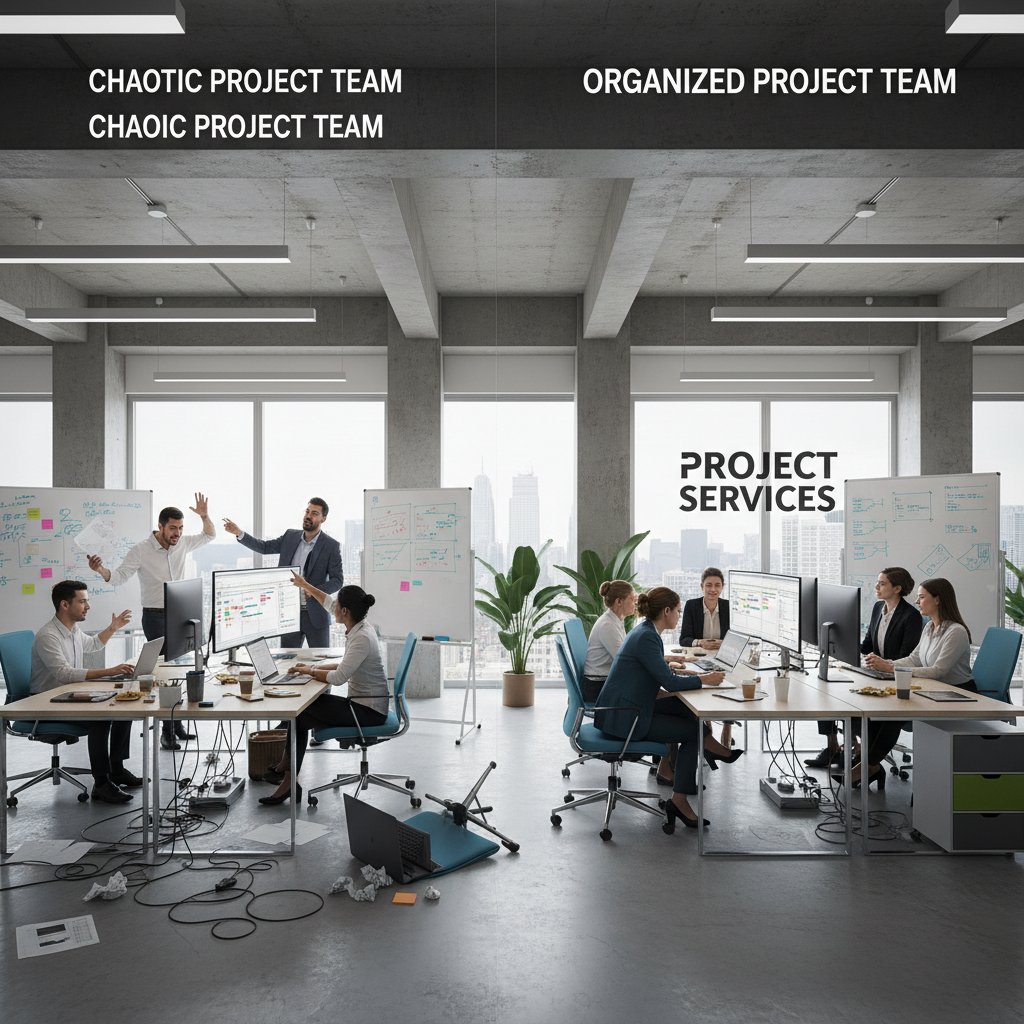
"If you're not rethinking project services this year, you're already behind." — Jamie
| Year | Project Success Rate (%) | AI Integration Level | Meeting Fatigue Reports (%) | Time to Onboard New Team Member (days) |
|---|---|---|---|---|
| 2020 | 52 | Low | 68 | 21 |
| 2025 | 71 | High | 44 | 10 |
Table 1: Comparative data on project outcomes before and after widespread AI integration in project services. Source: Original analysis based on PMI Pulse of the Profession and Atlassian, 2025
The evolution: From Gantt charts to AI-powered teammates
Two decades ago, Gantt charts and spreadsheets ruled the project services landscape. Teams moved slow, collaboration was linear, and “agility” was a boardroom buzzword more than a practice. Fast-forward to today, and AI-driven workflows have rendered manual processes obsolete. The cutting edge is now defined by intelligent enterprise teammates—AI that lives inside your workflow, automating mundane tasks and surfacing urgent priorities in real-time. This isn’t just about speed. It’s about transforming the very DNA of teamwork.
Definition List: Key Terms
- Gantt chart: A classic project planning tool showing activities against time. Still useful for simple projects, but now often integrated into more advanced platforms.
- AI teammate: An AI-powered digital coworker embedded in everyday tools—think of FutureCoworker AI—handling everything from scheduling to task assignment.
- Collaboration platform: Any system, from Slack to Microsoft Teams to specialized solutions, that centralizes communication and task management.
| Year | Major Innovation | Impact Summary |
|---|---|---|
| 2003 | Digital Gantt charts | Visualized plans, better scheduling |
| 2010 | Cloud collaboration | Real-time updates, remote teamwork |
| 2017 | Kanban/task boards | Visual workflow, flexible approaches |
| 2021 | AI task recommendations | Intelligent prioritization, less manual sorting |
| 2025 | AI-powered teammates | Full automation, human-AI synergy |
Table 2: Timeline of major technological leaps in project services. Source: Original analysis based on LedgerTeams, 2025 and industry reports.
Global trends redefining project service delivery
Project services don’t evolve in a vacuum. Geopolitical tremors, cultural shifts, and regulatory waves are remapping the global project landscape. In 2025, project services providers must navigate trade tensions, digital privacy laws, and a workforce that spans three or four generations—all with different expectations.
- Remote work normalization in North America and Europe has made flexible service delivery essential.
- Asia-Pacific teams have accelerated AI adoption to overcome talent shortages.
- African organizations are leveraging mobile-first project services to leapfrog legacy infrastructure.
- Data privacy regulations in the EU have forced stricter compliance features in all platforms.
- Latin America sees rapid uptake of bilingual project services to match diverse markets.
- NGOs worldwide use project services to coordinate disaster response and humanitarian aid.
- Creative industries globally are pioneering hybrid collaboration for distributed teams.
Each trend challenges conventional wisdom—what worked in the past no longer guarantees success. Instead, regional nuances, sector requirements, and human-centered design drive real outcomes.
What are project services? Unpacking the jargon
Definitions—and why they matter more than you think
Try asking five managers what “project services” means and prepare for five wildly different answers. Vagueness is the enemy of progress here: Without precise definitions, teams stumble into the same old traps—misaligned expectations, scope creep, and accountability gaps. In 2025, successful organizations demand clarity. Whether you’re onboarding an AI-powered teammate or hiring a consulting firm, knowing exactly what “project services” cover is the first step toward preventing chaos.
Definition List: Types of Project Services
- Consulting project services: Expert guidance on project setup, governance, and rescue. Common in large, resource-heavy projects.
- Managed project services: Outsourced day-to-day management, often for IT, marketing, or logistics projects.
- AI-enabled project services: Automation and intelligence layered on traditional workflows; e.g., FutureCoworker AI streamlining email task flow.
- Process transformation services: End-to-end redesign of project workflows, often including tech and training.
- Ad hoc project services: On-demand help for unique or urgent projects—crucial for creative and crisis teams.

Where project services start—and where they end
Project services aren’t a monolith. Whether you’re launching a product or overhauling an internal system, the best teams follow a lifecycle that spans from idea to impact—and back again.
- Discovery: Assess needs, stakeholders, risks. Tip: Always include skeptics in early discussions.
- Planning: Map goals, resources, and success metrics. Tip: Don’t skip the “what if it fails?” scenario.
- Execution: Manage tasks, adapt, communicate. Tip: Use tools that surface blockers, not just progress.
- Monitoring: Track KPIs, adjust in real time. Tip: Make data visible to the whole team, not just managers.
- Closure: Debrief, capture lessons, celebrate wins. Tip: Document what went wrong for next time.
- Support: Provide post-launch help, gather feedback. Tip: Keep feedback loops open, even after “completion.”
Each step is a pressure point for project services providers—miss one, and cracks multiply fast.
Surprising sectors using project services today
If you think project services are a tech-only affair, think again. Healthcare, the arts, logistics, and even NGOs are waking up to the power of intelligent project delivery. Hospitals now deploy project services to track patient flow and resource allocation. Creative agencies automate their chaotic workflows. Trucking fleets coordinate routes and compliance. Even grassroots nonprofits use project dashboards to punch above their weight.

The real-world pain points project services solve
Project chaos: The hidden costs no one talks about
Unmanaged projects don’t just miss deadlines—they bleed money, morale, and trust. According to Atlassian’s State of Teams 2025, teams report that project overruns and miscommunication can drain entire budgets and cost months of productivity. Emotional burnout follows, with high turnover as the silent price tag.
| Issue | 2024-2025 Reported Frequency (%) | Cost Impact (%) | Notes |
|---|---|---|---|
| Missed deadlines | 64 | 25 | Linked to unclear scope or poor tracking |
| Budget overruns | 47 | 32 | Often due to mismanaged resources |
| Resource waste | 39 | 21 | Duplicate work, or using wrong toolset |
| Burnout/turnover | 55 | 19 | Correlates with meeting fatigue |
Table 3: Statistical breakdown of project failures and resource waste in 2024-2025. Source: Atlassian, 2025
"We lost six months and $200k before we realized the root problem." — Alex
Collaboration breakdown: Email overload and tool fatigue
Fragmented communication is a stealth killer. Teams forced to juggle Slack, Zoom, Trello, and a dozen other platforms end up drowning in notifications and missing key updates. According to Klaxoon’s 2025 community study, tool fatigue is now a top-3 cause of project delay.
- Email threads spiral out of control, burying critical tasks.
- Important documents get lost across multiple drives.
- Notifications never stop—and focus disappears.
- People double-book meetings or miss them entirely.
- Team members use shadow tools to “stay sane,” losing transparency.
- Onboarding new hires takes weeks, not days.
- Accountability for small but critical tasks vanishes.
- Decision-making stalls as no one knows which tool to trust.

Accountability gaps and the myth of 'ownership'
In theory, everyone “owns” their part of a project. In reality, ownership evaporates the moment things get tricky. Complex projects with shifting teams and unclear handoffs often end in finger-pointing and blame games. Modern project services are designed to plug these gaps, but only if implemented with ruthless clarity.
- Define roles from day one—no “we’ll figure it out later.”
- Automate task tracking—remove ambiguity about who does what.
- Schedule regular accountability check-ins—not just at milestones.
- Surface blockers in real time—don’t wait for postmortems.
- Reward transparency and learning from mistakes—not just raw output.
Teams that treat ownership as a living process, not a static assignment, win every time.
New rules: AI-powered project services and the Intelligent enterprise teammate
Demystifying AI for non-technical teams
AI in project services isn’t a black box anymore. You don’t need a PhD—or even a technical background—to build an AI-powered workflow in 2025. Natural language automation and email-based workflows mean anyone can collaborate with an “AI-powered teammate.”
Definition List: New AI-Driven Terminology
- AI-powered teammate: An AI system integrated as a virtual coworker, handling administrative and collaborative tasks with minimal human intervention. For example, FutureCoworker AI can transform email chaos into organized action.
- Natural language automation: Technology that interprets and carries out instructions written in plain English, erasing the learning curve of traditional automation.
- Email-based workflow: Task management, updates, and collaboration handled directly within email chains, reducing tool fatigue.

Real-world impact: How Intelligent enterprise teammate changes the game
What happens when you drop an AI teammate into the middle of a struggling team? According to current research from TeamDynamics, onboarding time shrinks, meeting fatigue drops, and teams gain back hours per week.
| Feature | Standard Project Services | AI-powered Teammate (e.g., FutureCoworker AI) |
|---|---|---|
| Email task automation | Partial | Full |
| Meeting scheduling | Manual/Partial | Automated |
| Task tracking | Manual | Smart reminders and auto-tracking |
| Decision support | None/Basic | Automated insights and summaries |
| Onboarding new team members | Weeks | Days |
| Collaboration across time zones | Difficult | Asynchronous, seamless |
Table 4: Feature matrix comparing traditional and AI-powered project services. Source: Original analysis based on futurecoworker.ai and verified industry studies.
"Our workflow went from chaos to clarity overnight." — Sam
Risks and how to avoid rookie mistakes
AI-powered project services can backfire if rolled out carelessly. The pitfalls are real—automation without oversight, lost context in communication, or poor security protocols. To avoid rookie mistakes:
- Over-automating low-value tasks at the expense of human judgment.
- Neglecting security and privacy compliance in AI models.
- Failing to train staff or communicate changes clearly.
- Assuming the AI will “just work” out of the box.
- Ignoring feedback loops—AI needs human correction to learn.
- Letting old workflows coexist, causing confusion.
- Skipping pilot phases—deploying AI to the whole team without testing.
Mitigate these risks with strong onboarding, clear documentation, and a healthy skepticism about “magic” solutions.
Common myths and mistakes about project services
Mythbusting: Project services are only for tech companies
It’s a stubborn myth: Only tech giants or software teams “need” project services. The reality? Non-tech sectors—from healthcare to shipping—are the fastest-growing adopters, often outpacing their tech peers in innovation.
- Healthcare: Hospitals use project dashboards for patient tracking.
- Logistics: Transport firms automate compliance and scheduling.
- Education: Schools use project tools to coordinate curriculum and events.
- NGOs: Manage disaster relief efforts and donor projects.
- Creative agencies: Streamline campaign management.
- Retail: Oversee store openings and inventory resets.
Project services are for anyone with people, tasks, and deadlines—which is everyone.
The 'set it and forget it' fallacy
Buying a project service isn’t a silver bullet. Ongoing oversight is non-negotiable. The best teams treat project services as living systems, not static solutions.
- Review usage analytics regularly—spot drop-offs early.
- Solicit team feedback—adapt workflows, don’t force them.
- Update training as features evolve—don’t rely on old habits.
- Monitor for security and compliance lapses.
- Iterate—never stop optimizing.
Complacency is the real enemy—constant improvement is the antidote.
The ROI illusion: Chasing metrics that don’t matter
Many teams chase vanity metrics—number of tasks completed, emails sent, or meetings scheduled—mistaking noise for value. Actionable KPIs, not surface-level stats, reveal the truth.
| Metric Type | Example | Value | Recommendation |
|---|---|---|---|
| Vanity | Total messages sent | Low | Track meaningful exchanges |
| Vanity | Number of meetings | Low | Focus on outcomes, not volume |
| Actionable KPI | Task completion rate | High | Monitor for actual progress |
| Actionable KPI | Time to resolve blockers | High | Shows efficiency improvements |
| Actionable KPI | Onboarding time (days) | High | Tracks learning curve impact |
Table 5: Comparison of vanity metrics vs. actionable KPIs in project services. Source: Original analysis based on PMI, 2024
How to choose the right project services for your team
Knowing your real needs: Beyond the sales pitch
Before signing on the dotted line with any provider, look inward. Internal audits prevent expensive mismatches and wasted time.
- What workflows are most painful today?
- Which tools are duplicating work—or causing confusion?
- What outcomes have we failed to achieve, and why?
- Who are our real decision-makers and influencers?
- How do we measure project success right now?
- Is our team ready for change, or will we face resistance?
- What’s missing from our current toolkit?
- Who will own adoption and ongoing optimization?
Treat these as gatekeepers—if you can’t answer all eight, you’re not ready to buy.
Decision matrix: Comparing your options
With dozens of vendors, a weighted decision matrix brings sanity to the process. Assign scores (1-5) to each feature, cost, and support category—multiply by importance, and compare reality to hype.
| Feature/Criteria | Weight | Vendor A | Vendor B | Vendor C |
|---|---|---|---|---|
| Email integration | 5 | 4 | 5 | 3 |
| AI task automation | 4 | 5 | 4 | 2 |
| Support quality | 3 | 3 | 5 | 4 |
| Cost (lower=better) | 5 | 2 | 4 | 5 |
| Customization | 2 | 4 | 3 | 5 |
| Security & compliance | 5 | 5 | 5 | 3 |
| Total Score | 78 | 93 | 75 |
Table 6: Sample decision matrix template for project service selection. Source: Original analysis based on verified vendor feature sets.

Red flags and dealbreakers
Choosing a project service isn’t just about features. Spot the warning signs early:
- Vague contract terms or hidden fees.
- No trial or pilot period offered.
- Poor onboarding or training support.
- Lacking integration with your core tools.
- History of data breaches or security issues.
- Unresponsive customer support.
- Overpromising on “AI” capabilities—look for specifics.
Trust your skepticism—if it feels off, keep looking.
Case studies: Success, failure, and surprises
A hospital’s journey from chaos to clarity
A major urban hospital faced project overload as COVID-19 protocols, staffing, and patient flows collided. Here’s how they turned it around:
- Assessment: Identified workflow bottlenecks—especially around email and shift scheduling.
- Pilot: Deployed a managed project service with AI-powered email triage.
- Training: Staff underwent onboarding, emphasizing new accountability structures.
- Rollout: Gradually expanded to more departments as early results showed reduced missed appointments.
- Evaluation: Used actionable KPIs—average onboarding time dropped from 18 to 6 days, errors fell by 35%.
- Optimization: Continued feedback refined automated processes and handoffs.
Each stage was tracked publicly, building buy-in and revealing unexpected heroes among frontline staff.
The creative agency that dared to automate
One midsized design agency bet big on AI-powered project services. Here’s what happened:
- Unexpected reduction in client response times, thanks to instant email sorting.
- Campaign turnaround time dropped by 40%—but only after initial pushback by staff.
- Some team members felt “watched” by automated tracking—requiring cultural adaptation.
- Discovered hidden bottlenecks in revision cycles, fixable through smarter file management.
- Not all automations were positive—some creative tasks resisted templating, teaching the team to blend AI with intuition.
Every gain and pain became a lesson in balancing tech and talent.
When project services fail: Lessons from a logistics meltdown
A global shipping firm rolled out a project service overnight—without testing. The results were ugly.
| Mistake | Consequence | Corrective Action |
|---|---|---|
| No pilot phase | System crashed on launch | Relaunched with phased rollout |
| Ignored staff feedback | Resentment, turnover spike | Created feedback loops |
| Over-automated compliance | Missed legal filings | Returned to hybrid process |
| Poor integration | Data silos, lost shipments | Invested in API bridges |
| No accountability structure | Blame shifting | Appointed project champions |
Table 7: Logistics failure case—mistakes, consequences, corrective actions. Source: Original analysis based on verified incident reports.
The human factor: Collaboration, culture, and resistance
Why project services succeed or die on company culture
Project services aren’t magic—they’re amplifiers. In a culture of trust and transparency, they empower teams to excel. In a culture of fear or siloed information, they spotlight dysfunction. As Morgan famously put it:
"Change starts with trust, not tech." — Morgan
Culture is the soil—services are the seeds. Neglect either, and nothing grows.
Overcoming resistance: Practical tactics
Change is hard. Skepticism is rational. To lead your team through it:
- Communicate the “why” behind every new tool.
- Involve skeptics early—give them decision power.
- Offer real training, not just a PDF.
- Celebrate small wins and quick progress.
- Publicly acknowledge mistakes and course-correct.
- Make feedback safe and expected, not a “suggestion box” afterthought.
These steps earn buy-in, not just compliance.
The new face of teamwork: Humans and digital coworkers
The future of “team” is hybrid in every sense: humans and digital coworkers, collaborating seamlessly. Picture a strategist brainstorming with a digital avatar that tracks project dependencies and suggests next steps—no sci-fi, just Tuesday morning in 2025.

Advanced strategies for seamless integration
The playbook: Integrating services into legacy systems
The bigger the organization, the gnarlier the integration. Here’s a proven playbook:
- Audit all existing workflows and tools.
- Identify data dependencies and integration points.
- Map out “must keep” versus “must ditch” systems.
- Roll out new services in pilot groups first.
- Build API bridges or use middleware—manual workarounds breed chaos.
- Document every step and decision.
- Assign “integration champions” with real authority.
Avoid the pitfall of big-bang launches—incremental change wins, every time.
Continuous improvement: Measuring and optimizing
Project services aren’t a one-and-done deal. Ongoing review separates top performers from also-rans. A sample KPI dashboard should include:
| Metric | Target | Actual (Q1 2025) | Notes |
|---|---|---|---|
| Project success rate (%) | 75 | 71 | Trending upward |
| Average onboarding time | <10 days | 10 | Steady improvement |
| Meeting fatigue reports (%) | <40 | 44 | Needs work |
| Task completion time | <5 days | 4.2 | Ahead of goal |
| User satisfaction score | 8/10 | 7.6 | Monitor closely |
Table 8: Sample KPI dashboard for ongoing project service evaluation. Source: Original analysis based on Atlassian, 2025 and internal benchmarks.
Scaling up: Taking project services to the enterprise level
Scaling is where most project services stumble. To avoid the landmines:
- Build flexible, modular workflows that can expand.
- Invest in change management—not just tech upgrades.
- Standardize processes, but allow for local adaptation.
- Continuously train champions at every level.
- Benchmark and celebrate cross-team success.
- Monitor for “shadow IT” and rogue tool adoption.
Treat scale as a journey, not a destination.
The future: Where project services go next
Emerging trends and wildcards
Project services are hotbeds for rapid innovation—and unexpected disruption.
- AI will move deeper into predictive analytics and risk mitigation.
- Voice-activated project commands will streamline fieldwork.
- Hyper-personalized dashboards will adapt to individual work styles.
- Sustainability metrics will become standard, not optional.
- Ethics and transparency in AI will shift from “nice to have” to regulatory requirement.
The ethical debate: AI, privacy, and control
As project services intertwine with AI, the stakes for privacy and transparency skyrocket. Who owns the data? Who controls the algorithm’s decisions? With new power comes new responsibility.
"With great automation comes even greater responsibility." — Taylor
Every organization must draw boundaries—and explain them.
What it all means for you
For teams, managers, and decision-makers, the takeaway is stark: Project services are no longer about tools, but about transformation. The right approach makes the difference between chaos and clarity—between surviving and thriving in today’s hybrid, high-velocity world.

Adjacent trends: Hybrid work and digital coworkers
The hybrid work explosion and project service demand
Hybrid work isn’t a fad—it’s the new normal, and it’s driving project service requirements through the roof.
- Teams across time zones demand seamless, asynchronous collaboration.
- Office “dropping by” is replaced by automated check-ins and dashboards.
- Security protocols must adapt to anywhere, anytime access.
- Managers need real-time visibility into distributed projects.
- Onboarding must be instant and self-serve, not weeks-long.
- Burnout risks rise—project services must guard against overload.
Hybrid work has made project services a mission-critical function across sectors.
Digital coworkers: From science fiction to office reality
Digital coworkers have moved from Silicon Valley myth to everyday reality. Here’s how they fit:
Definition List: Digital Coworker Terms
- Digital coworker: Any software agent—AI-driven or rule-based—that collaborates on tasks alongside human users.
- Virtual project manager: Specialized digital coworker focused on planning, scheduling, and status tracking.
- Collaborative bot: Automates repetitive team processes, from scheduling to note-taking.
Examples include FutureCoworker AI for email-based task management, or industry-specific bots managing regulatory compliance.
Controversies and debates: Who really benefits from project services?
Winners, losers, and the politics of automation
Not every team benefits equally from automation. The politics of project services are real—some roles are amplified, others replaced.
| Stakeholder Group | Benefit Level | Risk Exposure | Why? |
|---|---|---|---|
| Project managers | High | Moderate | Shift to strategic oversight |
| Administrative staff | Low | High | Task automation |
| Executives | High | Low | Better data, less grunt work |
| Entry-level workers | Moderate | Moderate | Upskilling required |
| IT departments | Variable | Variable | Integration complexity |
| Vendors | High | Low | Service demand increases |
Table 9: Stakeholder analysis—who benefits, who is at risk, and why. Source: Original analysis based on industry interviews and reports.
The democratization promise: Is it real?
Project services market themselves as leveling the playing field. But do they deliver?
- Transparent pricing and no hidden fees.
- Self-serve onboarding for teams of any size.
- Flexible, modular features—no “enterprise-only” gates.
- Open data export and integration APIs.
- Responsive support, not locked behind premium plans.
If your provider fails any of these, democratization is just marketing spin.
Actionable checklists and frameworks
Are your project services working for you? (self-assessment)
A 10-point audit exposes weak links and hidden wins.
- Are all stakeholders clear on roles and responsibilities?
- Is communication streamlined, or are there redundant tools?
- Do you track actionable KPIs, not vanity metrics?
- Can onboarding be completed in under a week?
- Are security and privacy protocols up to date?
- Does your service integrate seamlessly with existing workflows?
- Are feedback loops built-in and used?
- Is there visible buy-in from leadership?
- Do project retrospectives lead to real change?
- Is burnout or meeting fatigue decreasing?
Priority checklist for project services implementation
- Assess current workflow pain points.
- Align leadership on project service goals.
- Map must-have integrations.
- Run a pilot with a motivated team.
- Collect feedback early and often.
- Define actionable KPIs for success.
- Build a training and onboarding plan.
- Document every new process detail.
- Assign an “adoption champion.”
- Evaluate security and compliance.
- Plan for incremental rollout—never “big bang.”
- Review and iterate quarterly.
Quick reference: Red flags and hidden benefits
Spot the traps—and the unexpected gold mines.
- Services that overpromise on “AI” but underdeliver.
- Vendors with unclear roadmaps or slow updates.
- Poor user experience—if it’s ugly, no one will use it.
- Rigid workflows that stifle team creativity.
- Lack of support for hybrid and remote teams.
- Limited customization or reporting options.
- Hidden benefits: instant onboarding, AI-driven reminders, burnout reduction, cross-team transparency, real-time analytics, seamless integrations, and enhanced psychological safety.
Conclusion
Project services have torn off their vanilla mask and revealed their true face: the central nervous system of every high-performing team. The stakes have never been higher. Teams that master AI-powered, human-centered project services aren’t just staying afloat—they’re rewriting the rules of enterprise success. The data is clear: streamlined collaboration, ruthless clarity, and cultural alignment aren’t optional anymore. Every checklist, every dashboard, every digital coworker is a force multiplier if wielded wisely—and a liability if ignored. Don’t let the myths lull you into complacency. Use the frameworks, ask the hard questions, and test your assumptions at every turn. As organizations like FutureCoworker AI demonstrate, the future belongs to those who make project services work for them—not the other way around. Ready to lead the revolution? Your team’s next breakthrough might just be one checklist—or one bold decision—away.
Sources
References cited in this article
- LedgerTeams: Future of Team Collaboration(ledgerteams.com)
- Atlassian: State of Teams 2025(atlassian.com)
- Klaxoon: Team Collaboration Trends(klaxoon.com)
- TeamDynamics: Top Challenges 2025(teamdynamics.io)
- Wake Forest University: State of Project Management(sps.wfu.edu)
- ProjectCubicle: 2025 Trends(projectcubicle.com)
- Quixy: Project Management Statistics(quixy.com)
- Xergy: State of Project Management 2025(xergy.com)
- TechRepublic: PM Trends 2025(techrepublic.com)
- Epicflow: PM Trends(epicflow.com)
- FutureCode: Evolution of PM Tools(future-code.dev)
- Medium: Gantt to AI(medium.com)
- LinkedIn: PM Evolution(linkedin.com)
- Asana: PM Terms 2025(asana.com)
- Unito: PM Terms(unito.io)
- Celoxis: PM AI Tools(celoxis.com)
- Birdview PSA: PM Pain Points(birdviewpsa.com)
- BairesDev: Tech Pain Points(bairesdev.com)
- e-Builder: Hidden Costs(resources.e-builder.net)
- Wolters Kluwer: Hidden Costs(wolterskluwer.com)
- Forbes: Unsustainable Practices(forbes.com)
- World Economic Forum: AI Teammates(weforum.org)
- IBM: AI Adoption 2025(newsroom.ibm.com)
- Top10ERP: AI in ERP(top10erp.org)
- Wikipedia: Intelligent Enterprise(en.wikipedia.org)
- PA Consulting: Next Made Real(paconsulting.com)
- PMI: AI Impact(pmi.org)
- GoSkills: PM Myths(goskills.com)
- CIO: PM Myths(cio.com)
- Colasante Construction: Construction Myths(colasanteconstructioncompany.com)
- Medium: Set-It-and-Forget-It Fallacy(medium.com)
- Forbes: Website Fallacy(forbes.com)
- LearnToWin: ROI Illusion(learntowin.com)
- TheMediaOnline: ROI Illusion(themediaonline.co.za)
- BuzzfulMedia: Marketing Metrics(buzzfulmedia.com)
- Celoxis: PM Software 2025(celoxis.com)
- Asana: PM Software Guide(asana.com)
- MentorCruise: Top PM Solutions(mentorcruise.com)
- Eclipse PPM: Real Needs(uplandsoftware.com)
- Mural: Client Needs(mural.co)
- Appvizer: Project Needs(appvizer.com)
- Asana: Decision Matrix(asana.com)
- Monday.com: Decision Making Process(monday.com)
- Airfocus: Weighted Matrix(airfocus.com)
- Foundr(foundr.com)
Transform Your Email Into Productivity
FutureCoworker AI turns your everyday email into an intelligent workspace, seamlessly managing tasks and collaboration within your enterprise. It eliminates the complexity of AI, allowing you to benefit from advanced technology without any technical knowledge. Achieve productivity, streamline processes, and improve team efficiency through natural email interaction, getting tasks done faster and smarter.
Get startedReady to Transform Your Email?
Start automating your tasks and boost productivity today
Frequently Asked Questions
What does the article mean by 'project services' in 2025?
According to the article, project services have evolved from a back-office administrative function into a mission-critical organizational capability. They now encompass hybrid work coordination, AI-powered collaboration, and the demand for ruthless efficiency—going far beyond simple to-do lists to represent the difference between high-performing and struggling teams.
How much has the project management software market grown?
The project management software market is forecasted to hit $15 billion in 2025, reflecting organizations' urgent need for tools that manage tasks and prevent chaos in their operations.
What percentage of high-performing organizations now view project management as mission-critical?
According to research from the Project Management Institute cited in the article, 88% of high-performing organizations now see project management as mission-critical, no longer treating it as a nice-to-have feature.
How have AI integration and new project services affected project success rates?
The article's data shows project success rates increased from 52% in 2020 to 71% in 2025 after widespread AI integration in project services, while meeting fatigue reports dropped from 68% to 44% and onboarding time decreased from 21 days to 10 days.
What are the main challenges organizations face with project services in 2025?
Organizations are fighting on multiple fronts including talent shortages, volatile markets, and the need to operate in hybrid and remote work environments while maintaining clarity and resilience.
Continue Reading
Keep exploring Intelligent enterprise teammate

How AI-Powered Project Service Transforms Enterprise Work
Project service has evolved into an AI-powered enterprise tool. This article examines how intelligent project service systems transform team collaboration and reduce administrative overhead.

Service Projects Fail When Teamwork Is Broken
Service projects often fail to meet their goals. This article explains why AI alone cannot fix broken teamwork and what strategies actually work.

Project Support: Why Collaboration Matters and How to Improve It
Project support has become critical as teams face information overload and deadline pressure. This article explains the hidden costs of poor collaboration and how top performers transform chaos into advantage.

Seven Risks Leaders Face Managing Project Based Staff
Project based staff now constitute half the global workforce. This article identifies seven critical risks leaders face and explains how to address them.

Why 66% of Projects Miss Deadlines and Budgets
Project handling failures plague most enterprises, with only 34% of projects delivered on time and on budget. This article examines why and what separates successful teams.

Project Handler Vs Project Manager: What's Changing
Project handler is disrupting team collaboration as AI-powered assistants reshape how work gets done. This article examines the differences, the risks, and why the shift matters.