AI-Powered Email Management and the New Rules of Digital Work
Written with AI assistance under our editorial guidelines
AI-powered email management is reshaping workplace dynamics by automating message prioritization and reducing digital overload. As organizations receive billions of daily emails, intelligent systems help cut through clutter, reducing decision fatigue and enabling better collaboration. However, this transformation extends beyond time savings—it fundamentally alters how power, trust, and communication flow through enterprises.
There’s a certain poetry in the chaos of a modern inbox. Each new message is a digital ping, a demand for your attention, a micro-battle for your time and sanity. For years, enterprises have thrown everything from “inbox zero” seminars to no-email-Fridays at the problem, only to watch the flood grow. But now, as AI-powered email management surges into the mainstream, a quiet revolution is dismantling the old rules of work—rewriting how power, productivity, and even trust flow through your organization. This isn’t just a story of clever algorithms or productivity hacks; it’s a story about the future of collaboration, the risks nobody wants to talk about, and the digital coworkers remaking what it means to work. In this deep dive, we’ll cut past the hype and myth, exposing the gritty truths and untold opportunities of AI-powered email management. If you think this is just about saving a few hours a week, think again.
The digital deluge: Why email broke and how AI is rewriting the rules
How inboxes became digital battlefields
Email was supposed to liberate us—an egalitarian tool for seamless, asynchronous communication. Instead, it became the ultimate proving ground for digital overload. By 2023, a staggering 347.3 billion emails were sent and received each day, according to Vibromedia, reflecting a relentless escalation that’s left knowledge workers drowning. This avalanche isn’t just a minor annoyance; it’s a psychic drain, a persistent source of stress and distraction. In the UK alone, employers in early 2024 reported a 59% increase in applications per role, much of it funneled through email, further amplifying the noise and the opportunities for critical messages to slip through the cracks. The modern enterprise inbox is less a tool and more a war zone where attention, clarity, and even human well-being are the spoils.

The real cost of email chaos: Beyond lost hours
For all the talk of “lost time” to email, the hidden costs run deeper. Decision fatigue, stress-related absenteeism, and strategic paralysis are endemic in organizations where email is unmanaged. According to a 2023 survey by Selzy, 56% of companies increased their email marketing budgets, not because email was efficient, but because they lacked the tools to cut through the clutter. The result? Burnout, missed opportunities, and a mounting invisible tax on productivity.
| Industry | Avg. Hours/Week Spent on Email | % Reporting Email Overload | Productivity Loss (%) |
|---|---|---|---|
| Technology | 13.2 | 63 | 21 |
| Finance | 11.7 | 58 | 19 |
| Marketing | 15.1 | 72 | 26 |
| Healthcare | 8.9 | 47 | 14 |
| Legal | 14.3 | 76 | 24 |
| Outliers (Nonprofits) | 16.5 | 81 | 31 |
Table 1: Statistical breakdown of average weekly time and productivity loss to email management by industry.
Source: Original analysis based on Selzy, 2023 and Vibromedia, 2023
Why every ‘solution’ failed—until now
The history of email productivity is a graveyard of broken hacks: color-coded folders, priority flags, even radical experiments like “no-email Fridays.” As Jordan, an IT manager, once vented, > “We tried everything—folders, flags, even no-email Fridays. It never stuck.”
— Jordan, IT Manager
No trick proved durable at scale because the core problem—making sense of vast, context-rich, ever-shifting communication—was simply too much for static rules and human willpower alone. The result? Enterprises were left with duct-taped workflows, frustrated staff, and a persistent sense that things were spiraling out of control.
What makes AI-powered email management different?
The anatomy of an intelligent email teammate
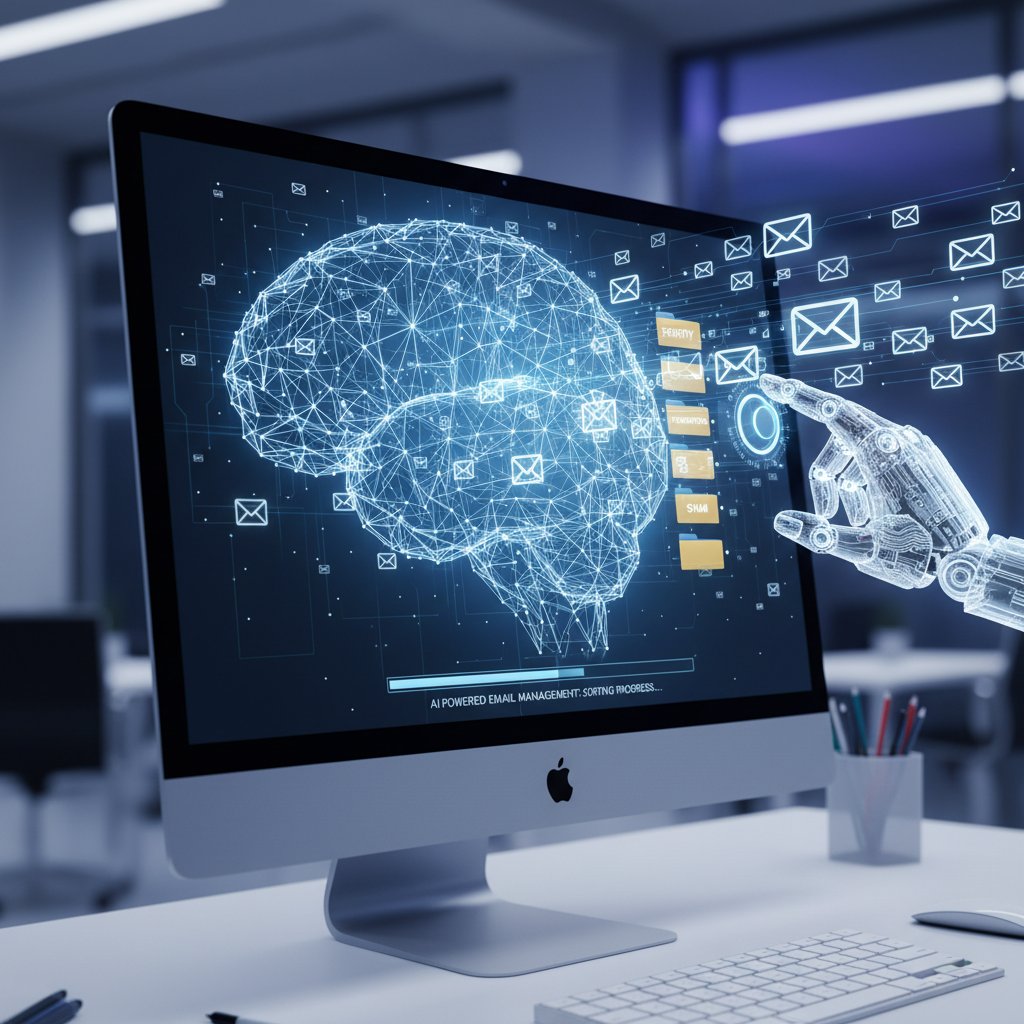
AI-powered email management is not just a smarter spam filter—it’s a paradigm shift. Modern solutions, like those inspired by the approach at futurecoworker.ai, deploy machine learning and natural language processing (NLP) to parse each message, extract intent, and classify not just “what” but “why.” The AI continuously prioritizes, delegates, and even suggests actions, learning from patterns across your entire organization while respecting privacy protocols. What sets these systems apart is their fluid contextual awareness: they evolve with your workflows, understanding urgency, hierarchy, and even the subtle cues that mark genuine opportunities from digital noise.
From spam filters to strategic partner: The AI leap
Yesterday’s “smart” email meant crude keyword filters and basic auto-replies. Today’s AI-powered tools have leapt from reactive scripts to proactive teammates, acting on context rather than just triggers. This evolution hinges on three key concepts:
- NLP (Natural Language Processing): Enables the AI to understand nuance, intent, and sentiment within emails, so it can distinguish between “urgent client issue” and “FYI update.”
- Contextual relevance: Rather than treating every email as equal, the system weighs sender, timing, thread history, and current workload.
- Automated triage: The AI sorts and delegates, assigning tasks, archiving noise, and flagging true priorities—often before you even open your inbox.
Definition List: Key AI Concepts
NLP refers to the AI’s ability to read, interpret, and even “understand” human language. In practice, this means it can spot subtle cues, sarcasm, or urgency that would baffle a simple rule-based system.
This is the AI’s capacity to weigh the importance of a message in relation to your work, team, and organizational goals—transforming the inbox from a chaotic list into a prioritized workflow.
The process by which the AI sorts, filters, and delegates emails, effectively acting as a first-line “digital assistant” and freeing humans for more strategic decisions.
Inside the black box: How does your AI coworker decide?
When an email lands, your AI-powered assistant doesn’t just tick boxes. It parses sender history, project context, even the social dynamics of your team. As Lena, an AI research lead, notes, > “The best AI doesn’t just sort—it reads between the lines.”
— Lena, AI Research Lead
The result is a system that anticipates needs, flags ambiguities for human review, and continuously refines its decision-making through feedback loops—while guarding against overreach or “black box” opacity by keeping humans firmly in the loop.
Debunking the myths: AI email management isn’t what you think
Myth vs. reality: Will AI take your job?
The specter of AI replacing humans haunts every discussion about automation. Yet, research from Statista (2024) shows 98% of companies plan to invest in AI email tools, and only a minority view this as a threat to core jobs. The reality is more nuanced: AI-powered email management offloads grunt work but creates new value in insight, creativity, and collaboration—areas where humans still reign. The winners are those who adapt, not those who resist.
Hidden benefits of AI-powered email management experts won't tell you:
- Sharper focus: By eliminating micro-decisions, AI frees you to tackle deeper, strategic work—think client negotiation, not inbox triage.
- Reduced burnout: Automated follow-ups mean fewer dropped balls and less anxiety about forgotten tasks.
- Fairer collaboration: AI levels the playing field by surfacing forgotten voices and tracking contributions objectively.
- Enhanced work-life boundaries: With AI gatekeeping after-hours email, employees reclaim personal time, reducing stress.
- Continuous learning: The AI adapts to your evolving style, improving with every interaction—something static rules could never do.
The privacy paradox: Who’s really reading your emails?
Nothing triggers organizational anxiety like the specter of privacy breaches. Legitimate concerns exist: who owns your communication data, and how is it used? Leading AI-powered email management platforms now tout end-to-end encryption, on-device processing, and strict adherence to protocols like SPF, DKIM, and DMARC. Yet, vigilance is critical—always demand transparency from vendors and scrutinize data handling policies.
| Tool (Anonymized) | Encryption Type | Data Storage Location | Human Oversight | User Control Features |
|---|---|---|---|---|
| Tool A | End-to-end | Local + Cloud | Optional | Granular |
| Tool B | In-transit only | Cloud | Default | Limited |
| Tool C | End-to-end | On-device | None | Full |
| Tool D | In-transit + at rest | Cloud | Optional | Granular |
Table 2: Privacy features and data handling policies among top AI-powered email management tools (anonymized for comparison).
Source: Original analysis based on vendor documentation, 2024.
AI bias and blind spots: What could go wrong?
For all their strengths, AI-driven systems are not immune to bias or missteps. A Zscaler ThreatLabz report highlights the rise of AI-driven phishing attacks that bypass traditional filters, while product strategists warn that algorithms can miss nuance—like the difference between sarcasm and urgency—with real-world consequences. As Priya, a product strategist, cautions, > “AI can miss context that’s obvious to humans—sometimes with real consequences.”
— Priya, Product Strategist
The lesson: AI is a teammate, not a replacement for human judgment.
Case studies: AI email in the wild
A day in the life: How enterprises use AI email coworkers
Take a mid-sized technology company grappling with project overload and rampant email sprawl. After deploying AI-powered email management, team leaders reported a 25% improvement in project delivery speed, as the AI automatically converted relevant emails into tasks, flagged urgent issues, and silenced irrelevant threads. The initial learning curve was real—some worried about losing control—but the breakthrough came when staff realized the AI was surfacing conversations and deadlines previously buried in the noise. Similar transformations are playing out in marketing agencies, finance firms, and even healthcare providers, each leveraging AI to reclaim hours lost to chaos.

Lessons from failure: When AI email goes off the rails
Not every story is a triumph. In one cautionary tale, a finance firm’s AI, misconfigured during onboarding, began auto-archiving key client emails as “low priority,” resulting in missed deadlines and a near-loss of a major account. Recovery required a reset, with humans reviewing and correcting the AI’s early misjudgments—a powerful reminder that oversight is non-negotiable.
Timeline of AI-powered email management evolution:
- Pre-2015: Basic spam filters set the stage, but fail to address context or workflow.
- 2016–2018: Rule-based automation emerges, offering some relief but breaking under complexity.
- 2019–2022: NLP-powered sorting allows for smarter categorization but still requires manual checks.
- 2023: Context-aware AI assistants debut, automating triage and task assignment with impressive results.
- 2024: First large-scale failures provoke debate on transparency, privacy, and human oversight.
- 2024-present: Human-in-the-loop models become the norm, balancing efficiency with judgment.
Winning strategies: What separates leaders from laggards
What do the most successful adopters do differently? They treat AI as a coworker, not a threat—investing in training, feedback loops, and transparent governance. Leaders actively engage with the technology, setting clear boundaries and review processes, while laggards hope for autopilot and suffer as a result.
Checklist: Priority items for evaluating AI-powered email management readiness
- Audit your current email workflow for bottlenecks and blind spots.
- Demand vendor transparency on data handling and AI decision logic.
- Establish human-in-the-loop protocols from day one.
- Train staff on both possibilities and limitations of the AI system.
- Regularly review AI-driven actions and solicit user feedback.
- Secure executive buy-in for sustained adoption, not just pilot programs.
The psychology of outsourcing your digital brain
Cognitive offloading: Relief or risk?
Handing over email triage to an AI is like handing your keys to a valet—relief laced with anxiety. On one hand, studies confirm that “cognitive offloading” can lower stress and boost creativity by freeing up working memory. On the other, over-reliance risks erosion of critical skills and situational awareness, a phenomenon dubbed “digital amnesia” by organizational psychologists. Striking the right balance is the enterprise’s next big challenge.

Trust issues: When to let go and when to take control
Trusting an algorithm with your most sensitive communications isn’t a binary choice. Building healthy boundaries means maintaining visibility, setting override protocols, and routinely checking the AI’s work. When it comes to digital coworkers, blind faith is as dangerous as knee-jerk suspicion.
Red flags to watch out for when setting up AI-powered email management:
- Opaque decision-making: If you can’t explain why an email was flagged or ignored, demand more transparency.
- One-size-fits-all rules: Effective AI must adapt to your team’s unique workflows, not force you into rigid templates.
- No review mechanism: Lack of easy overrides and audit trails is a recipe for disaster.
- Vendor lock-in: Beware platforms that make it hard to export data or switch providers.
- Missing compliance features: For regulated industries, lack of compliance tools is a non-starter.
The new etiquette: How AI email changes collaboration dynamics
AI doesn’t just change how you process email—it changes how you work together. Old norms crumble as AI streamlines delegation, tracks conversation threads, and even mediates disputes by providing objective records. The result? New forms of recognition and power, but also new losers—those slow to adapt or who rely on informal “side channel” communication.
| Collaboration Feature | Pre-AI Adoption | Post-AI Adoption | Who Wins? |
|---|---|---|---|
| Task assignment speed | Manual, slow | Automated, near-instant | Proactive teams |
| Decision transparency | Patchy, uneven | Systematic, logged | Data-driven staff |
| Micromanagement risk | High | Reduced | Self-starters |
| Email overload | Endemic | Controlled | All users |
| Informal influence (gatekeeping) | Common | Disrupted | Clear communicators |
| Work-life boundaries | Blurred | Reinforced | Everyone |
Table 3: Feature matrix showing collaboration changes before and after AI-powered email management adoption.
Source: Original analysis based on real-world case studies, 2024.
Choosing and implementing an AI-powered email coworker
What to look for: Beyond the buzzwords
With every vendor touting “intelligent automation,” separating hype from substance is a survival skill. The best AI-powered email management tools offer not just automation but adaptability—learning your team’s quirks, integrating smoothly with legacy systems, and providing transparency at every step.
Step-by-step guide to mastering AI-powered email management:
- Needs assessment: Map your current pain points; don’t buy tech for tech’s sake.
- Vendor due diligence: Insist on clear explanations of AI logic and privacy safeguards.
- Stakeholder engagement: Involve frontline users early; their buy-in will make or break adoption.
- Pilot phase: Start small, gather data, iterate rapidly.
- Human-in-the-loop setup: Define clear override and feedback processes.
- Training and change management: Equip your team for new workflows and norms.
- Continuous review: Set metrics, audit decisions, drive improvement.
Integration headaches: The messy side of adoption
Integration is rarely smooth. Legacy systems resist change, IT departments groan under the weight of tangled APIs, and users cling to old habits. Even the best AI-powered tools require careful orchestration to avoid data silos, duplicated efforts, or outright rebellion. The reward for persistence is a step-change in efficiency—and a more resilient digital culture.

Checklist: Are you ready for an AI email coworker?
Before you leap, run a quick self-assessment. Is your data infrastructure robust? Are your teams open to new workflows? Do you have buy-in from leadership and a plan for oversight? If you can’t answer “yes” to these, pause and regroup.
Definition List: Key Terms
Systems and solutions adopted by employees without official approval, often leading to security risks and workflow fragmentation.
The design and deployment of systems (often AI-powered) that streamline repetitive tasks and communications in business processes.
AI systems designed to keep humans involved in key decisions, ensuring oversight, accountability, and adaptability.
Controversies, risks, and the future of digital coworkers
Who owns your digital labor?
The rise of AI-powered email management raises sharp questions about data ownership and digital labor rights. When your AI coworker transforms your communications into actionable insights, who “owns” the output? Organizations must grapple with the shifting balance of power—protecting both user privacy and organizational value in a landscape where digital labor is increasingly codified.

The surveillance dilemma: Productivity vs. privacy
AI-driven monitoring can boost productivity—but at what cost? Invasive analytics and overbearing dashboards risk creating a surveillance culture that erodes trust. The ethical dilemma is real: how much oversight is too much?
Unconventional uses for AI-powered email management:
- Early fraud detection: Flagging anomalous communication patterns to spot insider threats.
- Sentiment analysis for leadership: Providing C-suite with pulse checks on morale and engagement.
- Supply chain resilience: Mapping communication bottlenecks to preempt disruptions.
- Merger/acquisition due diligence: Analyzing email networks for hidden risk or opportunity.
- Emergent disaster response: Rapidly triaging communications in crisis situations.
Each offers tantalizing benefits—and equally potent risks—demanding clear governance.
Regulation, compliance, and the legal gray zone
The legal landscape for AI workplace tools is in flux. New GDPR-like rules in Europe and evolving US state laws are forcing vendors and users alike to upgrade protocols, document consent, and embrace auditability.
| Year | Regulatory Event | Impact on AI Email Management |
|---|---|---|
| 2020 | CCPA goes into effect (California) | New consent/review requirements for automated communication |
| 2022 | GDPR clarifications (EU) | Tighter controls on automated decision-making, data subject rights |
| 2023 | AI Act draft (EU) | Explicit guidelines for workplace AI tools, risk-tier documentation |
| 2024 | DMARC enforcement (Global ISPs) | Mandatory authentication for all bulk senders, reducing spoofing |
Table 4: Timeline of major regulatory changes impacting AI-powered email management.
Source: Original analysis based on official legislative summaries, 2024.
The road ahead: AI, collaboration, and the meaning of work
From automation to augmentation: The new coworker paradigm
AI-powered email management is not about replacing humans—it’s about freeing us from the tyranny of the trivial. As Alex, founder at a tech startup, puts it, > “It’s not about replacing people—it’s about making space for higher-value work.”
— Alex, Founder, Tech Startup
Platforms like futurecoworker.ai embody this shift, acting less like tools and more like colleagues—augmenting your decisions, surfacing hidden priorities, and letting humans do what humans do best.
Cultural shifts: How AI email is redefining success
Success metrics are changing. It’s not just about clearing your inbox fastest, but about strategic clarity, effective collaboration, and creative output. Teams embracing AI-powered email management celebrate efficiency and work-life balance, while organizations clinging to manual methods risk falling behind—not just in output, but in employee satisfaction.

What’s next? Emerging trends and the next disruption
Emotion-aware AI, seamless cross-platform collaboration, and “invisible teammates” are already reshaping the landscape. The next disruption may not be a killer app, but a culture that values augmentation over automation and insight over inbox zero.
Priority checklist for staying ahead in AI-powered email management:
- Invest in ongoing training and digital literacy for all staff.
- Prioritize transparent, auditable AI systems.
- Establish clear policies for human-AI collaboration and override.
- Regularly review privacy, compliance, and ethical standards.
- Foster a culture of feedback, adaptability, and continuous improvement.
- Benchmark not just productivity, but employee experience and satisfaction.
Conclusion: Are you ready to meet your intelligent enterprise teammate?
AI-powered email management isn’t just a tool—it’s a tectonic shift in how enterprises operate, collaborate, and compete. As the evidence shows, those willing to adapt reap seismic benefits: sharper focus, less burnout, stronger collaboration, and a culture built for the complexity of modern work. But this revolution brings new questions too: about trust, privacy, and the very nature of digital labor. The challenge isn’t whether you’ll adopt an AI coworker, but what kind you’ll choose—and what kind of workplace you’ll create in the process. If you’re ready to elevate your organization’s productivity and collaboration, resources like futurecoworker.ai are helping enterprises lead the way into this new era. The only question left: Are you ready to make your inbox—and your enterprise—a place where intelligence works for you?
Sources
References cited in this article
- Market.us(market.us)
- Statista(statista.com)
- Selzy(selzy.com)
- Email on Acid(emailonacid.com)
- Trimbox(trimbox.io)
- IMD(imd.org)
- Zscaler ThreatLabz(info.zscaler.com)
- AI Briefing Room(aibriefingroom.com)
- LinkedIn(linkedin.com)
- CSIS(csis.org)
- Geneva Academy(geneva-academy.ch)
- Validity(validity.com)
- IBM Breach Report(f12.net)
- Radicati(radicati.com)
- Front.com(front.com)
- Trimbox(trimbox.io)
- Expert.ai(expert.ai)
- Mailsoftly(mailsoftly.com)
- Trimbox(trimbox.io)
- G2 Research(research.g2.com)
- Validity(validity.com)
- Salesforce(salesforce.com)
- Acronis(acronis.com)
- Gmelius(gmelius.com)
- TIME(time.com)
- SEMrush(us.semrush.com)
- Forbes(forbes.com)
- Indeed(indeed.com)
- Express Computer(expresscomputer.in)
- Bigly Sales(biglysales.com)
- Team-GPT(team-gpt.com)
- Mosaikx(mosaikx.com)
- Ubuntu Village(ubuntuvillageusa.org)
- LessWrong(lesswrong.com)
- Washington Post(washingtonpost.com)
- NextPedia(nextpedia.io)
- MaestroLabs(maestrolabs.com)
- DigitalOcean(digitalocean.com)
- Training Industry(trainingindustry.com)
- Eric.ai(eric.ai)
- MIT Sloan(sloanreview.mit.edu)
- Canary Mail(canarymail.io)
- DQ India(dqindia.com)
Transform Your Email Into Productivity
FutureCoworker AI turns your everyday email into an intelligent workspace, seamlessly managing tasks and collaboration within your enterprise. It eliminates the complexity of AI, allowing you to benefit from advanced technology without any technical knowledge. Achieve productivity, streamline processes, and improve team efficiency through natural email interaction, getting tasks done faster and smarter.
Get startedReady to Transform Your Email?
Start automating your tasks and boost productivity today
Frequently Asked Questions
How many emails are sent and received globally each day?
According to Vibromedia, 347.3 billion emails were sent and received each day as of 2023, reflecting a relentless escalation that has left knowledge workers overwhelmed.
What are the hidden costs of unmanaged email beyond lost time?
Beyond lost hours, unmanaged email leads to decision fatigue, stress-related absenteeism, and strategic paralysis in organizations, contributing to burnout and missed opportunities.
How has email volume increased for UK employers in early 2024?
UK employers reported a 59% increase in applications per role in early 2024, much of which was funneled through email, amplifying noise and causing critical messages to slip through the cracks.
Why did 56% of companies increase their email marketing budgets according to a 2023 Selzy survey?
Companies increased their email marketing budgets not because email was efficient, but because they lacked the tools to cut through the clutter and manage the overwhelming volume of messages.
Continue Reading
Keep exploring Intelligent enterprise teammate

Email Expert Skills in the Age of AI Coworkers
Email expert skills are evolving as AI transforms enterprise collaboration. This article examines how artificial intelligence reshapes inbox management and productivity strategies.

AI-Driven Email Collaboration and the Quiet Rewrite of Workplace Power
Discover insights about AI-driven email collaboration

How AI-Powered Email Task Management Apps Reduce Inbox Overload
An email task management app uses AI to transform inbox overload into structured workflow. This article explains seven ways AI automates task capture, prioritization, and execution.

Email-Focused Productivity in the Age of AI Coworkers
Discover insights about email-focused productivity

Expert in Inbox: the AI Coworker That Rewrites How You Work
Discover insights about expert in inbox

Email Help: Why Traditional Strategies Fail and AI Changes the Game
Email help strategies often fail against digital overload. This article examines why inboxes cause productivity loss and how AI-powered email help is changing the landscape.