


What a Work From Home Coordinator Actually Does: Real Challenges and Strategies
Written with AI assistance under our editorial guidelines
The work from home coordinator role emerged from 2020's rapid shift to remote work as companies realized managing distributed teams required dedicated coordination. By 2024, hybrid positions grew significantly, making coordinators essential for bridging communication gaps and preventing team dysfunction. However, the role lacks universal definition and carries serious burnout risks without proper support and boundaries.
The corporate world loves buzzwords. Every few years, a new job title appears that’s supposed to be the secret sauce for efficiency, well-being, and digital transformation. Enter the work from home coordinator—supposedly the backbone of remote operations, the fixer of all things virtual, the ultimate conductor of the distributed orchestra. But peel back the glossy recruitment ads and LinkedIn headlines, and you’ll find a messier, more nuanced reality. The role isn’t universally defined, often misunderstood, and, quite frankly, a magnet for burnout if you walk into it blind. Yet, done right, it can be a career-defining gig that transforms teams and futures. This guide doesn’t sugarcoat the challenges of remote coordination. Instead, it delivers the raw, data-backed truths and offers strategies to thrive—because in 2025, the only thing more dangerous than working from home without a coordinator is believing one person alone can tame the chaos.
The rise (and myth) of the work from home coordinator
How remote work changed everything
The last decade has been a relentless experiment in workplace evolution. Remote work, once reserved for digital nomads and startups, exploded in scale after 2020. According to research from Pumble (2024), only 25% of companies offered fully flexible remote work in 2024, down from 31% in 2023. Yet, the hybrid model surged: in late 2024, 23% of new job postings were hybrid, a massive leap from 9% in early 2023 (Robert Half, 2024). This seismic shift didn’t just change where we work—it transformed how work is organized, communicated, and managed.
Suddenly, companies realized that digital tools and policies weren’t enough. There needed to be someone—part project manager, part therapist, part digital native—who could bridge the gaps left by the absence of physical offices. That’s how the work from home coordinator role was born: not from a master plan, but as a firefighting measure to keep distributed teams from tearing themselves apart.

| Year | Key Event | Coordinator Role Evolution |
|---|---|---|
| 2010 | Video conferencing mainstreams | Early adopters manage by email/phone |
| 2015 | Rise of Slack, Asana, Trello | Team leads handle coordination informally |
| 2020 | Global remote work surge (COVID) | Remote coordinator emerges in large firms |
| 2022 | Hybrid models dominate | Coordinator role formalized in some sectors |
| 2024 | 25% companies fully remote; 23% new hybrid postings | Coordinator as “glue” in distributed orgs |
| 2025 | AI-powered tools adopted | Coordinator’s job blends with automation |
Table 1: Timeline of the evolution of remote work coordinator roles, 2010-2025.
Source: Original analysis based on Pumble, 2024, Robert Half, 2024
Why everyone thinks coordination is easy (and why it isn’t)
It’s tempting to view remote coordination as a string of calendar invites, Slack reminders, and the occasional Zoom party. This surface-level impression feeds a dangerous myth: that anyone with basic digital skills can handle the job. In reality, remote coordination is a high-wire act—juggling shifting priorities, time zones, tech meltdowns, and the emotional weather of multiple teams, all without the benefit of hallway conversations or reading the room.
-
Myth 1: “It’s just about scheduling meetings.”
Reality-check: Coordinators are expected to anticipate conflicts, mediate misunderstandings, and shepherd projects through digital minefields—far beyond sending invites. -
Myth 2: “You can automate most of it.”
Reality-check: Automation helps, but human judgment, nuance, and empathy are irreplaceable, especially during crises. -
Myth 3: “Anyone who uses Slack can coordinate remotely.”
Reality-check: Platform familiarity is the baseline; real coordination requires leadership, negotiation, and cultural awareness. -
Myth 4: “Remote teams manage themselves.”
Reality-check: Without oversight, silos form, deadlines slip, and morale tanks. -
Myth 5: “Remote coordinators have less work.”
Reality-check: The workload is often higher—more documentation, more check-ins, more troubleshooting. -
Myth 6: “It’s a soft job for soft skills.”
Reality-check: It’s a hybrid role—part analyst, part communicator, part firefighter. -
Myth 7: “Anyone can learn it on the fly.”
Reality-check: The learning curve is steep, and the cost of mistakes is real—lost productivity, missed deadlines, broken trust.
"Most people only see the calendar invites, not the chaos behind the scenes." — Alex, remote coordinator
What companies get wrong about remote coordination
Organizations routinely stumble at the first hurdle by assuming that digital tools and a handful of policies are all that’s needed. Too many firms dump coordination tasks onto overworked managers or HR staff, skimping on specific training or support. They mistake the presence of a coordinator for a panacea, ignoring the underlying need for a culture of communication, trust, and clear expectations.
Consequences? Burnout soars, projects stall, and team morale nosedives. According to Owl Labs (via Pumble, 2024), 31% of employees would consider quitting if their remote flexibility vanished—down from 66% in 2023, but still a powerful signal that remote work and its coordination are not “nice-to-haves” anymore—they’re critical retention levers.
Red flags to watch out for:
- Coordinator duties tacked onto another full-time role without extra compensation or training
- Reliance on outdated tools or platforms that don’t integrate seamlessly
- Vague job descriptions with no clear KPIs or authority
- Poor documentation of team processes and responsibilities
- No plan for handling cross-timezone communications or cultural differences
- Absence of feedback loops for continuous improvement
- Lack of buy-in from leadership, treating remote coordination as “admin work”
Behind the screen: what a work from home coordinator really does
Breaking down the real job description
Forget the sanitized corporate job postings. The daily grind of a work from home coordinator is a masterclass in organized chaos. Mornings might begin with triaging overnight Slack threads from three continents, untangling a calendar snarl involving six overlapping time zones, and prepping a crisis plan for an “urgent” product bug. Weekly tasks include running pulse surveys, onboarding new hires, documenting processes, and acting as the digital glue for project launches. Monthly, it’s about auditing workflows, analyzing productivity metrics, and championing cultural rituals—like virtual coffee chats or online hackathons—that keep distributed teams human.
| Responsibility | Tech Industry | Healthcare | Creative Sector |
|---|---|---|---|
| Daily standups | Yes, cross-team syncs | Patient/staff handoffs | Project kickoffs, client briefs |
| Scheduling & calendar mgmt | Complex, global teams | Strict compliance windows | Flexible, shifting timelines |
| Documentation | Product specs, SOPs | Policy updates, compliance | Creative briefs, feedback |
| Conflict mediation | High (multi-role teams) | Moderate (hierarchy) | Frequent (client feedback) |
| Onboarding | Automated, tool-heavy | Blend of digital & in-person | Informal, mentorship-based |
Table 2: Feature matrix comparing work from home coordinator responsibilities across sectors.
Source: Original analysis based on Been Remote, 2024, ArchieApp, 2024

The hidden labor: emotional intelligence and digital presence
There’s a dark secret to remote coordination: the labor you can’t measure in dashboards. It’s the emotional heavy lifting—knowing who’s on the verge of burnout, who needs a public win, who’s quietly disengaging. Coordinators become cultural stewards, empathy engines, and the “emotional thermostat” for entire teams.
"You can’t just be a taskmaster—you’re the team’s emotional thermostat." — Jamie, HR lead
Emotional intelligence
The “sixth sense” of the digital workplace. It means reading between the lines of a terse email, noticing a pattern of muted Slack responses, and knowing when to reach out privately.
Example: A coordinator spots a sudden drop in team participation and initiates a one-on-one to address issues before they escalate.
Asynchronous communication
Not just a buzzword, but a survival skill. Asynch mastery means crafting clear, context-rich messages that don’t require real-time replies—crucial for global teams.
Example: Coordinators document decisions and next steps in shared channels, reducing confusion and repeat questions.
Digital presence
Projecting confidence, warmth, and leadership through a screen is an art. Digital presence is about being visible, accessible, and trusted in the absence of physical proximity.
Example: Regular video updates, active participation in discussions, and celebrating wins publicly.
A day in the life: real stories from the trenches
7:00 AM: Priya, a startup coordinator in Bangalore, scans Slack for blockers and sends custom reminders before the US team logs in.
9:30 AM: Mike, in healthcare, starts his day with a cross-department huddle, troubleshooting a last-minute schedule change for a nurse working remotely due to illness.
2:00 PM: Lena, a coordinator at a global NGO, juggles translation requests, donor updates, and a spontaneous emergency call from the West Africa team.
4:00 PM: Priya drafts a process improvement plan, while Lena hosts a virtual “coffee connect” to keep spirits up.
6:00 PM: Mike audits compliance logs before logging off, knowing he’ll be “on call” for overnight disruptions.

Skills that separate the best from the rest
Technical must-haves (and the ones you can fake)
Mastering digital platforms is table stakes. But it’s not about having every badge on your LinkedIn—it’s about using tools to solve real problems. The best coordinators build nimble stacks, lean into automation where it counts, and know when to switch off the tech and pick up the phone.
- Slack: Real-time troubleshooting, automated reminders, and pulse checks
- Asana/Trello: Task tracking, project board management, cross-team transparency
- Zoom/Google Meet: Hosting meetings, breakout sessions, digital whiteboarding
- Miro/FigJam: Facilitating interactive workshops and brainstorming remotely
- Notion/Confluence: Documentation, process wikis, and knowledge management
- FutureCoworker.ai: Email-based collaboration, intelligent task automation (a major asset for coordination at scale)
- Loom: Quick video updates, onboarding walkthroughs
Some skills—like platform setup or template creation—are teachable. But others, like crisis management or digital diplomacy, must be hardwired or developed through hard-won experience.
Soft skills you can’t automate (yet)
No AI has matched the human art of negotiation, empathy, and inspiring trust. The invisible currency of a great work from home coordinator is their ability to defuse tension, nurture culture, and build psychological safety—especially when the WiFi’s shaky and tempers flare.
- Practice radical transparency: Share all relevant context to avoid confusion and mistrust.
- Develop active listening: Don’t just wait for your turn to speak—really absorb what’s being said (and unsaid).
- Set clear boundaries: Model sustainable work hours and discourage digital presenteeism.
- Master feedback loops: Give and receive feedback constructively—privately when necessary, publicly when deserved.
- Cultivate resilience: Bounce back from setbacks and model calm during digital emergencies.
- Embrace diversity: Adapt your communication and leadership style across cultures and personalities.
- Lead by example: Demonstrate integrity, follow through on promises, and advocate for your team’s needs.
Where most coordinators stumble (and how to avoid it)
Falling into the “order taker” trap—merely processing requests without influencing outcomes—is a fast track to invisibility and exhaustion. Other common pitfalls include over-relying on tech, failing to document decisions, and neglecting self-care.
Hidden benefits only seasoned coordinators reveal:
- Influence: Coordinators often become trusted advisors to leadership, shaping policy.
- Flexibility: The role can be less about hours clocked, more about outcomes.
- Skill stacking: You’ll hone skills in project management, HR, tech, and even psychology.
- Global exposure: Coordinators frequently work cross-culturally, accelerating learning.
- Career mobility: Mastery opens doors to operations leadership, consulting, or specialized project management.
To sidestep burnout: schedule regular digital detoxes, set hard stop times, and build a network of peer coordinators for moral support.
Pay, perks, and brutal trade-offs: the economics of coordination
Salary realities in 2025
Compensation for work from home coordinators varies wildly—by industry, geography, and company size. According to aggregate data from Been Remote (2024), the average salary for coordinators in North America hovers between $55,000 and $85,000 USD, with tech and healthcare on the upper end. In Europe, averages are €35,000-€60,000, while roles in Asia and Latin America track lower, often due to regional cost-of-living differences. Notably, coordinators who leverage their digital and cross-functional skills often command higher rates, especially in fast-scaling tech companies.
| Region | Tech Industry | Healthcare | Creative Sector |
|---|---|---|---|
| North America | $70,000-$90,000 | $65,000-$80,000 | $55,000-$75,000 |
| Europe | €50,000-€75,000 | €45,000-€65,000 | €35,000-€60,000 |
| Asia | $30,000-$50,000 | $28,000-$48,000 | $25,000-$45,000 |
| Latin America | $22,000-$40,000 | $20,000-$38,000 | $18,000-$35,000 |
Table 3: Statistical summary of coordinator salaries by region and sector, 2025 data.
Source: Original analysis based on Been Remote, 2024, Robert Half, 2024
"The pay can be great—if you know how to leverage your skills." — Taylor, remote consultant
Perks, benefits, and hidden costs
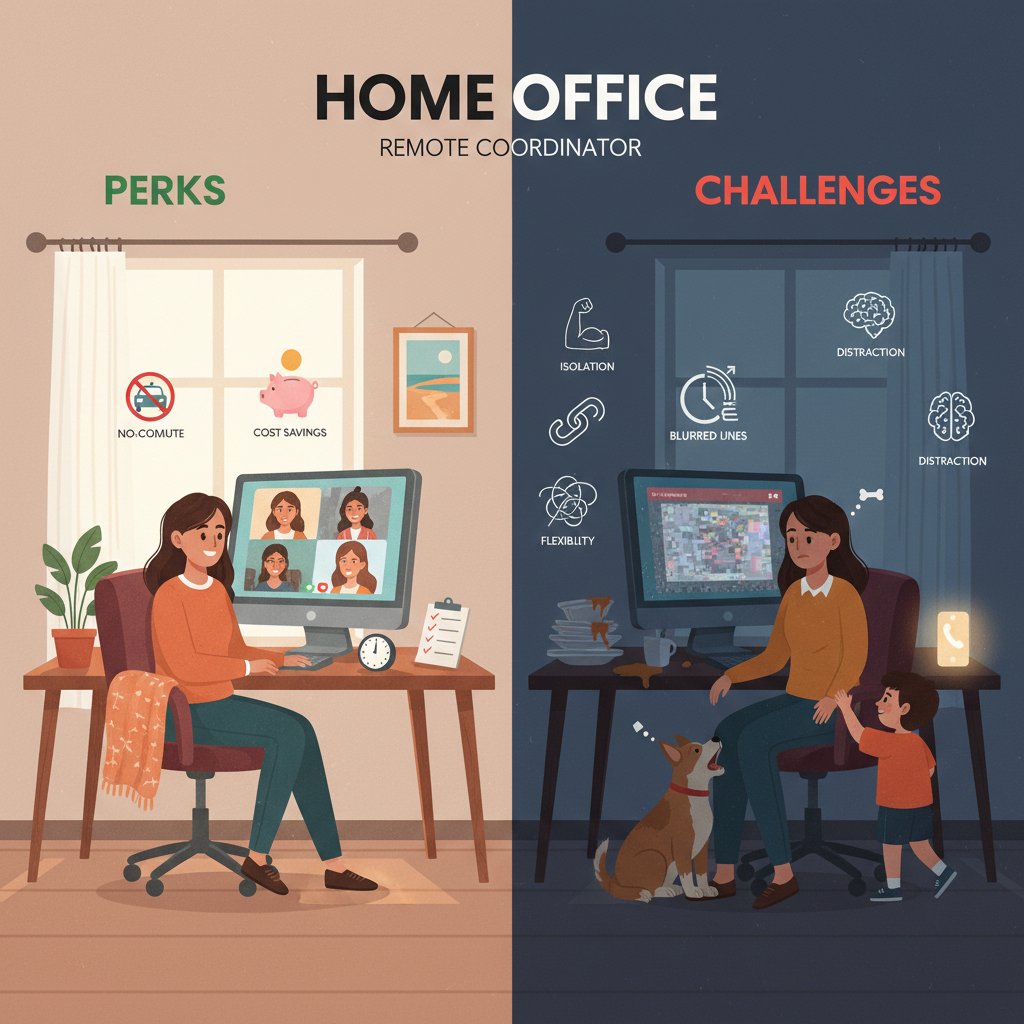
Remote coordination comes with perks tailored for digital work—and hidden costs that rarely make the job posting.
Six unconventional perks:
- Home office stipends (covering ergonomic chairs, monitors, or even coffee subscriptions)
- Quarterly wellness budgets (for online therapy, yoga, or mental health days)
- Annual learning allowances (covering online courses or certifications)
- Flexible hours (as long as KPIs are met, clock in when you want)
- “No meeting” days (to ensure deep work)
- Paid digital retreats (virtual team-building experiences)
Four hidden costs:
- Out-of-pocket tech upgrades (not every employer covers high-speed internet or new laptops)
- Emotional taxation (virtual empathy is draining, especially across cultures)
- Social isolation (missing out on office banter and spontaneous connection)
- Blurred boundaries (work-life balance evaporates without discipline)
Cost-benefit analysis: is it worth it?
Is being a work from home coordinator worth the grind? The answer, predictably, is “it depends.” For those who crave autonomy, love digital problem-solving, and have the stamina for emotional labor, it’s a ticket to a high-impact, flexible career. For others, the stress and ambiguity can be overwhelming.
| Benefit/Cost | Salary | Perks | Risks | Advancement |
|---|---|---|---|---|
| High-caliber firms | $$$$ | Top-tier | Burnout, visibility | Fast track |
| SMEs | $$ | Variable | Role creep | Lateral moves |
| Freelance/contract | $-$$$ | Flex-only | Lack of benefits | Portfolio growth |
Table 4: Cost-benefit matrix—salary, perks, risks, and advancement potential for work from home coordinators.
Source: Original analysis based on Pumble, 2024, Been Remote, 2024
Those who thrive are organized, tech-savvy, and resilient. Anyone seeking rigid hierarchies or constant handholding should look elsewhere.
Remote chaos: challenges and how pros handle them
The dark side: burnout, miscommunication, and tech overwhelm
The glamour of working in pajamas fades quickly when you’re fielding midnight messages, untangling digital drama, or racing to fix a platform outage. According to current statistics (Pumble, 2024), 31% of employees would consider leaving if remote flexibility vanished—a clear sign that pressure remains high on coordinators to keep the system running smoothly.
Seven major red flags for burnout or system breakdown:
- Chronic after-hours pings (well after you sign off)
- Lengthy, unfocused meetings draining willpower
- Conflicting instructions from different managers
- Unclear or shifting priorities
- No documentation or onboarding support
- Silos forming between remote and in-office teams
- Unaddressed conflicts simmering below the surface

Smart solutions: what actually works
The best remote coordinators don’t just survive chaos—they build systems to prevent it. Top strategies include ruthlessly prioritizing tasks, automating repeat processes, and carving out non-negotiable downtime.
8-step checklist for managing remote chaos:
- Prioritize ruthlessly: Triage tasks daily—what’s truly urgent vs. what can wait.
- Automate workflows: Use AI-powered tools like futurecoworker.ai for task and email automation.
- Document decisions: Keep running logs of all major decisions and next steps.
- Enforce boundaries: Set (and stick to) core work hours; communicate them clearly.
- Rotate meeting leads: Prevent “Zoom fatigue” by rotating facilitation.
- Do regular retros: Weekly reviews to identify bottlenecks and celebrate wins.
- Practice digital detox: Schedule regular screen-free breaks—no exceptions.
- Check in on mental health: Foster psychological safety with regular, informal check-ins.
AI-driven platforms, such as futurecoworker.ai, are now essential allies—handling the grunt work so coordinators can focus on strategy and human connection.
Case studies: companies that cracked the code
Three organizations stand out:
Tech Unicorn: Introduced “asynchronous Mondays” (no meetings) and automated task reminders with futurecoworker.ai, slashing project delays by 30%.
Healthcare Chain: Implemented cross-functional coordinator roles, investing in digital training and peer-to-peer mentorship, resulting in a 20% reduction in error rates.
NGO: Built a “culture playbook” and used global pulse surveys to spot and address remote engagement gaps, boosting donor satisfaction scores to record highs.
The tech stack arms race: tools, traps, and future trends
Today’s essential tools (and why less is more)
The temptation to onboard every new digital tool is real—but more isn’t always better. The smartest coordinators keep their tech stacks lean and focused.
- Slack: Pro—ubiquitous, real-time. Con—information overload.
- Zoom: Pro—stable video, breakout rooms. Con—“Zoom fatigue.”
- Asana: Pro—task clarity. Con—setup complexity.
- Miro: Pro—visual brainstorming. Con—steep learning curve.
- Notion: Pro—central knowledge base. Con—can become a dumping ground.
- Loom: Pro—async video. Con—adds to notification noise.
- Futurecoworker.ai: Pro—email-driven, reduces context-switching. Con—requires initial workflow setup.
Over-tooling is the silent killer—each platform is another place for things to break or information to hide. Example: A mid-sized marketing firm added six new tools in six months, and productivity tanked as teams struggled to remember where anything lived.
Automation, AI, and the next wave
AI is everywhere in 2025, but the hype often outpaces reality. Automation can do the heavy lifting—automate routine tasks, triage emails, schedule meetings—but it can’t replace the judgment, empathy, and adaptability of a seasoned coordinator.
AI assistant: An intelligent agent that manages tasks, sends reminders, and flags urgent issues. Use case: Automatically sorting and assigning incoming tasks from a shared mailbox.
Workflow automation: Scripts or platforms that connect tools for seamless data flow. Use case: Triggering status updates in Slack when a project advances in Asana.
Digital coworker: An advanced system like futurecoworker.ai that blends with your email, automatically transforming messages into actionable tasks and keeping team members aligned.
For coordinators, these tools are force multipliers—if used thoughtfully.
When tech goes wrong: cautionary tales
There’s no shortage of horror stories:
- 2018: Fortune 500 firm suffers a week-long outage after a poorly configured workflow tool deletes key project boards.
- 2020: Healthcare group faces compliance penalties when a misconfigured chat bot exposes private data.
- 2022: Creative agency spends $15,000 on overlapping SaaS subscriptions, only to see team adoption plummet.
- 2023: Major retailer’s “all-in-one” communication suite overloads staff with pings, leading to mass burnout.
- 2024: Startup loses six months of documentation due to a failed migration between project management tools.
- 2025: NGO faces global miscommunication disaster after sudden shift to a new platform without training.
Best practices: Map your processes before layering on tools, audit your stack quarterly, and always pilot new platforms with a small team before full rollout.
Becoming a work from home coordinator: your step-by-step playbook
Assessing your fit: is this the right path?
Not everyone is cut out for the pressures and ambiguity of remote coordination. Self-awareness is your first defense. Key criteria:
- Do you thrive in high-autonomy settings?
- Can you manage ambiguity with poise?
- Are you comfortable learning new tech on the fly?
- Can you set and maintain boundaries?
- Do you enjoy facilitating rather than “being the boss”?
- Are you willing to document and over-communicate?
- Are you resilient under stress?
- Can you juggle multiple priorities without dropping balls?
If not, roles in operations, HR, or project management may offer a better fit.
Building your skills and portfolio
Mastery is earned through sweat and iteration. Here’s how to build a portfolio that stands out:
- Volunteer for cross-team projects—practice coordination in a low-risk environment.
- Document every process—showcase your ability to reduce chaos.
- Curate a library of templates—meeting agendas, retros, onboarding flows.
- Experiment with new platforms—demonstrate digital fluency.
- Get certified—consider project management or remote work credentials.
- Collect testimonials—from teams you’ve wrangled successfully.
- Contribute to remote work forums—demonstrate thought leadership.
- Publish case studies—highlighting challenges and solutions.
- Mentor or buddy up—support newer coordinators.
- Track impact metrics—show how your coordination improved outcomes.
Landing the job and surviving your first 90 days
Winning the job means acing behavioral interviews, demonstrating digital comfort, and sharing stories of remote rescue missions. The first 90 days demand humility—listening, absorbing culture, and incrementally improving processes without stepping on toes. Rookie mistakes: over-promising, under-documenting, or focusing on tools over relationships.

Adjacent roles and the future of remote team orchestration
How coordinators, project managers, and virtual assistants overlap (and differ)
The digital workplace is a Venn diagram of overlapping duties. Project managers own delivery; virtual assistants focus on admin; coordinators stitch it all together—driving process, culture, and execution.
| Role | Core Duties | Required Skills | Salary Range | Career Path |
|---|---|---|---|---|
| Coordinator | Team sync, process, culture | Communication, empathy, tech | $55k-$90k | Ops lead, consulting, PM |
| Project Manager | Delivery, scope, metrics | Planning, risk mgmt, leadership | $60k-$110k | Senior PM, program mgmt |
| Virtual Assistant | Admin, scheduling, support | Organization, tech, discretion | $30k-$60k | Ops, specialist roles |
Table 5: Comparison table of remote coordinator, project manager, and virtual assistant roles.
Source: Original analysis based on Been Remote, 2024, Robert Half, 2024
Hybrid roles are surging—think “operations coordinator” or “digital project lead”—blending the best of all worlds.
The next frontier: what’s coming for remote work
AI, globalization, asynchronous work, and rapidly diversifying teams are the current tectonic forces. The skills that matter now—empathy, process discipline, digital savvy—will only grow in importance.
"The future belongs to those who can coordinate humans and machines." — Riley, tech strategist
The role of the work from home coordinator is evolving into something more strategic—part orchestrator, part technologist, part culture carrier.
Common misconceptions about remote work and coordination
Five stubborn myths, debunked:
-
Myth: Remote means less work.
Reality: Coordinators often work more hours managing distributed chaos. -
Myth: Anyone can master remote tools.
Reality: Adoption is uneven; digital literacy is a journey. -
Myth: Remote teams don’t need culture.
Reality: Without it, teams drift, engagement drops, and productivity suffers. -
Myth: Coordinators are replaceable by bots.
Reality: AI handles grunt work; humans handle nuance. -
Myth: The biggest risk is slacking off.
Reality: Burnout, not laziness, is the real threat for dedicated teams.
The real-world impact: stories, controversies, and what comes next
How coordinators change companies—and lives
Great coordination has a ripple effect—employee retention spikes, projects land on time, and teams feel seen and heard. But botched coordination leaves wreckage: missed deadlines, eroded trust, and teams checking out for good.

Debates and controversies: the coordinator as gatekeeper
The coordinator role sits at the crossroads of autonomy and oversight. Some hail them as heroes; others see them as bureaucratic obstacles.
Arguments for and against proliferation:
- For: Creates accountability in distributed teams.
- Against: Risk of micromanagement and process bloat.
- For: Accelerates onboarding and reduces chaos.
- Against: Role creep—coordinators become catch-alls.
- For: Fosters digital culture and inclusion.
- Against: Can slow decision-making with too many check-ins.
Key takeaways and your next move
Here’s the unvarnished truth: the work from home coordinator role is as complex—and as rewarding—as you make it. There are pitfalls, yes, but also wild opportunities for those who operate with eyes wide open.
Priority checklist for current and aspiring coordinators:
- Build digital and soft skills in equal measure.
- Prioritize documentation and process clarity.
- Set and defend healthy boundaries.
- Audit your tech stack—less can be more.
- Seek mentorship and build your network.
- Track impact—measure what matters.
- Stay curious—experiment with new tools.
- Champion culture and celebrate wins.
- Protect your own mental health as fiercely as your team’s.
Remote work is here to stay, and so are its complexities. For deeper dives, case studies, and resources, futurecoworker.ai remains a trusted hub for coordination know-how and industry insights. Stay sharp, stay real, and remember: you’re not just fighting remote chaos—you’re shaping the future of work.
Sources
References cited in this article
- Pumble(pumble.com)
- Robert Half(roberthalf.com)
- Been Remote(beenremote.com)
- Splashtop(splashtop.com)
- ArchieApp(archieapp.co)
- Policy Options(policyoptions.irpp.org)
- Custom Virtual Office(customvirtualoffice.com)
- IEMLabs(iemlabs.com)
- Splashtop(splashtop.com)
- LA Times(latimes.com)
- Forbes(forbes.com)
- MIT Sloan(sloanreview.mit.edu)
- JobGether(jobgether.com)
- Shopify(shopify.com)
- Forbes(forbes.com)
- LinkedIn(linkedin.com)
- Yale Center for Emotional Intelligence(medicine.yale.edu)
- FlexJobs(flexjobs.com)
- TheTutorResource(thetutorresource.com)
- Forbes(forbes.com)
- Indeed(indeed.com)
- Bloomberg(sponsored.bloomberg.com)
- World Economic Forum 2023(weforum.org)
- AARP(aarp.org)
- ZipRecruiter(ziprecruiter.com)
- Business Insider(businessinsider.com)
- Toggl(toggl.com)
- Forbes(forbes.com)
- USA Today(usatoday.com)
- TravelPerk(travelperk.com)
- PeopleSpheres(peoplespheres.com)
- ThinkRemote(thinkremote.com)
- Oncology Practice Management(oncpracticemanagement.com)
- PRNewswire(prnewswire.com)
- SoftwareSuggest(softwaresuggest.com)
- PCWorld(pcworld.com)
- Forbes(forbes.com)
- Zylo SaaS Index(chiefmartec.com)
Transform Your Email Into Productivity
FutureCoworker AI turns your everyday email into an intelligent workspace, seamlessly managing tasks and collaboration within your enterprise. It eliminates the complexity of AI, allowing you to benefit from advanced technology without any technical knowledge. Achieve productivity, streamline processes, and improve team efficiency through natural email interaction, getting tasks done faster and smarter.
Get startedReady to Transform Your Email?
Start automating your tasks and boost productivity today
Frequently Asked Questions
What is a work from home coordinator?
A work from home coordinator is a role that emerged to manage the gaps created by remote and distributed work. The position combines project management, team support, and digital literacy to help coordinate teams working across different locations and ensure remote operations run smoothly.
Has remote work actually increased in recent years?
The data shows a mixed picture: fully flexible remote work actually declined from 31% of companies in 2023 to 25% in 2024, according to Pumble research. However, hybrid work has surged dramatically, with hybrid job postings jumping from 9% in early 2023 to 23% in late 2024.
Why did companies create the work from home coordinator role?
Companies didn't plan the role strategically; it emerged as a firefighting measure after remote work exploded post-2020. Digital tools and policies alone proved insufficient, so organizations needed someone to bridge the gaps created by the absence of physical offices and manage the complexities of distributed teams.
What are the main challenges of being a work from home coordinator?
The role is not universally defined and often misunderstood, making it a magnet for burnout. The position requires balancing project management, emotional support, and digital expertise across distributed teams without clear boundaries or expectations.
Continue Reading
Keep exploring Intelligent enterprise teammate

Work From Home Specialist: Productivity Gains Versus Burnout Risks
Work from home specialist roles are growing across remote-friendly job markets. This article examines the genuine productivity gains, collaboration benefits, and persistent burnout risks.

Remote Office Coordinators: What They Actually Do for Your Team
Remote office coordinators have become essential to distributed team success. This article examines their expanding role, debunks common misconceptions, and analyzes their impact on productivity.

Work From Home Manager: Core Challenges and Evidence-Based Solutions
Work from home managers face distinct challenges in maintaining team morale and leadership. This article examines 11 core difficulties and research-backed solutions for remote team leaders.

Work From Home Staff: Realities Behind the Remote Work Shift
Work from home staff now make up a significant portion of the workforce. This article examines the realities, myths, and strategies shaping remote work performance.

Online Coordinators: What They Solve and How to Use Them
Online coordinator tools address task overload and fragmented team communication. This article examines what makes them matter and how enterprises can use them effectively.

Office Coordinators in 2025: the Role Beyond the Job Description
Office coordinators balance hybrid scheduling, manager priorities, and workplace culture. This article explains the evolving role and hidden skills required today.