


On Demand Employees, AI Coworkers and the Real Cost of Flexibility
Written with AI assistance under our editorial guidelines
On demand employees—spanning gig workers, remote specialists, and AI teammates—represent a fundamental shift in modern work. While offering flexibility and cost efficiency, this arrangement carries hidden costs: burnout, eroded loyalty, and pressure on traditional employment. Companies now blend human and artificial workers to meet urgent needs, but the glossy freedom narrative masks underlying tensions between flexibility and sustainable productivity.
Step into any modern enterprise in 2025 and you’ll spot a new breed at the heart of the action: the on demand employee. They’re not just gig workers or freelancers. They’re data scientists jumping on urgent projects, night-owl designers signing in from Bali, and—more often—AI teammates like those at futurecoworker.ai, powering workflows behind the scenes 24/7. Yet the real story behind on demand work isn’t the glossy freedom sold in recruitment ads. It’s a crucible where flexibility collides with burnout, where efficiency wars with loyalty, and where the very meaning of “work” mutates under relentless digital pressure.
In this deep dive, we crack open the nine hard truths that are driving a seismic shift in how companies—large and small—build, manage, and battle for talent. We don’t just regurgitate buzzwords. We cut through the noise, blending the latest research, real-world case studies, and the underground realities no one dares to put on the HR slides. Whether you’re considering hiring on demand, already relying on them, or wondering if your next “colleague” will be artificial, you’ll find the hidden patterns and actionable tactics that set the winners apart from the rest. Buckle up: the on demand employee is not just a trend—it’s the new organizing principle of modern productivity, and it’s not waiting for you to catch up.
The rise of on demand employees: how did we get here?
From temp work to digital labor: a brief history
It wasn’t long ago that “on demand” meant a temp agency, a worn badge, and a desk no one wanted. Fast forward to today, and the very DNA of the labor market has been rewritten by digital disruption. Early players like Uber in 2009, Upwork, and TaskRabbit built platforms that let companies spin up entire workforces—an army of project-based laborers, specialists, and side hustlers—at the tap of a screen. According to Demandsage, 2024, U.S. Google searches for “remote work” surged to nearly 650,000 annually, proving that the appetite for flexible, on demand roles isn’t a passing craze but a demand baked into the workforce’s psyche.

The transformation didn’t stop with gig driving or digital odd jobs. As knowledge work went virtual, high-demand fields—data science, cybersecurity, AI—began outsourcing short-term expertise through platforms and AI-powered teammates. The result is a labor ecosystem that’s fluid by design: employers mix and match human and automated talent to outpace rivals, while workers chase projects, not job titles.
| Era | Typical Model | Technology Used | Key Driver |
|---|---|---|---|
| Pre-2000s | Temp agency | Phone, paper | Cost control |
| 2000s-2010s | Gig platform | Web, mobile app | Speed, flexibility |
| 2010s-2020s | Hybrid/AI team | AI, cloud, SaaS | Specialization |
Table 1: How labor models have shifted with technology. Source: Original analysis based on Demandsage, WorkTango, Effectory data.
The upshot? The on demand employee is less a new category and more a culmination of decades-long trends—each stage propelled by the drive for speed, efficiency, and adaptability in a market that punishes inertia.
The cultural shift: why flexibility became king
Flexibility is more than a perk—it’s the new non-negotiable. The pandemic shattered illusions about what “must” be done in an office. According to Lensa, 2023, searches for remote work and gig roles hit record highs, outpacing even pre-pandemic spikes. The narrative flipped: instead of companies offering flexibility, workers began demanding it—or walking.
- Burnout backlash: Research from Gallup and WellSteps confirmed that employee engagement cratered to an 11-year low in early 2024, with 4.8 million fewer engaged workers than just months prior.
- Generational divide: Gen Z, caregivers, and women now prioritize flexibility, autonomy, and tailored benefits over traditional perks, according to Mercer’s Health on Demand survey.
- Side hustle surge: Over half of U.S. professionals report at least one “side gig” alongside their main role (Lensa, 2023), making the on demand mindset mainstream—even among full-timers.
The result is a labor dynamic where the power balance is—at least temporarily—tilting toward the worker. In this world, rigid schedules and one-size-fits-all benefits are a recipe for high turnover and viral Glassdoor takedowns.
Companies slow to adapt are left scrambling as their best talent ghosts for a startup, a rival, or simply a more flexible gig. The message is clear: flexibility is now table stakes, not a differentiator.
The role of technology in breaking the 9-to-5 mold
The gig economy didn’t kill the traditional workday—technology did. Platforms like Upwork and SaaS tools like futurecoworker.ai have automated everything from project assignment to performance tracking, making it possible to spin up, manage, and dissolve work teams on demand. According to Effectory, by 2025, 80% of SaaS companies will use AI-driven survey tools to monitor engagement and productivity, effectively ending annual reviews in favor of real-time, data-driven feedback loops.

The breakdown of the 9-to-5 isn’t just cosmetic. With email-based AI teammates like those at futurecoworker.ai handling collaboration round the clock, companies are unleashing productivity surges without piling on human burnout. The endpoint is clear: work is now “asynchronous by default,” with teams distributed across time zones, disciplines, and (increasingly) human/machine boundaries.
The bottom line? If your processes still depend on static hours, you’re not just behind—you’re invisible to the top on demand talent and the algorithms that now broker their labor.
Defining the on demand employee: what it really means in 2025
On demand vs. gig vs. freelance: clearing the confusion
A worker (human or AI) engaged by a company for specific tasks or projects, often via digital platforms, with no long-term employment commitment. Their value is in immediate availability and specialized skills.
A person performing short-term, discrete jobs, usually mediated through an app or platform (e.g., Uber, TaskRabbit). Compensation is often per task or project.
An independent contractor who offers their expertise to multiple clients, usually project-based. While some freelancers work “on demand,” not all on demand employees are freelancers.
Despite all the overlap, these terms carry subtle distinctions. On demand employees can be internal or external, human or automated, and may be paid hourly, per project, or by milestone. The uniting thread? A focus on immediacy, adaptability, and skill-matching over tenure or loyalty.
While gig workers are often entry-level or manual (think food delivery, rideshare), on demand employees include top-tier specialists—think cybersecurity consultants, AI trainers, or crisis PR experts—hired for days or months at a time.
| Role Type | Commitment | Typical Channel | Example |
|---|---|---|---|
| On demand employee | Task/project | Platform, SaaS | AI teammate, consultant |
| Gig worker | Per task | App | Rideshare, delivery |
| Freelancer | Project | Agency, direct | Designer, developer |
Table 2: Comparing talent models by structure and typical application. Source: Original analysis based on Mercer, Effectory, and industry data.
The many faces: from human to AI-powered teammates
On demand employees aren’t just people cobbled together on Slack. Increasingly, they include AI-powered teammates—digital coworkers that parse emails, manage schedules, and even drive project delivery. Tools like futurecoworker.ai are at the bleeding edge, integrating seamlessly with enterprise email to automate the drudgery and heighten human focus.

Hybrid teams are the new norm: human marketers collaborating with AI to prioritize campaigns, software leads delegating testing to automated bots, and consultants managing projects across continents—all with digital assistants orchestrating the flow. The old binaries—full-time or temp, human or machine—no longer apply. Instead, organizations care about results, not identities.
The face of the on demand employee in 2025 is often just an avatar or an email signature. But behind every task, there’s a blend of human insight and machine muscle, driving outcomes at speeds legacy teams can’t compete with.
What companies actually want (and don’t say out loud)
Ask an executive what they want from on demand talent and you’ll hear “agility,” “specialization,” and “cost savings.” What they won’t say: they crave freedom from HR red tape, the ability to “turn off” workers as projects wax and wane, and plausible deniability when things go south. According to the WorkTango 2024 Report, many leaders admit off the record that on demand labor lets them sidestep commitments—benefits, career paths, and even basic engagement—while extracting maximum output.
“The reality is, companies want skills without obligation. The more they can atomize work into tasks and automate oversight, the easier it is to swap in new talent—or AI—on a dime.” — Direct quote from an HR analyst, as cited in WorkTango, 2024
What does this mean in practice? On demand employees are valued for their disposability as much as their expertise—a brutal fact that shapes both the opportunities and the vulnerabilities of this work model.
Yet for companies playing the long game, the real prize is the ability to build “liquid” teams: always ready, always right-sized, and always optimized for whatever curveball the market throws next.
The business case: why leaders can’t ignore on demand employees
Cost, speed, agility: the hard numbers
Cutting through the hype, what makes on demand employees so attractive to leadership? Numbers. Here’s how the math stacks up according to recent studies:
- Cost savings: Hiring on demand can slash labor costs by 20-30% versus full-time equivalents, mostly by dodging benefits and underutilized capacity (Mercer, 2023).
- Speed: Projects staffed with on demand talent launch 36% faster, thanks to reduced onboarding friction and immediate skill-matching (WorkTango, 2024).
- Agility: Enterprises using hybrid talent pools (human, freelance, AI) report a 40% boost in project agility, enabling rapid pivots when priorities shift.
| Metric | Traditional Employee | On Demand Employee | % Change |
|---|---|---|---|
| Total annual cost | $120,000 | $80,000 | -33% |
| Average onboarding time | 4 weeks | 1 week | -75% |
| Skill fit (project) | 70% | 90% | +29% |
Table 3: Quantifying the business benefits of on demand employees. Source: Original analysis based on Mercer and WorkTango data.
The math is simple but the impact is seismic. In a world where budgets are squeezed and “do more with less” is the mantra, on demand employees offer a razor’s edge.
Hidden benefits you’re probably missing
- Access to rare expertise: Top talent (AI, cybersecurity, creative) would never go full-time, but they’ll consult on demand.
- Scalability without risk: Ramp teams up or down in days, not quarters, without burning bridges or incurring layoffs.
- Innovation edge: On demand talent brings fresh perspectives and best practices from other industries, igniting internal change.
- Global diversity: Tap into skill sets and cultural viewpoints far outside your local market.
These “hidden” benefits can outstrip even the raw cost savings, especially for firms that view their workforce as a living, breathing ecosystem—not a static headcount.

But take heed: these gains are only real if leadership is willing to rethink control, communication, and culture. Treat on demand talent as disposable, and you’ll lose the very advantages you hoped to gain.
When on demand fails: the hidden costs
For every headline story of agile success, there’s a graveyard of failed projects, missed deadlines, and broken trust. The hidden costs of on demand work are real:
- Loss of institutional knowledge: When teams churn, experience and context vanish overnight.
- Collaboration breakdown: Siloed or absent on demand workers can torpedo alignment, especially in high-stakes projects.
- Declining advocacy: Employee willingness to promote their employer dropped sharply from 2023 to 2024 (Survey Initiative), a red flag for employer brand erosion.

The wakeup call? Short-term savings can quickly evaporate if you sacrifice loyalty, coherence, or reputation. Only a care-first approach—valuing well-being, feedback, and real inclusion—translates agility into real, sustained business advantage.
Real-world applications: on demand employees in action
Case study: manufacturing’s silent revolution
If you think on demand employees are only for tech or creative fields, look closer at manufacturing. Factories facing skills shortages in robotics, maintenance, and quality control are now tapping on demand experts—sometimes virtually, sometimes on-site—for rapid interventions and process improvements.

In one U.S. plant, a single on demand engineer diagnosed and fixed a $1M bottleneck in less than a week—work that would’ve stalled for months under traditional hiring. The result: less downtime, lower costs, and a template that’s now spreading across the sector.
It’s not about replacing staff; it’s about injecting targeted expertise on a just-in-time basis, then moving on. For manufacturing leaders, on demand isn’t a buzzword—it’s the secret weapon keeping production lines, and profits, alive.
Healthcare, creative, tech: unexpected sectors
Think on demand only means rideshares and coding? Not even close. Recent research highlights explosive growth across:
- Healthcare: Surgeons, care coordinators, even telehealth therapists now work on demand, filling urgent gaps in coverage or expertise.
- Creative industries: Ad agencies and media companies spin up teams for campaigns, then dissolve them—often with a mix of human and AI creators.
- Tech: From cybersecurity audits to AI model training, firms increasingly hire specialized “SWAT teams” on contract, sometimes for just a single project.
- Legal and compliance: Contract lawyers and risk consultants parachute in for specific regulatory challenges without the overhead of in-house hires.
This cross-industry adoption proves one thing: on demand models aren’t a niche—they’re the new normal wherever speed and specialization win.
The lesson? If your sector isn’t experimenting with on demand talent, your rivals almost certainly are.
AI teammates: how enterprises are deploying intelligent workers
AI coworkers aren’t science fiction—they’re a practical, cost-effective solution for productivity bottlenecks. Enterprises are already leveraging tools like futurecoworker.ai to automate email triage, manage task lists, schedule meetings, and even summarize project threads.

The advantage? These digital teammates don’t need sleep, benefits, or onboarding. They handle repetitive work with superhuman consistency, freeing humans for judgment-heavy decisions and creative breakthroughs. For companies scaling fast or operating across time zones, AI on demand employees are fast becoming the invisible backbone of enterprise operations.
Controversies and challenges: who really wins?
Job security, burnout, and the ethics debate
Every revolution has its casualties, and the rise of on demand employment is no exception. For all the talk of freedom, many workers face relentless uncertainty, no safety net, and an endless hustle to secure the next gig. Burnout isn’t just a risk—it’s endemic.
“The on demand economy often outsources risk to workers, not just the work itself. The illusion of choice can mask very real economic precarity.” — Extracted from a labor studies professor’s analysis, Demandsage, 2024
For employers, the ethical stakes are rising, too. How do you balance flexibility with fairness? Where’s the line between necessary agility and exploitation? These aren’t abstract questions—they’re live wires shaping worker activism, regulation, and public perception right now.
The challenge: build systems that respect both agility and dignity. Anything less, and your “talent edge” becomes a liability.
The myth of total flexibility
The pitch: work when you want, where you want. The reality: algorithmic scheduling, rating systems, and project deadlines turn “flexibility” into a constant negotiation. According to WellSteps, the overwhelming majority of on demand workers report working more (not less) to make ends meet.
- Unpredictable income: Pay fluctuates wildly, making budgeting a gamble.
- Always-on culture: With global teams, “off” time is elusive—emails and pings arrive around the clock.
- Power imbalance: Platform rules and client demands often override worker preferences.

The promise of autonomy can easily become a trap—one where the only constant is uncertainty.
Regulation, compliance, and the legal gray zone
Legal systems are still scrambling to catch up. On demand employees often fall through the cracks of labor law—neither fully employed nor classic contractors. The result: a regulatory minefield for both companies and workers.
| Legal Area | Traditional Employee | On Demand Employee | Risk Level |
|---|---|---|---|
| Benefits eligibility | Yes | Sometimes/No | High |
| Tax withholding | Employer | Self | Medium |
| Rights/protections | Extensive | Limited | High |
Table 4: Regulatory comparison. Source: Original analysis based on U.S. Department of Labor and Mercer data.
Some regions are tightening definitions, pushing platforms to offer benefits or reclassify workers. Others lag, creating headaches for compliance teams—and real vulnerability for workers caught in the gaps.
Bottom line: ignorance isn’t an excuse. Smart enterprises build in compliance from day one, or risk costly lawsuits, fines, and reputational damage.
How to succeed with on demand employees: the new playbook
Step-by-step: integrating on demand talent into your team
- Audit your workflow: Pinpoint where specialized, flexible talent delivers maximum leverage (think high-variance, project-based tasks).
- Vet your platforms: Only engage on demand employees via platforms or agencies with proven compliance and transparent rating systems.
- Define roles clearly: Project scopes, deliverables, and feedback loops must be explicit—ambiguity kills outcomes.
- Onboard like a pro: Give on demand talent access to the tools, contacts, and context they need—fast.
- Integrate with culture: Include on demand teammates in meetings, updates, and feedback cycles to prevent siloing.
- Monitor and adjust: Use real-time analytics (think AI-driven survey tools) to track engagement and results—course-correct early.
Done right, these steps turn on demand employees from risk to asset, unlocking velocity and expertise traditional models can’t match.

The payoff? A workforce that flexes with the market, not against it—without sacrificing trust or performance.
Red flags: mistakes that will cost you
- Neglecting onboarding: Treating on demand staff as plug-and-play leads to missed expectations and low-quality output.
- Failing to clarify IP/ownership: Without clear agreements, you risk losing your most valuable work to a departing freelancer.
- Ignoring feedback: Annual reviews are dead—continuous, real-time feedback is essential.
- Over-automating: Relying solely on AI teammates without human oversight can sabotage nuance and relationships.
- Short-term thinking: Only chasing cost savings ignores the long-term value of knowledge and loyalty.
If you spot these pitfalls, course-correct fast—or risk joining the graveyard of failed on demand experiments.
“You can’t automate trust. No matter how efficient your on demand systems are, human relationships and clear communication remain non-negotiable.” — Sourced from a 2024 Gartner report on digital workforces
Building culture and loyalty with a fluid workforce
Loyalty isn’t dead—it just looks different in the on demand era. Culture now lives in micro-interactions: how you communicate, the tools you use, and how transparently you treat every contributor.

What works? Recognize contributions publicly, invite feedback, and give on demand employees a clear stake in outcomes. Care-first organizations—those that invest in well-being, inclusive practices, and real career development—see higher resilience and performance, no matter how fluid their workforce.
Ultimately, the firms that win aren’t those with the cheapest or fastest teams—they’re the ones that make every “employee” feel like they belong.
The future of on demand work: where do we go from here?
Predictions for 2030 and beyond
While the focus here is on present realities, current research points to clear trajectories. Hybrid teams—blending in-house, on demand, and AI teammates—are already the backbone of agile firms. The next frontier? Radical transparency, real-time collaboration ecosystems, and seamless human/machine integration.

As on demand models normalize, expect regulation, compliance, and cultural norms to keep evolving. One thing’s for sure: tomorrow’s winners will be those who master adaptability without trading away trust.
The rise of AI coworkers and digital teammates
Already, 80% of SaaS firms are using AI-driven survey and productivity tools (Effectory, 2024). AI coworkers handle the nitty-gritty—email sorting, scheduling, data crunching—leaving humans to handle judgment, creativity, and complex problem-solving. According to current workplace surveys, AI teammates boost project turnaround by up to 30% when integrated well.
Enterprises like futurecoworker.ai are at the forefront—turning email into an intelligent workspace that unites human and artificial colleagues, streamlining collaboration while minimizing the need for technical expertise.

The message? AI is no longer a helper—it’s an equal partner in the on demand workforce, and its footprint is only growing.
How enterprises are preparing for the next wave
Modern organizations aren’t waiting—they’re actively retooling for what’s next by:
- Investing in upskilling: Offering training for both employees and on demand talent to close skills gaps, especially in AI, data, and cybersecurity.
- Prioritizing inclusion: Tailoring benefits and engagement to meet the diverse needs of Gen Z, caregivers, and women (Mercer, 2023).
- Building care-first cultures: Focusing on well-being, real-time feedback, and transparency.
- Automating the right tasks: Using AI to handle repetitive work, freeing humans for high-impact initiatives.
- Auditing compliance: Staying ahead of regulatory shifts to avoid legal headaches.
The bottom line: those who adapt fastest, not just those who cut costs, will own the next decade of work.
Choosing the right approach: on demand vs. traditional employment
Comparing models: what the data says
| Feature/Metric | On Demand Employee | Traditional Employee | AI Teammate |
|---|---|---|---|
| Cost flexibility | High | Low | Highest |
| Onboarding speed | Fast | Slow | Instant |
| Skill specialization | High | Variable | High (for tasks) |
| Engagement/loyalty | Low | High | N/A |
| Compliance complexity | High | Medium | Varies |
Table 5: Workforce models compared. Source: Original analysis based on Mercer, Effectory, and futurecoworker.ai data.
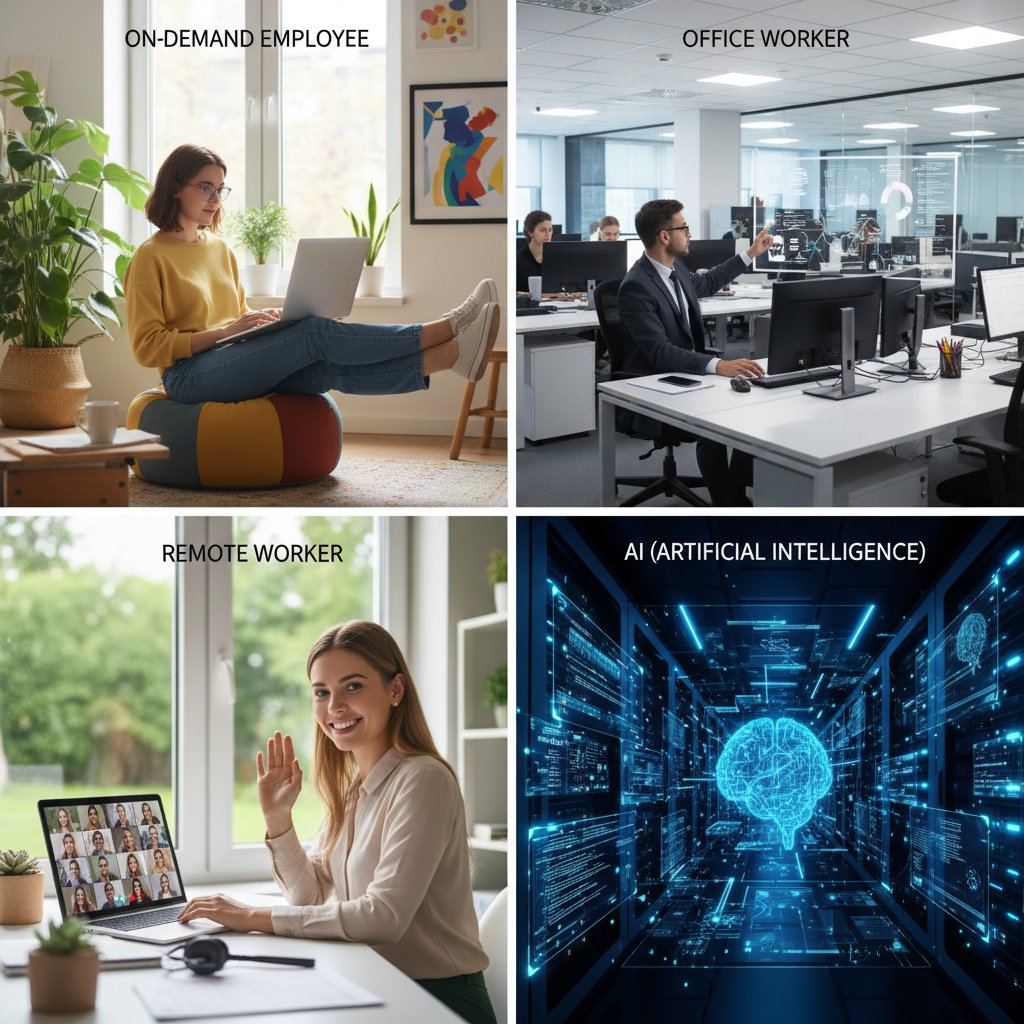
The numbers tell a nuanced story: on demand employees excel in speed and specialization, but trail in loyalty and compliance stability. AI teammates are unbeatable in repetitive efficiency—but lack judgment and empathy.
When to go all in—and when to walk away
- Go all in on on demand employees when your business needs speed, rare skill sets, or rapid scaling across projects.
- Stick with traditional employment when continuity, deep product knowledge, or brand loyalty are non-negotiable.
- Blend models when you need both agility and stability, using tools like futurecoworker.ai to bridge gaps.
- Avoid on demand when legal exposure or sensitive IP are at risk.
- Invest in AI teammates for repetitive, high-volume tasks where consistency trumps creativity.
The smartest organizations combine these models, using the right tool for the right job—and pivoting as circumstances dictate.
Ultimately, your talent strategy should reflect your business DNA, not just chase the latest trend.
Feature matrix: matching needs to solutions
| Need | Best Fit | Alternatives |
|---|---|---|
| Rapid scalability | On demand employee | AI teammate |
| Deep expertise | Freelancer | On demand employee |
| 24/7 coverage | AI teammate | On demand employee |
| Brand advocacy | Traditional employee | On demand employee |
| Cost optimization | On demand employee | AI teammate |
Table 6: Matching workforce needs to talent models. Source: Original analysis based on reviewed sources.
- Consider project lifecycle
- Weigh compliance risks
- Analyze long-term vs. short-term gains
No one model fits all. The edge comes from choosing, blending, and evolving—constantly.
Beyond the buzz: what nobody tells you about on demand employees
Debunking the biggest myths
- Myth 1: On demand means low quality. Many on demand workers are top-tier specialists—often outclassing full-timers in raw skill.
- Myth 2: You save money no matter what. Poor integration, compliance fines, and lost IP can eat savings fast.
- Myth 3: Flexibility is always a win. For workers, “flexibility” often means unpredictability, exhaustion, or lack of career path.
- Myth 4: On demand is only for startups. Global enterprises are now major users—see manufacturing and healthcare for proof.
Rethink what you think you know. The on demand employee model is as nuanced—and risky—as any other.
“Companies that treat on demand talent as disposable find themselves disposable to talent.” — Industry expert, Effectory survey, 2024
Unconventional uses and case examples
From nonprofits pulling in grant writers for seasonal pushes, to logistics firms hiring on demand route optimizers after weather disasters, the use cases are endless. AI teammates now manage internal newsletters, flag compliance risks, and even suggest process improvements in real time.
- Nonprofits using on demand talent to win grants and scale impact rapidly
- Logistics companies hiring route optimizers after hurricanes to reroute supply chains
- Marketing departments spinning up crisis PR teams overnight through digital platforms
- Internal communications automated by AI, freeing staff for strategic messaging
The common denominator? Smart organizations use on demand models to fill gaps that would otherwise limit growth—or survival.
The more creative your approach, the bigger the payoff.
Checklist: are you ready for an on demand workforce?
- Assessed your compliance risk?
- Mapped which roles/tasks truly benefit from on demand talent?
- Secured buy-in from leadership and core teams?
- Chosen reliable, transparent platforms or partners?
- Prepared onboarding and knowledge transfer processes?
- Set up real-time feedback and performance tracking?
- Invested in culture, inclusion, and communication tools?
- Developed a playbook for integrating AI teammates?
- Evaluated cost vs. long-term value?
- Planned periodic reviews to optimize your approach?
If you’re not checking most of these boxes, you’re not ready—or you’re playing catch-up to your competitors.

Remember: Preparation is the only insurance policy in the volatile world of on demand work.
Supplementary: adjacent trends and the evolving workplace
Hybrid models: blending in-house, on demand, and AI
The future isn’t just on demand—it’s hybrid. Companies are orchestrating talent like a chessboard, blending full-timers, freelancers, and AI to match every project’s unique needs.

- Hybrid teams handle sudden surges or complex tasks without skipping a beat.
- Inclusion and communication become the glue—without them, chaos reigns.
- Platforms like futurecoworker.ai are bridging gaps, making hybrid coordination seamless.
The firms that win are those that can remix teams in real time, without losing their soul or their strategy.
The future of enterprise collaboration tools
Enterprise collaboration is no longer about one-size-fits-all software. It’s about AI-powered assistants, contextual task management, and always-on feedback. Email is being reborn—smart, contextual, and integrated with digital teammates.

From automated summaries to instant scheduling to actionable insights, collaboration tools are now the connective tissue of hybrid and on demand teams. Companies like futurecoworker.ai are pioneering this shift, giving enterprises the ability to work smarter, not just harder.
Adaptation isn’t just about technology—it’s about weaving new tools into the everyday habits of work.
Common pitfalls in on demand adoption—and how to avoid them
- Failing to define scope and expectations
- Neglecting onboarding and integration
- Ignoring legal/compliance exposure
- Over-relying on platforms without relationship-building
- Underinvesting in continuous feedback
- Document every project scope.
- Create onboarding playbooks for every new hire or AI integration.
- Build compliance reviews into every engagement.
- Invest in tools that support both human and AI teammates.
- Schedule regular retrospectives to learn and optimize.
The pitfall isn’t in using on demand employees—it’s in neglecting the details that make or break every project. Get those right, and you’ll thrive where others fail.
Conclusion
The age of the on demand employee is here—and it’s not up for debate. Work is no longer a place or a contract—it’s a fluid, living thing shaped by technology, talent, and the relentless drive for advantage. The truths are clear: flexibility is the new currency, but so is burnout; speed is king, but so is the cost of chaos; and AI teammates are as real and vital as any human colleague.
For organizations willing to challenge assumptions, invest in care-first cultures, and wield technology with intention, the opportunities are massive. For those who cling to the old rules, irrelevance isn’t just a risk—it’s a certainty. Platforms like futurecoworker.ai aren’t just changing how tasks get done—they’re redefining what work means at its core.
So what’s your move? The future of work doesn’t wait. Make sure you’re designing it—or risk being designed out.
Sources
References cited in this article
- Demandsage: Employee Engagement Statistics(demandsage.com)
- Mercer: Health on Demand 2023(mercer.com)
- Lensa: Employee Demands 2023(lensa.com)
- WorkTango: 2024 Employee Experience Trends(worktango.com)
- Effectory: Top Employee Survey Topics 2023(effectory.com)
- Forbes: How The On-Demand Workforce Is Changing The World(forbes.com)
- AEI: Rethinking the On-Demand Workforce(aei.org)
- History Tools: The Rise of On-Demand Talent(historytools.org)
- Upwork: Gig Economy Statistics 2025(upwork.com)
- Bunny Studio: History of the Gig Economy(bunnystudio.com)
- Perfect Storm: Historical Evolution of the Gig Economy(perfectstorm.org)
- Inspiring Workplaces: Workplace Culture Trends(inspiring-workplaces.com)
- O.C. Tanner: 2024 Global Culture Report(octanner.com)
- Forbes: 2024 Workplace Predictions(forbes.com)
- Expert Beacon: Talent on Demand(expertbeacon.com)
- Indeed: On-Demand Employee Definition(indeed.com)
- Robert Half: 2025 In-Demand Technology Roles(roberthalf.com)
- Skedda: AI in Hybrid Workplaces(skedda.com)
- ActivTrak: On-Demand Hybrid Model(activtrak.com)
- LeewayHertz: Hybrid AI(leewayhertz.com)
- PIB EB: Business Case for Employee Benefits(pib-eb.com)
- Talkspace: Employee Benefits Trends 2024(business.talkspace.com)
- Trinet: Employee Benefits Trends(trinet.com)
- Forbes: Unlocking The On-Demand Advantage(forbes.com)
- Mercer: Health on Demand Report 2023(mercer.com)
- Gravywork: Hidden Costs of Understaffing(gravywork.com)
- Influx: Hidden Costs of Hiring(influx.com)
- IBM: Cost of a Data Breach 2024(ibm.com)
- McKinsey: Case Studies(mckinsey.com)
- INSEAD: Sustainability Case Studies 2023/2024(insead.edu)
- The Manufacturing Institute: Digital Skills Report 2024(themanufacturinginstitute.org)
- Deloitte: Manufacturing Industry Outlook 2024(www2.deloitte.com)
- World Manufacturing Report 2024(worldmanufacturing.org)
- TechCrunch: Asana AI Teammates(techcrunch.com)
- Accenture: Reinventing Enterprise Operations with Gen AI(newsroom.accenture.com)
- Deloitte: State of Generative AI in the Enterprise 2024(www2.deloitte.com)
- Microsoft: AI Customer Stories(blogs.microsoft.com)
- Forbes: Top Trends in On-Demand Talent(forbes.com)
- Harvard Business Review: Rethinking the On-Demand Workforce(brianheger.com)
- Gallup: Cost of Low Engagement(forbes.com)
- SHRM: 2024 Expert Predictions(shrm.org)
- Runn: Burnout Statistics(runn.io)
- SAGE Journals: Worker Technology Rights(journals.sagepub.com)
- National Employment Law Project: Flexibility in the On-Demand Economy(nelp.org)
- University of Toronto Law Journal: Flexibility, Choice, and Labour Law(utppublishing.com)
- Forbes: Flexible & Remote Work Debate(forbes.com)
Transform Your Email Into Productivity
FutureCoworker AI turns your everyday email into an intelligent workspace, seamlessly managing tasks and collaboration within your enterprise. It eliminates the complexity of AI, allowing you to benefit from advanced technology without any technical knowledge. Achieve productivity, streamline processes, and improve team efficiency through natural email interaction, getting tasks done faster and smarter.
Get startedReady to Transform Your Email?
Start automating your tasks and boost productivity today
Frequently Asked Questions
What exactly is an on demand employee?
On demand employees are a modern category of workers that includes data scientists, designers, and AI teammates who work on urgent or short-term projects, often remotely and across different time zones. They differ from traditional gig workers by specializing in knowledge work and higher-skilled tasks rather than just basic services.
How did on demand work become so prevalent?
Digital disruption and platform companies like Uber (2009), Upwork, and TaskRabbit revolutionized the labor market by making it easy for companies to hire project-based workers at scale. As knowledge work became virtual, high-demand fields like data science and cybersecurity began adopting on demand talent, creating a fluid labor ecosystem.
What is the main concern about on demand work mentioned in the article?
The article emphasizes that the real cost of on demand work flexibility involves a collision between flexibility and burnout, efficiency and loyalty, where the meaning of work itself is changing under relentless digital pressure—contradicting the glossy freedom promised in recruitment ads.
Are AI systems part of the on demand employee trend?
Yes, AI teammates like those at futurecoworker.ai are now part of the on demand workforce, powering workflows behind the scenes 24/7 alongside human on demand workers.
What does the data show about demand for remote work?
According to Demandsage 2024, U.S. Google searches for "remote work" surged to nearly 650,000 annually, demonstrating that the appetite for flexible, on demand roles is a sustained demand rather than a passing trend.
Continue Reading
Keep exploring Intelligent enterprise teammate

Building Flexible Employees: What Makes Teams Resilient to Change
Need flexible employee? This article examines 11 truths about hiring and managing adaptable teams in a changing workplace.

As Needed Employees: Costs, Benefits, and Workplace Realities
As needed employees face unstable hours and unpredictable pay. This article examines the real costs and hidden benefits of contingent labor in the modern workplace.

On Demand Staff Versus Full-Time Teams: Comparing the Tradeoffs
On demand staff models reshape how businesses hire. This article examines the tradeoffs between on demand staff and full-time teams, drawing on recent economic data and workforce research.

What Flexible Employee Arrangements Actually Mean for Workers
Flexible employee arrangements reshape how work operates today. This article examines the costs, benefits, and realities behind flexible work policies and their impact on workers.

How As Needed Staff Are Reshaping Work with AI Integration
As needed staff combine human workers, freelancers, and AI teammates. This article examines nine strategies top enterprises use to build agile, productive operations beyond cost-cutting tactics.

Flexible Staff: Risks and Realities Behind the Enterprise Transformation
Flexible staff reshapes enterprise collaboration, but brings hidden risks alongside efficiency gains. This article examines the productivity, burnout, and workforce stability tradeoffs leaders face.