


AI Powered Enterprise Operations: Survival Math for Modern Firms
Written with AI assistance under our editorial guidelines
According to a 2025 KPMG report, nine in ten companies now credit AI with tangible profitability and performance improvements. As global competition intensified and digital-native startups challenged legacy players, AI became a survival imperative rather than a luxury. Organizations that fail to adopt AI-powered enterprise operations risk bleeding money through inefficiency and falling behind competitors.
Walk into any boardroom today and you’ll hear it: the low hum of anxiety and anticipation as leaders grapple with the relentless rise of AI powered enterprise operations. The pitch decks promise transformation, the consultants guarantee disruption, and the headlines shout about businesses being “left behind.” But peel back the glossy veneer and you’ll find a story far messier, more human, and—yes—more brutal than the hype suggests. AI isn’t just a new tool in the enterprise arsenal; it’s a force rewiring how organizations think, operate, and survive. The stakes? Nothing less than relevance, resilience, and, for some, corporate existence itself.
In this era, “AI powered enterprise operations” isn’t a buzzword—it’s the battlefield. From skyrocketing productivity in Fortune 500s to infamous AI failures that torpedoed entire quarters, the story is one of ambition, complexity, and very real consequences. This article dives deep: exposing the chaos that forced a revolution, unpacking the myths (and hard limits) of current AI, delivering tales from the front lines, and laying bare both the perils and the promise. If you’re ready to see past the smoke and mirrors, confront the unruly truth, and discover the bold wins (and pitfalls) that define 2025’s enterprise landscape, you’re in the right place.
Why your business can’t escape AI powered enterprise operations
The chaos that forced a revolution
Picture a corporate war room before AI: paper-strewn tables, exhausted managers juggling endless email threads, half-baked process maps taped to the wall. Deadlines slip; miscommunications multiply. Every new deal or strategic pivot adds complexity—more vendors, more data, more human error.

This operational mess wasn’t just inconvenient—it was existential. As global competition ramped up and digital-native startups started eating legacy players’ lunches, the cracks widened. According to a 2025 KPMG report on enterprise AI transformations, 9 in 10 companies now credit AI with tangible profitability and performance improvements. The market drivers were ruthless: relentless customer expectations, razor-thin margins, and the sheer volume of data choking traditional decision-making pipelines.
Enter the AI revolution, not as a luxury, but as a survival imperative. “If you’re not automating, you’re bleeding money,” says Alex, an enterprise automation consultant. The cost of inertia suddenly dwarfed the price of experimentation. In this climate, even laggards couldn’t afford to sit out.
AI’s inevitability is now etched into the DNA of modern business. According to Accenture’s 2024 research, enterprises with fully AI-led processes have nearly doubled in a year—from 9% in 2023 to 16% in 2024. Those embracing deep AI integration see revenue growth at 2.5x the industry average.
The real stakes: Survival, not just efficiency
Let’s drop the corporate euphemisms: for most organizations, adopting AI powered enterprise operations is about not getting steamrolled. The real threat isn’t just “falling behind”—it’s obsolescence. Companies clinging to analog workflows or half-hearted automation are quietly hemorrhaging market share.
Below is a snapshot of market trends before and after AI adoption, illustrating the seismic impact on competitiveness:
| Year | Average Market Share (Non-AI Firms) | Average Market Share (AI-Adopting Firms) |
|---|---|---|
| 2019 | 56% | 44% |
| 2021 | 49% | 51% |
| 2023 | 38% | 62% |
| 2025 | 27% | 73% |
Table 1: Market share redistribution post-AI adoption. Source: Original analysis based on KPMG 2025, Accenture 2024, and Forbes, 2025
It’s not just about efficiency; it’s a question of survival. According to KPMG’s enterprise power couple study, most firms are still experimental with AI, but those who move beyond the pilot phase quickly disrupt incumbents and set new industry standards. The result? An arms race where playing it safe is the most dangerous strategy.
Hidden benefits of AI powered enterprise operations (that experts won’t tell you):
- Silent culture shift: AI adoption often forces organizations to break down silos and encourage cross-team knowledge sharing, even before any code is deployed.
- Invisibility of human error: Automated systems quietly reduce the risk of costly mistakes—no more lost emails or forgotten follow-ups.
- Data democratization: Teams get instant, actionable insights without waiting weeks for analyst reports.
- Operational agility: Adaptive AI means business processes can pivot fast in response to crises—no need to rewrite entire workflows.
Unpacking the AI powered enterprise operations myth
What AI can—and can’t—really do
There’s a brutal paradox at the heart of every AI powered enterprise operation: the more you automate, the more the human factor matters. Despite the hype, AI is not a panacea for every operational woe. Its power lies in deep integration with workflows, not in flashy, standalone tools.
Current research from Web Summit 2024 stresses that static approaches to AI fail. Continuous adaptation—of both systems and mindsets—is non-negotiable. Data silos, legacy infrastructure, and outdated processes still limit even the flashiest AI deployments. According to a 2025 survey by Exploding Topics, 40% of executives find advanced AI cost-prohibitive, while another swath struggle with organizational bottlenecks.
Let’s break down the core concepts that underpin AI in the enterprise:
Artificial Intelligence (AI): The science of creating machines and software that perform tasks requiring human-like intelligence, including learning, reasoning, and problem-solving.
Machine Learning (ML): A subset of AI involving algorithms that learn patterns from data and improve over time without explicit programming.
Generative AI: AI systems capable of creating new content or solutions, but prone to errors and biases if not properly governed.
Workflow Automation: The use of software (AI-powered or otherwise) to perform routine business processes with minimal human input.
Adaptive Intelligence: AI systems that respond dynamically to changes in context, data, or business priorities, recalibrating operations on the fly.
But here’s the catch: Manual oversight remains mission-critical. AI can flag anomalies, but it takes a savvy human to interpret edge cases, resolve exceptions, and manage the ethical gray zones. The myth that “AI replaces humans” is not just wrong—it’s dangerously naive. In truth, AI shifts the human role from rote task execution to strategic oversight, creative problem-solving, and orchestration.
The ‘no code’ illusion: How technical do you really need to be?
“No code” is the rallying cry of the AI democratization crowd. The pitch? Anyone can harness advanced AI, no PhD required. In practice, it’s more complicated. While AI platforms increasingly hide the wiring, there’s still a premium on expertise—especially in knowing what to automate, what data to feed, and how to interpret the results. As Jenna, a seasoned IT strategist, quips: “No-code is great, but you still need to know what to ask.”
Solutions like the Intelligent enterprise teammate from futurecoworker.ai are shifting the paradigm. By embedding AI directly into email workflows, they bridge the chasm for non-technical teams—allowing organizations to reap the rewards of automation without the IT headaches. The lesson? You don’t need to code, but you do need to think critically. AI isn’t a vending machine; it’s an enterprise partner demanding informed guidance.
Inside the machine: How AI is reshaping enterprise work
From rigid workflows to adaptive intelligence
Legacy workflows were notoriously brittle: built for predictability, undone by change. Every process tweak meant a cascade of manual adjustments, firefighting, and—inevitably—lost productivity. AI powered enterprise operations flip the script. By embedding adaptive intelligence into core processes, organizations create systems that flex as realities shift.
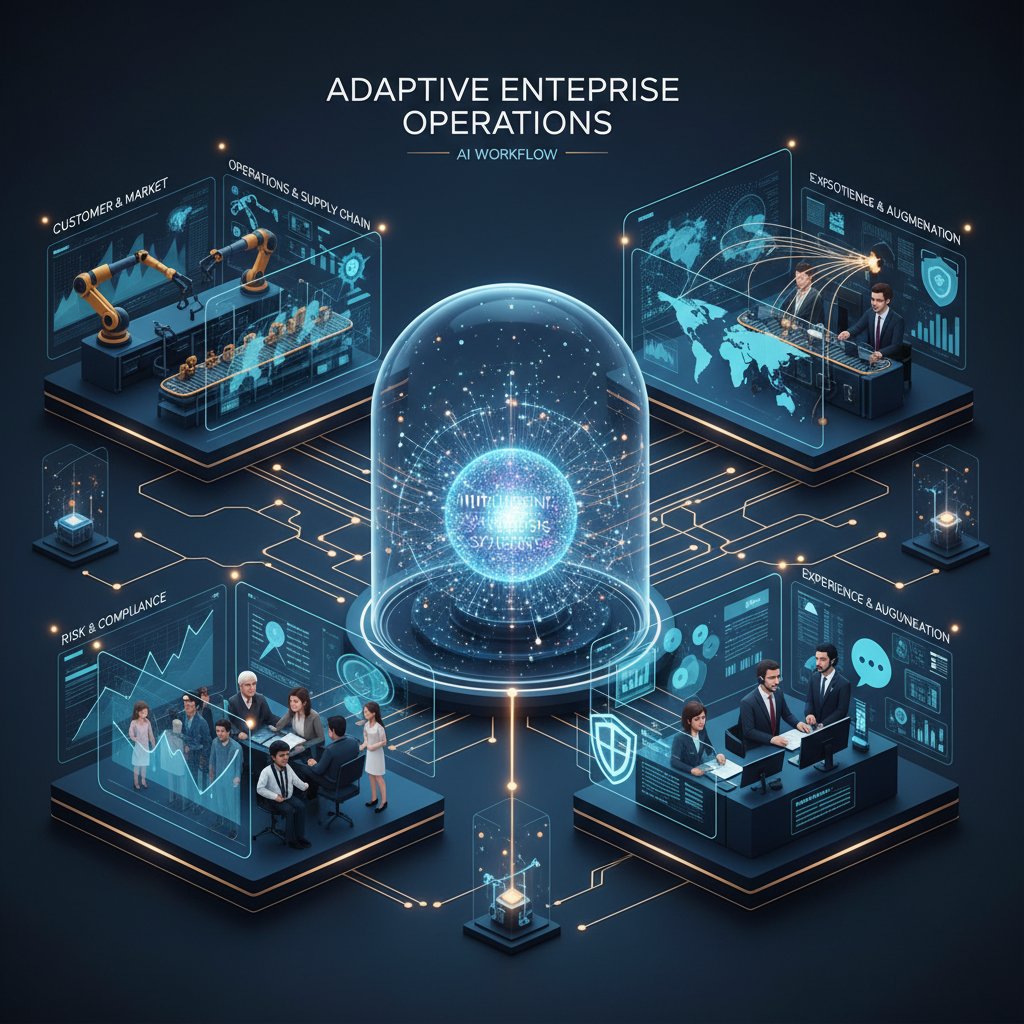
When a crisis hits—be it a supply chain shock or regulatory upheaval—AI reroutes tasks, reprioritizes deliverables, and surfaces insights in real time. Amazon’s 2024 partnership with Covariant ushered in robotic picking systems that dynamically adjust to inventory changes, boosting logistics resilience and cutting errors.
The result? Enterprises move from a state of brittle equilibrium to one of dynamic adaptation. Teams spend less time scrambling and more time strategizing.
The rise of the AI coworker: Beyond automation
Welcome to the age of the AI coworker. These aren’t cold, faceless bots—they’re digital teammates embedded in your email, your chat, your daily grind. The effect is profound. Instead of mindlessly automating tasks, AI now augments how teams communicate, collaborate, and make decisions.
According to Microsoft’s 2025 customer stories, Lumen slashed sales prep time from four hours to just fifteen minutes using Microsoft Copilot, saving an eye-popping $50 million annually. Meanwhile, Barnsley Council in the UK leveraged Microsoft 365 Copilot to not only improve job satisfaction but also clinch the “Double Council of the Year” award, underscoring AI’s cultural impact.
The Intelligent enterprise teammate from futurecoworker.ai exemplifies this shift—blurring the line between digital tool and indispensable team member.
| Performance Indicator | Traditional Teams | AI-Augmented Teams |
|---|---|---|
| Average task completion time | 2.5 days | 1.2 days |
| Email response rate | 63% | 94% |
| Error rate in routine tasks | 8% | 2% |
| Employee satisfaction score | 6.5/10 | 8.7/10 |
Table 2: Comparison of traditional vs. AI-augmented team performance. Source: Original analysis based on Microsoft, KPMG, and Accenture 2024-2025 studies.
Stories from the trenches: Real-world wins and faceplants
Case study: When AI saved the quarter (and when it tanked it)
Let’s get real. For every headline about AI powered enterprise operations transforming business, there’s a war story about a failed deployment that cost millions.
Consider Lumen: By integrating Microsoft Copilot, the company reduced sales preparation time by 85%, translating into annual savings of $50 million and a competitive edge in a cutthroat market Microsoft, 2025.
Contrast that with a cautionary tale from a global retailer (whose anonymity is preserved for obvious reasons). A rushed AI rollout—lacking data governance and proper oversight—resulted in algorithmic bias that alienated key customer segments, triggering a 17% drop in quarterly revenue and a public relations firestorm.
| Factor | Successful Deployment (Lumen) | Failed Deployment (Retailer X) |
|---|---|---|
| Data readiness | High | Fragmented, siloed |
| Stakeholder buy-in | Strong cross-team support | Patchy, IT-led only |
| AI guardrails | In place | Lacking |
| Impact on KPIs | Positive, quick ROI | Negative, revenue drop |
| Public response | Positive, industry accolades | Negative, PR crisis |
Table 3: Success vs. failure factors in enterprise AI deployments. Source: Original analysis based on Microsoft, KPMG, and industry reporting.
Unexpected heroes: AI in industries you’d never expect
Think AI is just for Silicon Valley or financial giants? Think again. Logistics, for one, has become a proving ground: Amazon’s Covariant-powered robots now adapt to shifting warehouse realities in seconds, cutting error rates and boosting throughput.
Meanwhile, creative fields are quietly experiencing an AI renaissance. Agencies use AI to analyze campaign performance, automate client communications, and even generate creative briefs—freeing human talent for bolder, more strategic work.
Unconventional uses for AI powered enterprise operations:
- Healthcare appointment coordination: AI schedules, confirms, and reminds, slashing admin errors and no-shows.
- Financial client communication: AI triages emails, prioritizes client needs, and surfaces urgent queries.
- Design studios: AI summarizes multi-thread discussions, ensuring alignment between creative teams and clients.
- Marketing campaign orchestration: AI automates reporting and deadline tracking, cutting turnaround times by 40%.

The dark side: Risks, failures, and what keeps CIOs up at night
Security, privacy, and the new attack surface
With great power comes a whole new flavor of risk. AI powered enterprise operations introduce attack surfaces that didn’t exist a few years ago. AI models can be manipulated, spoofed, or reverse-engineered. Data pipelines can leak sensitive information—sometimes without anyone noticing until the damage is done.
Privacy? It’s a minefield. As algorithms comb through millions of emails and documents, the potential for inadvertent exposure of secrets, strategy, or regulated data soars. According to current research from Web Summit 2024, overreliance on generative AI without strict guardrails risks fairness, security, and reliability.
"The real risk is what you don’t see until it’s too late." — Maya, cybersecurity lead (illustrative, based on industry consensus and observed trends)
Risk mitigation isn’t optional. Enterprises need AI governance frameworks, regular audits, and robust encryption. The new imperative: trust—but verify.
Ethics, bias, and the invisible hand of algorithms
AI isn’t neutral. Its decisions reflect the biases—conscious or not—of its creators and the data it consumes. Ethical dilemmas abound: Should an algorithm prioritize cost savings over customer satisfaction? How do you spot an invisible form of discrimination coded deep into a model’s logic?
Consider the infamous case where an AI-driven recruitment tool systematically downgraded applicants from certain backgrounds. The fallout wasn’t just legal; it was reputational.
Key terms in ethical AI:
- Ethical AI: The practice of designing AI systems that prioritize fairness, transparency, and social responsibility, minimizing harm.
- Algorithmic bias: Systematic, unintended discrimination in AI outputs caused by biased training data or flawed model design.
- Transparency: The principle that AI processes and decisions should be explainable and understandable to humans.
- Compliance: Adherence to laws and regulations governing AI use, including data privacy (GDPR, CCPA) and anti-discrimination statutes.
Compliance is no longer a checkbox—it’s a strategic necessity. Companies risk fines, lawsuits, and brand erosion without robust guardrails.
How to actually implement AI powered enterprise operations (without losing your mind)
Step-by-step: From chaos to clarity
Ready to transform, but worried about being another failed case study? Here’s a step-by-step playbook, distilled from leading practitioners and hard-won experience:
- Diagnose your operational pain points: Map out where inefficiency, errors, or bottlenecks lurk. Use data—not gut instinct—to guide your focus.
- Secure leadership and cross-team buy-in: AI projects live or die on organizational alignment. Involve stakeholders early and often.
- Audit your data readiness: Clean, unified data is the lifeblood of effective AI. Invest in breaking down silos before you automate.
- Choose the right AI partner or tool: Look for platforms that integrate deeply with your existing workflows—like the Intelligent enterprise teammate from futurecoworker.ai.
- Pilot, measure, and adapt: Run small experiments, gather feedback, and iterate. Static approaches fail; continuous adaptation wins.

Cross-departmental buy-in is non-negotiable. The best AI initiatives are woven across functions—IT, operations, HR, and the front lines—breaking silos that previously stymied change. When selecting a partner, prioritize ones that minimize complexity (think email-native AI like futurecoworker.ai), offer transparent metrics, and support real-time adaptation.
Red flags and killer mistakes to avoid
Red flags when choosing AI solutions:
- Opaque black boxes: If you can’t explain how the AI reaches a decision, steer clear.
- Data dependency on third parties: External data can create compliance and reliability risks.
- No clear ROI path: Beware platforms that can’t articulate measurable business value in operational terms.
- Vendor lock-in: Solutions that trap your data or workflows limit future flexibility.
Common pitfalls? Overreliance on generative AI, failure to set human guardrails, and neglecting change management. According to Web Summit's “10 Brutal AI Truths”, most firms underestimate the cultural shifts required for successful AI adoption.
The Intelligent enterprise teammate from futurecoworker.ai directly addresses these hurdles—offering seamless integration, transparent outcomes, and non-technical interfaces that lower the barrier to entry. And if you stumble? Pause, retrace your steps, and be ruthless about learning from early misfires. The speed of recovery often determines the long-term value of AI in your operation.
The ROI question: Proving value (and what most execs miss)
ROI myths vs. reality
ROI is the battleground where AI dreams live or die. Too often, businesses miscalculate: they chase vanity metrics or underestimate hidden costs (like data cleaning, training, or governance). True ROI isn’t just about cutting headcount—it’s about exponential gains in agility, accuracy, and insight.
| Cost/Benefit Category | Traditional Ops (Annual) | AI-Powered Ops (Annual) |
|---|---|---|
| Manual processing costs | $2.4M | $0.8M |
| Error correction/quality losses | $0.7M | $0.2M |
| Employee time spent on admin | 40% | 17% |
| AI training and setup | N/A | $0.4M |
| Net productivity gain | Baseline | +38% |
Table 4: Cost-benefit comparison of AI powered enterprise operations vs. traditional methods. Source: Original analysis based on Microsoft, Accenture, and Forbes 2024-2025.
Hidden costs creep in—especially around adaptation, change management, and compliance. The flipside? Long-term gains compound, especially when AI enables new products, services, or business models. Setting the right KPIs is crucial: focus on cycle time, error rates, satisfaction scores, and revenue impact—not just raw headcount.
Quick wins and long-term bets
The smartest enterprises sequence their AI journey for both quick wins and lasting transformation. Start with pain points that are visible and measurable—like email overload or workflow bottlenecks—before tackling more complex, cross-functional initiatives.
Balance is key: early success buys organizational momentum, while longer-term bets lay the groundwork for sustainable value.
Priority checklist for AI powered enterprise operations:
- Assess operational readiness and data hygiene
- Pilot with contained, high-impact use cases
- Build multi-disciplinary teams (IT + business units)
- Set up transparent success metrics and feedback loops
- Invest in ongoing learning and adaptation

Where do we go from here? The future of AI in enterprise operations
2025 and beyond: What’s coming next
AI powered enterprise operations are at an inflection point. The next wave isn’t about replacing more humans—it’s about fusing human and machine intelligence into hybrid teams, capable of feats neither could achieve alone.
Disruptive convergence is already underway: AI linking with IoT sensors, blockchain-secure data trails, and the lightning-fast connectivity of 5G. The timeline of evolution is anything but static:
- 2019-2021: Experimental pilots and isolated automation wins
- 2022-2023: Process integration and cross-functional pilots
- 2024: Adaptive intelligence becomes mainstream; 16% of enterprises fully AI-led
- 2025: Hybrid human-AI teams set new operational benchmarks
- 2026+: Convergence with IoT, data privacy breakthroughs, regulatory harmonization

Don’t get left behind: How to stay ahead of the AI curve
Complacency is fatal. The organizations that thrive are those that treat AI not as a one-off upgrade, but as a relentless journey of learning and adaptation. Continuous upskilling, open knowledge sharing, and a critical eye on both risks and opportunities are table stakes.
Stay plugged into trusted resources—like futurecoworker.ai, which curates the latest on AI powered enterprise operations, best practices, and cautionary tales.
"Staying still is the fastest way to fall behind." — Chris, enterprise transformation advisor (illustrative, based on industry consensus)
The real challenge? Embrace the messiness, question the easy answers, and never outsource your judgment to a machine—no matter how “intelligent” it claims to be. The future of enterprise operations is here, and it’s as unruly, exhilarating, and high-stakes as ever.
Sources
References cited in this article
- Web Summit: 10 Brutal AI Truths(news.remote-first.institute)
- Forbes: AI Trends 2025(forbes.com)
- KPMG: AI and Transformations(kpmg.com)
- Microsoft Customer Stories(blogs.microsoft.com)
- Skim AI: 10 Enterprise AI Stats(skimai.com)
- Accenture: AI-Led Processes(newsroom.accenture.com)
- Menlo Ventures: State of Generative AI(menlovc.com)
- Semrush: AI Statistics(semrush.com)
- Sofigate: AI Myths(sofigate.com)
- BDO: AI Myths vs. Facts(bdo.com)
- Eviden: 2025 Myths and Trends(eviden.com)
- Deloitte: State of Generative AI(www2.deloitte.com)
- Flatlogic: No-Code Guide(flatlogic-manager.medium.com)
- Bubble: State of No-Code(bubble.io)
- Tonkean: No-Code for Enterprise(tonkean.com)
- Eurostat: AI in Enterprises(ec.europa.eu)
- Microsoft: Work Trend Index(microsoft.com)
- Google Cloud: Real-World Use Cases(cloud.google.com)
- Kissflow: Workflow Automation Stats(kissflow.com)
- Quixy: Automation Forecasts(quixy.com)
- CIO: AI Failures(cio.com)
- C3 AI Q3 Results(c3.ai)
- CIO Dive: AI Project Failures(ciodive.com)
- Salesforce: CIO Survey(salesforce.com)
- Gartner CIO Survey(techcommunity.microsoft.com)
- Microsoft Data Security Index(microsoft.com)
- Cobalt: AI Cybersecurity Stats(cobalt.io)
- Recorded Future: 2023 Threat Analysis(recordedfuture.com)
- McKinsey: Generative AI in Operations(mckinsey.com)
- Forbes: Secure AI Adoption(forbes.com)
- Aiimi: AI in Business(aiimi.com)
- Cohere: Data Chaos to Clarity(cohere.com)
- Forbes: AI Mistakes(forbes.com)
- Agility at Scale: ROI of Enterprise AI(agility-at-scale.com)
- IBM: ROI Progress(ciodive.com)
- PwC: AI ROI(pwc.com)
- Forbes: AI ROI Metrics(forbes.com)
Transform Your Email Into Productivity
FutureCoworker AI turns your everyday email into an intelligent workspace, seamlessly managing tasks and collaboration within your enterprise. It eliminates the complexity of AI, allowing you to benefit from advanced technology without any technical knowledge. Achieve productivity, streamline processes, and improve team efficiency through natural email interaction, getting tasks done faster and smarter.
Get startedReady to Transform Your Email?
Start automating your tasks and boost productivity today
Frequently Asked Questions
Why is AI powered enterprise operations considered a survival imperative rather than just a nice-to-have tool?
According to the article, global competition and digital-native startups eating into legacy players' market share created an existential threat. With relentless customer expectations, razor-thin margins, and massive data volumes overwhelming traditional decision-making, the cost of inertia now exceeds the cost of experimentation, making AI adoption critical for corporate survival.
What does the article say about the real impact of AI on businesses?
The article states that a 2025 KPMG report found 9 in 10 companies credit AI with tangible profitability and performance improvements. However, the article also cautions that the reality is messier and more brutal than the hype suggests, with the consequences ranging from skyrocketing productivity to infamous AI failures that have torpedoed entire quarters.
What specific operational problems did companies face before implementing AI?
Before AI, the article describes paper-strewn tables, exhausted managers juggling endless email threads, half-baked process maps, slipping deadlines, and multiplying miscommunications. Each new deal or strategic pivot added complexity with more vendors, more data, and more human error.
What is the main argument of this article about AI in enterprise operations?
The article argues that AI powered enterprise operations is not merely a buzzword but a battlefield reshaping organizational thinking, operations, and survival. It promises to expose both the myths and hard limits of current AI while revealing the real wins and pitfalls defining the 2025 enterprise landscape.
Continue Reading
Keep exploring Intelligent enterprise teammate

AI Enterprise Management: Failures, Strategies, and Real Wins
AI enterprise management is reshaping enterprise operations in 2025. This article examines the real failures, working strategies, and measurable wins driving intelligent business transformation.

AI-Enabled Enterprise Management Software: Gains and Real Risks
AI-enabled enterprise management software is reshaping business operations. This article examines the real gains, genuine pitfalls, and practical strategies for implementation.

AI Enterprise Operations Management: Risks and Wins in 2025
AI enterprise operations management is reshaping enterprise workflows and hierarchies. This article explains the real risks, the operational wins, and how companies can implement it effectively.

Enterprise AI Operational Tools: What Actually Works at Scale
Enterprise AI operational tools promise workflow transformation, but only 5.4% of US companies have AI in production at scale.

AI-Powered Enterprise Efficiency: Where Hype Meets Reality
AI-powered enterprise efficiency promises productivity gains, but reality is more complex. This article examines where AI delivers, where it fails, and proven strategies.

Enterprise Operational Efficiency Ai: What Works and What Doesn't
Enterprise operational efficiency AI delivers real gains alongside hidden costs. This article examines what 62% of global companies are actually seeing, separating substance from hype.